Alachua Audubon Society

A Chapter of the National Audubon Society

Recent Sightings

(From the Alachua County birders' hotline. The most recent posts are at the top. Scroll down for older ones. Only the last month's are shown.)

     -------- Original Message --------
Subject:     Early warblers
Date:     Sun, 06 Apr 2008 20:54:38 -0400
From:     Rex Rowan < rexrowan@earthlink.net >
To:     Alachua County birding report

My memory is such a disaster that it qualifies for FEMA funding, and it let me down yet again: I forgot some good birds in this morning's report.

Three migrant warblers turned up earlier than usual. The first was a male Black-throated Green that landed on Ron Robinson's backyard water feature on March 22nd, by nine days a new early record for the county (but the spring's first at Atlanta's Kennesaw Mountain generally arrives during the last week of March, so it wasn't unusually early for the region). The second was a Worm-eating Warbler that Pat Burns saw at Loblolly on April 3rd, by two days a new early record. And the third was a male Black-throated Blue Warbler that Jeff Kanipe saw in SW Gainesville on April 5th. That one didn't set a new early record, it simply tied the existing one - which was set by Frank Chapman in 1887.

John Martin's still got his Pine Siskins. He counted six at his feeder on April 5th. They're like freeloading brothers-in-law who won't go home. Have you tried Siskin-No-More siskin repellent, John?

In regard to the tick-removal advice in this morning's report, Davis McGlathery wrote, "As a result of many years removing ticks from dogs and people ... what seems to work best for me is to saturate a cotton ball with alcohol and hold it against the tick, saturating it for at least ten seconds or more. This seems to stun them and I can then place tweezers close to the head, then pull gently but firmly and they release their bite and come out." (People have used the same technique on me.)


*****************************************************************************************

-------- Original Message --------
Subject:     Fulvous Whistling-Ducks at Paynes Prairie
Date:     Sun, 06 Apr 2008 11:42:39 -0400
From:     Rex Rowan < rexrowan@earthlink.net >
To:     Alachua County birding report

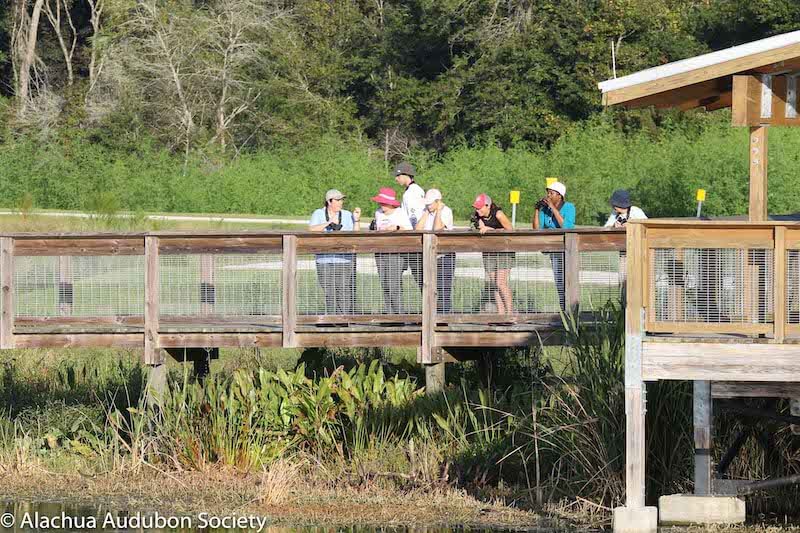
Wow, a darn good morning! Steve Nesbitt had seen 41 Common Loons going over SW Gainesville yesterday between 7:26 and 7:35, so I got out to the US-441 observation deck at 7:23 this morning. In the wake of last night's front the sky was chaotic and I may well have missed some early loons against the multi-colored, multi-textured clouds, but I didn't notice my first until 8:05. They kept coming for the next forty minutes until I'd tallied 66 - including single flocks of 10, 11, 12, and 16. This was my best count of the spring.

I had intended to stop the count at 9:00 and head home, but the loon watch actually ended at 8:50 when a pair of caramel-colored birds flew right past the platform and I realized that they were Fulvous Whistling-Ducks. They landed just out from the platform, at the far end of the open water, and stuck around for about twenty minutes before flying south. I was able to show them to three birders, none of whom I'd met before, including a pair of new-to-Gainesville grad students named Chris and Beth. I think that's the 17th occurrence for Fulvous Whistling-Duck in Alachua County, and as always their presence in spring or summer makes me wonder whether at least one pair is nesting here. From 1999 to 2006 there were five May-June sightings at Paynes Prairie or (when it was a big marsh) Newnans Lake.

There were two more nice birds while I was out there. Chris pointed out a King Rail sitting about two feet up in some brush near the water's edge, and a Merlin flew over not long after my arrival, headed due north.

If you're so inclined, try keeping your own watch for migrating loons over the next week or so and send me your results. Ideally you can choose a place with a wide view of the western sky, but it's awfully pleasant just to sit in your own backyard with a cup of coffee, gazing dreamily upward. Watching from 8:00 to 9:00 would probably cover the peak flight time, but as I mentioned Steve Nesbitt has seen them as early as 7:26 and Geoff Parks has seen a few going over at lunchtime. They'll fly pretty high, singly or in small flocks (though Steve saw 26 together yesterday) generally separated from each other by several yards. They're white underneath, with trailing feet, and most will have black heads. They flap steadily on long, pointed wings. Any loon-shaped birds that are all black, or flying in lines or V's, are Double-crested Cormorants.

After a lunchtime walk with Adam Kent last week I found a couple ticks on me, a first-of-the-season that I'm not so excited about. So I went online and found this "Evaluation of five popular methods for tick removal." So now you can do it right! No no, don't bother to thank me, or to send gifts of cash, candy, or alcohol; it's nothing less than my mission in life to be an imparter of information.

http://www.ncbi.nlm.nih.gov/pubmed/4000801?dopt=Citation

You say you don't have curved forceps? Well do you have fourteen bucks?

http://www.amazon.com/Excelta-24-SA-PI-Precision-Stainless-Tweezers/dp/B000H7YHYG/ref=sr_1_29?ie=UTF8&s=industrial&qid=1207255236&sr=8-29

No? How about $6.50?

http://www.emsdiasum.com/microscopy/products/tweezers/forceps.aspx

You're welcome! Now go watch for loons.


*********************************************************************************************

-------- Original Message --------
Subject:     Short-eared Owl at Paynes Prairie
Date:     Sun, 30 Mar 2008 17:07:20 -0400
From:     Rex Rowan < rexrowan@earthlink.net >
To:     Alachua County birding report

David Steadman wrote this afternoon (March 30th), "I saw a Short-eared Owl at 10 a.m. today from the observation tower at Paynes Prairie State Park near the visitor's center. I and three others watched it for at least a minute as it flew around, low over the ground, several hundred yards away over the prairie. The buoyant flight, distinctive underwing pattern, overall shape, etc. were seen clearly. In the vicinity at the same time were a male and a female harrier. " Assuming all previous reports are reliable - which they're probably not - this would be the 12th report in the county's history, and by four days the latest.

At a somewhat lower level of interest, I saw a fledgling Northern Mockingbird in Branford this morning. It still had a stubby tail and a fleshy gape, but it was wing-flashing just like an adult.


*********************************************************************************************

-------- Original Message --------
Subject:     Feels like spring + looks like spring = must be spring.
Date:     Sat, 29 Mar 2008 23:45:35 -0400
From:     Rex Rowan < rexrowan@earthlink.net >
To:     Alachua County birding report

Six of us watched for loons from the US-441 observation platform this morning (the 29th). We were there from 7:50 to 9:41, but the twelve Common Loons we saw all flew over between 8:03 and 8:35. A male Indigo Bunting, a Black-necked Stilt, and several Black-crowned Night-Herons were the only other sightings worth a mention.

After leaving the loon watch, Pat Burns went on to Bolen Bluff, which was "buggy and not very birdy", and then to Chapmans Pond, where she saw "many Lesser & a couple Greater Yellowlegs, 5 Stilt & 2 Least Sandpipers."

More spring arrivals:

The San Felasco Hammock butterfly walk on the 22nd stumbled across a few interesting birds on its way to the Goatweed Leafwings and Yucca Giant-skippers: according to Adam Kent at least three Hooded Warblers were singing, as were "tons of Red-eyed Vireos and a few Yellow-throateds." Most surprising, though, was that the group "saw one Veery after first hearing it do its 'veerrrrr' call." This was by about a week the earliest of the dozen spring reports for Alachua County.

Also on the 22nd Michael Drummond heard a Prothonotary Warbler "singing from the western edge of small depression wetland" near Possum Creek Park (corner of NW 43rd Street and 53rd Avenue). That's the first of the spring as far as I know.

Linda Terry and Cecelia Lockwood saw a male Painted Bunting at a SW Gainesville feeder on the 22nd, and in Alachua on the 24th Deb Werner saw that her regular male Painted, wintering for its fifth year in a row, had been joined by a second one. There seem to be a lot of Painted Buntings around this winter. Or else they're migrating early. Or both.

On the 23rd Geoff Parks saw the spring's first Chimney Swift over his NE Gainesville home.

On the 27th Michael Meisenburg heard one Great Crested Flycatcher at the IFAS lab on Millhopper Road and John DeLuca heard another on the UF campus. John heard a rather early Yellow-billed Cuckoo in Alachua the same morning.

Also on the 27th, I found a singing Prairie Warbler in the little park a block south of Alachua General Hospital.

If you see Swallow-tailed Kites this season, the Center for Birds of Prey wants to hear about them. Go here to report your sightings:

http://www.thecenterforbirdsofprey.org/swallowtail/swallowtail.html

David LaPuma has the migration radar going again:

http://badbirdz2.wordpress.com/


*****************************************************************************************

-------- Original Message --------
Subject:     Whoons and loopers
Date:     Sat, 22 Mar 2008 11:07:03 -0400
From:     Rex Rowan < rexrowan@earthlink.net >
To:     Alachua County birding report

Yesterday's loon watch snared a measly five Commons, but this morning's was outstanding. I was out there from 7:42 to 10:00, joined for part of that time by Cecelia Lockwood and Bob Carroll. We noticed something a little off about the birds' flight schedule. According to Andy Kratter's calculation, the peak of the flight should be 75 to 105 minutes after Cedar Key sunrise, which this morning would have been from 8:48 to 9:18. But of the 56 (!) Common Loons we counted, only eight flew over during that "peak" period. Six came afterward, between 9:24 and 9:35, and 42 came before. Fully half of them (28) came in the thirteen-minute span between 8:16 and 8:29, well before the predicted peak. So that may need a little recalculation. Or perhaps it differs significantly from day to day.

We also saw two Black-necked Stilts (third week in a row), a pretty good number of Black-crowned Night-Herons, and a Whooping Crane flying east across 441, the first I've ever seen in flight.

This must be a particularly good day for Whooping Cranes, because when I got home I found a phone message from Pat Burns, reporting that she'd seen one at Alligator Lake this morning.

(By the way, Pat denies the steroid charge I made in my last post. She claims, "For the record - I'm high on spring birding & antihistamines.")

More spring arrivals. Pat says the Barn Swallows are back at their I-75 / US-441 overpass nesting sites as of the 18th, and Linda Hensley tells me that the Northern Rough-winged Swallows have returned to Bed, Bath & Beyond, where they nested last year. Pat saw a very early Eastern Kingbird in Alachua on the 20th, and Linda had an Indigo Bunting at her NW Gainesville feeder on the 21st.


*********************************************************************************************

-------- Original Message --------
Subject:     Rarities at Alligator Lake, spring arrivals and departures.
Date:     Wed, 19 Mar 2008 22:00:44 -0400
From:     Rex Rowan < rexrowan@earthlink.net >
To:     Alachua County birding report

You may have heard of Malkolm Boothroyd, the teenage boy who's biking and birding his way across America to call attention to the many dangers facing our wild birds. He's biking to Gainesville this week, and will speak Friday evening at 7:00 at the Unitarian Universalist Fellowship, 4225 NW 34th Street (just north of NW 39th Avenue). His goal has been to raise $12,000 for bird conservation - a dollar for each mile of his trip - but he's barely raised a third of that, so if you're feeling generous please donate. Here's a link to an article about him, followed by a link describing where the money will go:

http://audubonmagazine.org/profile/profile0803.html

http://www.birdyear.com/Sponsor/Sponsor_Us.html

Pat Burns continues to find great birds at such an amazing pace that I think steroid testing is in order. At Alligator Lake in Lake City she saw a White-faced Ibis, a Lincoln's Sparrow, and a Clay-colored Sparrow on the 15th, and was able to relocate both sparrows (along the center dike) on the following day. Lesser discoveries - lesser for Pat, not for the rest of us - were seven Pectoral Sandpipers at the Dollar General pond and, at O'Leno on the 16th, singing Bachman's Sparrows and the first Great Crested Flycatcher of the year, a very early bird.

The loon watches continue. I saw none on Sunday or Monday, but four this morning between 8:45 and 8:54. Peter Polshek, keeping watch at Westside Park, saw one on Monday (9:01) and one today (8:58). All Common Loons so far.

Standing in the parking lot behind my office, watching the sky, I've seen more signs of spring this week. The Red-headed Woodpeckers have returned to their customary perches on nearby telephone poles. A Ruby-crowned Kinglet has been singing from an oak across the street, as they often do before they start north (I always think I'm listening to a Prairie Warbler for the first few notes). Several species should be saying goodbye to us in the next week or so, if they haven't already: Eastern Phoebes, Hooded Mergansers, Yellow-bellied Sapsuckers, and Song Sparrows.

John Martin's Pine Siskins are still here, though, as of the 16th.

Remember: Malkolm Boothroyd on Friday night!


*********************************************************************************************

-------- Original Message --------
Subject:     First day of loon watch
Date:     Sat, 15 Mar 2008 10:33:41 -0400
From:     Rex Rowan < rexrowan@earthlink.net >
To:     Alachua County birding report

I'm not going to pester you with daily reports on this, but a few things about this morning's loon watch are worth sharing:

First, they were earlier than expected. Peak time was supposed to be 8:56 to 9:26, but the birds I saw were earlier: two at 8:16 and three at 8:40. All were Common Loons.

Second, we saw some other interesting stuff: a pair of Black-necked Stilts flew past the observation deck heading east, by nine days a new early-arrival record for the county; an American Bittern started across 441, barely dodged a Gatornationals-bound car, and then gave us a nice look as it flew way out before dropping into the marsh; and finally, Green Herons were pretty common for the first time this year. I walked with Phil Laipis and Ted and Steven Goodman along the wildlife barrier to look for the Lincoln's Sparrow I saw two weeks ago, and we scared up a couple of Marsh Rabbits in the decreasing space of dry land between the barrier and the water's edge.


*********************************************************************************************

-------- Original Message --------
Subject:     The loonacy begins.
Date:     Fri, 14 Mar 2008 22:10:45 -0400
From:     Rex Rowan < rexrowan@earthlink.net >
To:     Alachua County birding report

It's that time again. From March 15th to April 10th, Andy Kratter does his annual Loon Watch. Or perhaps I should say, always DID his annual Loon Watch. Tragically, Andy is stranded in Panama till June, consoling himself with brightly colored tanagers and the like, thinking, "Well, they ain't loons, but they're not bad," and he needs us to carry on for him.

Andy figures that the peak of the flight is from 75 minutes after sunrise until 105 minutes after. To figure when that is, go to this web site and select Cedar Key:  http://sunrisesunset.com/usa/Florida.asp  Peak time should be 8:56 to 9:25 on March 15th and 8:26 to 8:56 on April 10th. If the weather is good tomorrow morning, I'll be out at the US-441 observation deck, so if you want to look for loons, join me. Our chances are no better than 50-50 - this is the beginning of the watch period, after all - but I'd say they're no worse than 50-50 either (the loons should have a nice tailwind!). Plus, you'll be out at Paynes Prairie, birding, on a Saturday morning, and not much is better than that.

I kept watch this morning under a blanket of clouds. No loons, but about 20 robins in two flocks - I'm seeing them less and less often - as well as two birds I couldn't ID; at various times I considered nighthawks, killdeer, kestrels, and martins, but they weren't quite right for any of those.

David Steadman spied an insanely early Mississippi Kite over the museum on March 3rd.

Pat Burns reported our first passage bird of the spring, a Louisiana Waterthrush, along the O'Leno State Park River Trail on the 9th. She added, "Dogwood, Viburnum, Yellow Jessamine & a few Wild Azalea are in bloom. The greens of spring are popping.  There is enough water in the river for a slight swirly at the sink. A very enjoyable hike in a Florida paradise."

Whip-poor-wills often sing before they start north, and we've had two reports of that recently, one from Doug Levey on the 10th and another from Anne Casella on the 13th.

Marcy Jones's mother, who lives toward Archer, and Bill and Jan Bolte, who live in Melrose, both reported several dead birds at their feeders. Marcy notified the Fish and Game Commission, and received a reply from biologist Daniel Wolf. I thought it was worth sharing, since so many of you feed birds in your own yards:

"No, moving the feeders will probably not halt the die-off. Bird feeders help a wild population of animals congregate in a much smaller area than they normally would. If there is an infectious disease component involved, bird feeders and waterers are much more likely to propagate it. Birds do not have a mouth like we do. They have an oral cavity which, when the head is tipped forward, allows the contents to fall back out. I physically went to the site yesterday, and from the description of clinical signs, the birds very likely have Trichomoniasis (Canker). This protozoa will proliferate in the esophagus and the lesions generated by it will obstruct the esophagus and trachea. Symptoms include appetite failure, weakness, difficulty breathing and emaciation. As the protozoa is found in the oral cavity (which fall out into feeders and waterers), and placing feeders and waterers out where birds are known to be dying (which allows feeding or drinking in larger groups than are normally found in nature), we are only increasing the mortality and prolonging the event. Taking the feeders and waterers away (and removing all spilled feed from under the feeders) for 1-2 weeks will allow the birds that are infected to die and not expose the other species. I recommended this to your aunt. The same recommendations apply, whether the cause of the disease is Canker, Aspergillosis, Salmonellosis, or any other disease. We need people to understand that birds are not solely dependent on their feeders and waterers. These birds have other sources for both food and water. The birds are not here for our enjoyment and we need to understand that their welfare comes before our own selfish enjoyment. We are stewards for a reason."

Hope to see some of you fellow loonies tomorrow morning at the 441 observation deck.


*********************************************************************************************

-------- Original Message --------
Subject:     Water water everywhere ... finally.
Date:     Mon, 10 Mar 2008 06:01:20 -0400
From:     Rex Rowan < rexrowan@earthlink.net >
To:     Alachua County birding report

I spent Sunday morning on the La Chua Trail with John Killian and Ted and Steven Goodman. Water levels are back to normal, maybe slightly higher than normal. But the Prairie won't recover from the drought any time real soon. Boat-tailed Grackles and Red-winged Blackbirds were common and noisy at Alachua Lake, but sparrows and warblers need more substantial cover than dried dog fennel stalks. Hopefully things will pick up later this spring, with the growth of cattails, pickerelweed, and lotus; if so, maybe next winter's crop of sparrows will be heavier. We tried walking down the powerline trail to the willows where the Vermilion Flycatcher was seen a couple of weeks ago, but stopped short due to flooding. We tried to take a side trail that starts under the powerlines and ends at the water control structure, but it was flooded too.

The herps took it on the chin Sunday morning. We found a foot-and-a-half alligator that had been run over by a truck at the water control structure, saw a White Ibis fly past with a Black Swamp Snake writhing in its bill, watched a Little Blue Heron gulp down a newt, and saw a Snowy Egret eat a smallish siren or amphiuma. Leopard frogs were chuckling everywhere, but for some reason nothing was eating them.

Phil Laipis checked out the Deerhaven pond Sunday afternoon and found a Royal Tern, the county's first in over a year. I had an errand in that neighborhood, so I stopped by the pond, but the tern had moved on. My consolation prize was a female Bufflehead.

Hot on the heels of the county's first Swallow-tailed Kite Saturday came the second, seen Sunday by Laura Levin over West 6th Street and University Avenue.

Laura works at Wild Birds Unlimited, and she had comforting words for those of you who have been missing your American Goldfinches this winter: "The Goldfinches are back at feeders. We sold 300 lbs of thistle yesterday at work, selling us out until our next seed shipment on Wednesday. I myself counted 20 Goldfinches this morning, the first I have had the entire winter!" Mike Manetz reports an increasingly busy feeding station as well: "For what it's worth, I've had a molting male Indigo Bunting at my feeder for two days. Maybe just a tad early? Chippies are steadily building. I have at least a hundred, plus a couple dozen goldfinches that showed up just this week."

I saw my first Green Heron of the spring across 441 from the observation platform Saturday morning. Last Thursday four Cattle Egrets were hunting along La Chua. Both species tend to move south for the winter, and start to arrive in numbers during March.

Paynes Prairie isn't the sole beneficiary of our recent weather. City naturalist Geoff Parks writes, "Re: the effect of our 3" of rain on the local wetlands - I'm really happy about how things are looking. As of yesterday the cypress dome at Morningside was about 2/3 full (having been saturated but without standing water at the beginning of the week) - hopefully this means we'll be able to burn a large chunk of the park west of the education office if we get good weather." Fire management of the park, checked for about a decade by pine beetles and drought, has been proceeding more rapidly over the last few years, resulting in the return of Bachman's Sparrows and Eastern Wood-Pewees. Let's cross our fingers and hope for good burning conditions.


*********************************************************************************************

-------- Original Message --------
Subject:     Sunday's field trip
Date:     Sat, 08 Mar 2008 20:28:23 -0500
From:     Rex Rowan < rexrowan@earthlink.net >
To:     Alachua County birding report

Remember that Daylight Saving Time starts tonight, so you'll set your clocks forward. Consequently, tomorrow's Emeralda Marsh field trip will be adjusted a little. Field trip leader Bubba Scales writes, "I will delay the departure by a half hour to allow for the difficulty getting out of bed.  Anyone who shows up on time can stay warm and nap in their vehicles or go railing with me around behind Sweetbay." So the departure time will be 7:30 a.m. Eastern Daylight Time.

Helen Warren saw Alachua County's first Swallow-tailed Kite over NW 43rd Street today.

John Martin's flock of Pine Siskins is still around. As of this morning there were six.

All this rain is good for the local wetlands. Paynes Prairie is slowly getting back to normal. I walked out La Chua to the bend before the observation deck the other day, and counted 145 alligators. Not a single sparrow. No warblers except for a single flock of eight bright and gorgeous breeding-plumage Palm Warblers. Only two wrens, and only a handful of blackbirds. But 145 alligators!