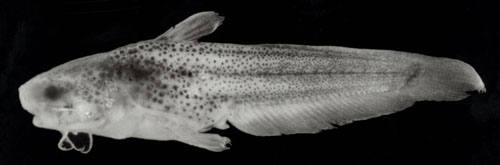
Photo by Britt Griswold
Reproduced from Vari, Ferraris and de Pinna (2005).
Denticetopsis Ferraris, 1996
Denticetopsis can be differentiated from all other members of the Cetopsinae by the following features. The caudal-fin margin is either shallowly-forked or obliquely-truncate with the outmost rays no more than one and one-half times the length of the inner most rays (versus one and three-quarters to two times that length in other genera of the Cetopsinae). The medial most pelvic-fin ray has a membranous attachment to the body for the basal one-third to one-fourth of its length (versus an attachment more typically along the basal one-half of the ray, respectively). The possession of a first pectoral-fin ray that is spinous for the basal one-half of its length further separates Denticetopsis from Cetopsis and Paracetopsis both of which lack a spinous first pectoral-fin ray. Denticetopsis is further distinguished from Cetopsidium in the lack of the dorsal-spine locking mechanism that is present in the latter genus and in the having a lateral line extending either only onto the abdomen or distinctly further posteriorly onto the caudal peduncle (versus terminating above the base of the anal fin, receptively).
KEY TO THE SPECIES OF DENTICETOPSIS
| 1. | Dorsal fin with first ray not spinous; caudal fin margin obliquely-truncate; vomer without teeth; dentary teeth enlarged teeth proximate to symphysis | 2 |
| Dorsal fin with first ray spinous; caudal fin either forked or emarginate; vomer with teeth; dentary teeth not noticeably enlarged proximate to symphysis | 3 | |
| 2. | Membranous attachment between anal and caudal fins deeply incised; depth of body at dorsal-fin origin less than 20% of SL | Denticetopsis sauli |
| Membranous attachment between anal and caudal fins not notched or incised; depth of body at dorsal-fin origin approximately 25% of SL | Denticetopsis royeroi | |
| 3. | Head globose, wide (0.77 to 0.84 of HL), its postorbital margins distinctly convex from dorsal view | Denticetopsis macilenta |
| Head not globose, moderately wide (0.61 to 0.74 of HL), its postorbital margins running nearly in parallel from dorsal view | 4 | |
| 4. | Premaxilla with 2 rows of teeth in individuals of all sizes | Denticetopsis praecox |
| Premaxilla with 3 rows of teeth, at least in region proximate to symphysis, in all but smallest individuals | 5 | |
| 5. | Anal-fin origin located distinctly anterior of middle of TL | Denticetopsis seducta |
| Anal-fin origin located at middle of TL | 6 | |
| 6. | Anal fin with 29 rays | Denticetopsis iwokrama |
| Anal fin with 25 to 27 rays | Denticetopsis epa |