|
Plants in the Garden
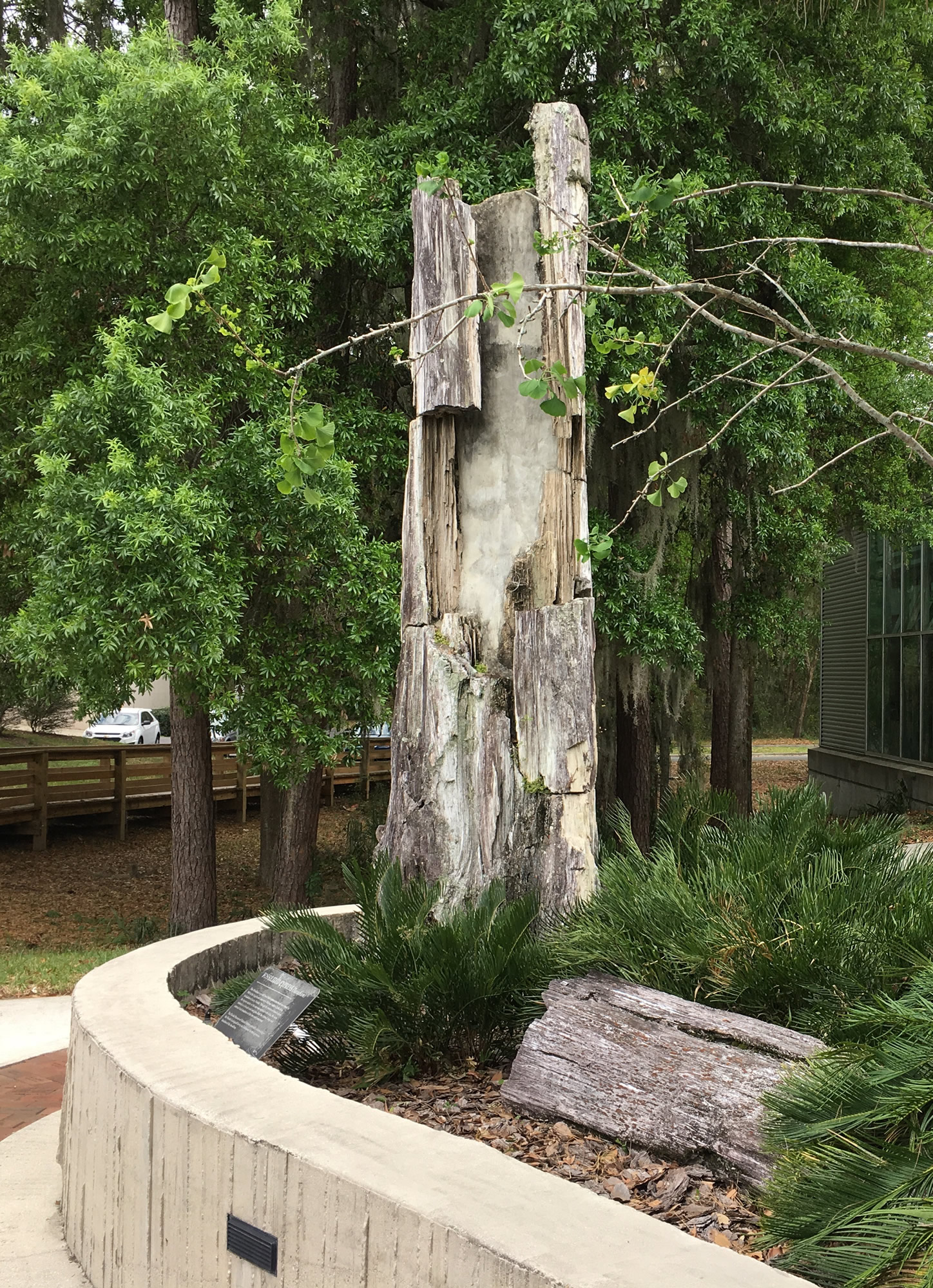
Fossil
Cypress Tree
This 18-million-year-old tree was found in 1963 in the Englehard Company's
Midway Fuller's Earth Mine, in Gadsen County, Florida. Through the process
of fossilization the organic matter of this tree was replaced with silica,
the same mineral in beach sand and glass. The tree's estimated weight
is 8 tons. Both the internal rings and external bark structures of the
tree were preserved. The Florida Museum of Natural History gratefully
acknowledges the Florida Geological Survey in Tallahassee for its generous
donation of this fossil tree.
Cabbage Palm (Sabal palmetto)
Native to the southern United States and Bahamas. Florida's state tree.
Most palm fruits or seeds are edible and form a major part of many animal
diets. Palms first appear in the fossil record 70 million years ago during
the late Cretaceous Period. They were common in Gulf coast swamps 50 to
15 million years ago during the Eocene-Miocene Epochs. During the same
time, the limestone boulders in this garden were forming in the ancient
seas of what is now peninsular Florida.
East Coast Coontie (Zamia umbrosa)
East Coast Coonties are cycads and inhabit hardwood-palm hammocks along
the east coast of Florida. Cycad species contain toxins (Cycasin and macrozamin)
that can cause death in humans if ingested in sufficient quantities. Cycads
may have evolved these toxins during the Mesozoic Era to prevent foraging
by herbivorous dinosaurs, mammals and insects.
Ginkgo
(Ginkgo biloba)
Ginkgos are native to Japan and unusual because they are deciduous gymnosperms.
The seeds and other parts of the ginkgoes are harvested for medical uses.
Along with cycads, ginkgos are among the most primitive and ancient seed
plants living today. Ginkgo biloba is the only living species of a once
common and diverse fossil lineage dating back over 250 million years ago,
to the late Paleozoic Era.
Mosses
Mosses grow together in a thick mat in moist environments. These bryophytes
do not produce seeds or flowers, and most species do not have water conducting
tissues like other plants. There were no trees when these mosses first
appeared on land and more than 400 million years ago during the Paleozoic
Era.
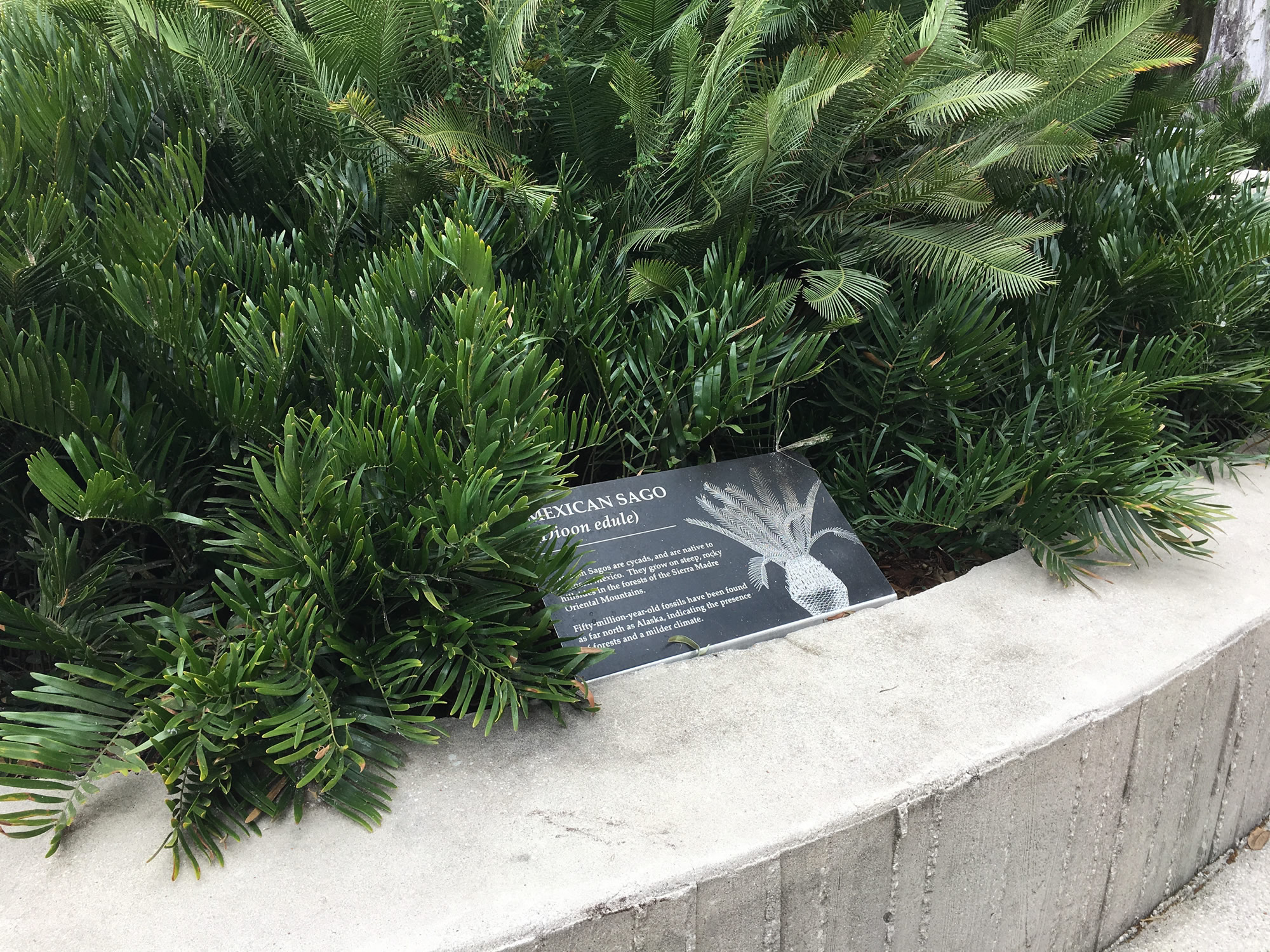
Sago Palm (Cycas revoluta)
Sago palms are slow growing gymnosperms native to Japan. Although
the plants resemble palms they are not true palms, which are flowering
plants. Male and female cones are borne on separate plants at the top
of the trunk, and are usually yellow-orange. Members of the Cycad family,
Sago Palms are a link to ancient seed plants. Cycads first appear in the
fossil record about 260 million years ago, during the late Paleozoic Era.
They became common about 175 million years ago, during the Mesozoic Era,
when the climate was mild worldwide and there were many ferns and extinct
species of early seed plants.
Saw
Palmetto (Serenoa repens)
Saw Palmettos grow along coastal sand dunes, near wetlands and in pinelands.
They are well adapted to a fire-maintained habitat, rebounding quickly
after burning. The fruits are harvested for medical products. Saw Palmettos
appear in the fossil record 45-50 million years ago in early Eocene forests.
Fossils found in present-day England indicate that the climate at high
latitudes was warmer and more moderate in the past than today.
West Coast Coontie (Zamia floridana)
West Coast Coontie inhabit dry soils on the west side of the Florida
peninsula. They grow in warm temperatures to tropical climates as understory
plants in habitats ranging from savannas to dense forests. Zamia species
are native to Florida, Georgia, many Caribbean islands, Mexico, Central
America and northern South America. Fossils have been found in 150-30
million-year-old deposits in the southern United States, Puerto Rico and
Argentina.
|