Platygonus
Mammalia; Artiodactyla; Tayassuidae; Platygonus (Peccary)
|
| |
Like their cousins the Old World pigs, New World pigs, or peccaries, are short,
stout animals with coarse, bristly hair and large heads. They have long snouts
that sport a hard, disk-shaped nose pad used for rooting around for tubers, and
in the case of peccaries, for peeling spiny cacti, a preferred food.
|
Peccaries, (or 'pecari', a Brazilian Tupi word for 'an animal which makes many
paths through the woods'), also known as tayassuids ('gnawers of roots'), are
endemic to the Americas, their known fossil record extends back approximately
37 million years in North American late Eocene deposits. The skeleton shown here
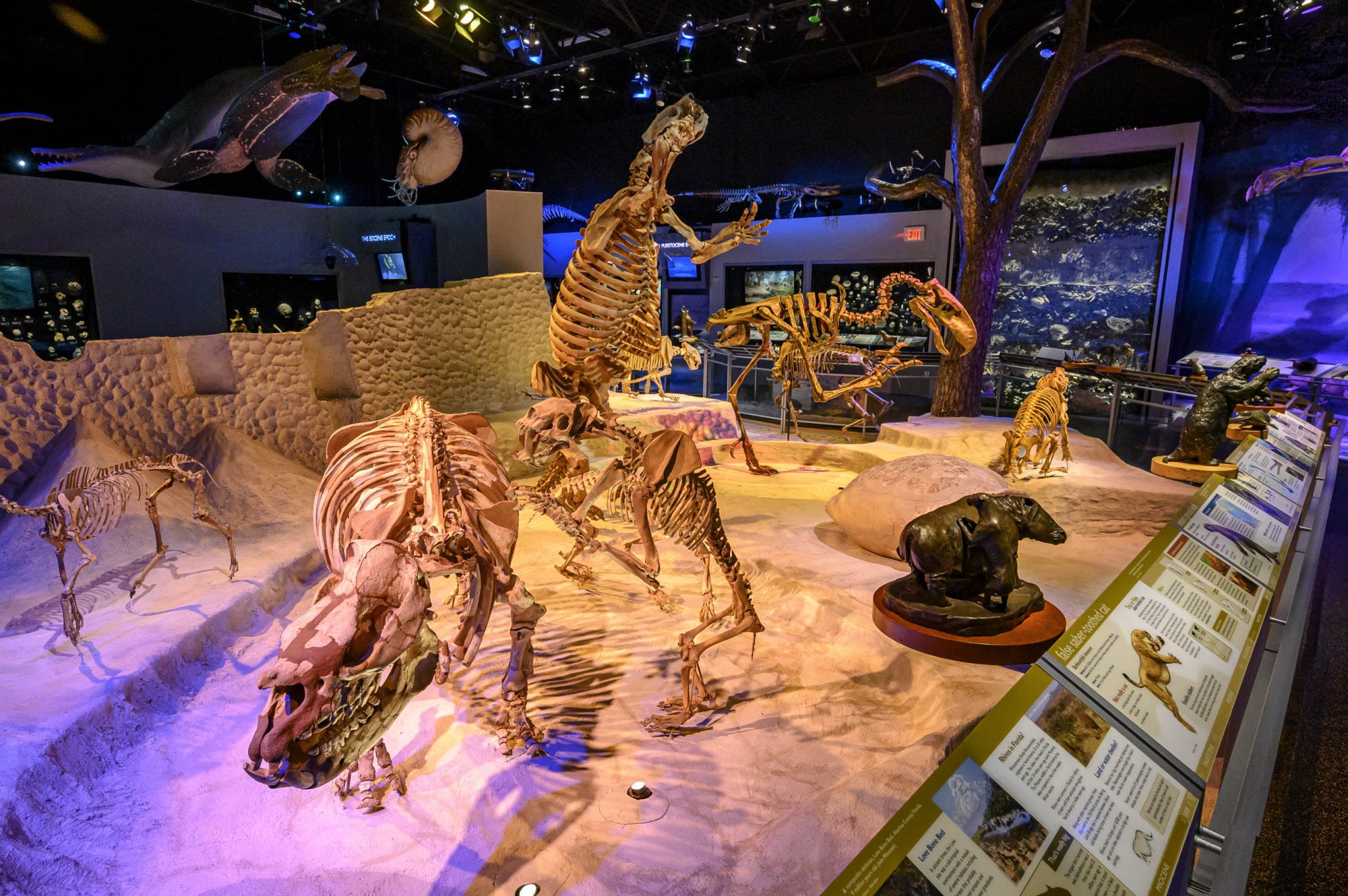
is Platygonus cumberlandensis Gidley, 1920, a 1 million-year-old Pleistocene
fossil peccary. This species is regarded as the largest known peccary ever
discovered and this specimen is the only one mounted of its kind. The animal stood
almost 3 feet tall and probably weighed about 130 pounds when it was alive.
Life History
|
Peccaries, like pigs, are social animals that live in mixed-sex groups, or 'herds'
(true pig groups are called 'sounders'). Herd sizes vary from 4 to hundreds of
individuals across the three living species. They have complex social systems,
and unlike other herding mammals, they generally live in the same herd and in
the same geographical area their entire lives. Like their cousins, peccaries
have designated areas within their home range for sleeping, foraging, and even
defecating. This social hierarchy is facilitated and maintained by a wide range
of vocalizations (including 'purring' and 'tooth chattering') and behavioral
displays (such as grooming other members of the herd). Peccaries are known to be
fiercely loyal to one another. Hunters tell tales of being forced into the
tree-tops for sometimes days after shooting an animal travelling in the front
of a herd. They are even known to hurl themselves at the trees in attempt to
bring down the tree and the hunter!
Mating behavior in peccaries is not well known. Both male and female peccaries
reach sexual maturity at approximately one year of age. Females are polyestrous,
that is, they are sexually receptive all year around. The litter size is usually
small, 1-2 piglets. Male peccaries, unlike pigs, have few secondary sexual
characteristics (i.e., large tusks). Most of the 'display' characteristics are
seemingly more for interspecific recognition; for example, the bristling of hair
prominently displays the differences in pelages between the species.
| |
Distribution of Tayassuidae.
|
Collared Peccary.
|
White-lipped Peccary.
|
Chacoan Peccary.
|
|
Evolutionary History
|
Chacoan Peccaries Platygonus Cousins?
|
tiptoeing through the thorn bush
|
setting boundaries
|
an afternoon bath
|
| |
There are three species of living peccaries in the family Tayassuidae, the
Collared (Pecari tajacu or Dicotyles tajacu), White-lipped
(Tayassu pecari), and Chacoan peccaries (Catagonus wagneri);
the latter was discovered in the Paraguayan Chaco in 1975. Peccaries are most
closely related to Old World pigs, or suids, and are in the Order Artiodactyla
(even-toed ungulates), a group of ungulates (e.g., camels, goats, giraffes, cows,
deer, hippos) that share in common a double-pulley ankle, among other characteristics.
Peccaries are distinguished from pigs by numerous anatomical characters: the
presence of a scent gland located just above the tail, a complex stomach with a
reduced liver and no gall bladder, fused foot and leg bones, fewer than four toes,
and a short tail. One of the more discernable features between the two groups
is the attitude of the canine tooth; the upper and lower canines interlock tightly
when closed, thus chewing has the effect of continuously sharpening the canines.
The interlocking mechanism, however, restricts lateral jaw movement, hence
peccaries are unable to chew 'cud', a behavioral characteristic typical of other
artiodactyls.
Both anatomical and molecular characters suggest that the white-lipped and the
chacoan peccaries are closely related to one another. The chacoan peccary is
considered to be the most primitive of the living forms, resembling the extinct
form, Platygonus.
The tayassuid fossil record is rich with some 11 fossil genera known from North
America, and six genera known from Eurasia, and Africa, although it is not widely
accepted that these Old World forms are true 'tayassuids'
|
Biogeographical History
The earliest known North American peccary, Perchoerus, is from late Eocene
sediments (37 million years ago) in North America. By the early Miocene (about
20 million years ago), the lineage of Platygonus and other closely related
forms appeared and subsequently radiated across North America, arriving in South
America just after the formation of the Panamanian land bridge approximately 2.3
million years ago. There is some evidence to suggest that the white-lipped
peccary evolved in South America and migrated to North America in Recent times.
There are some purported fossil peccaries from the late Eocene through the late
Miocene in Eurasia and Africa; however, allocation of this material to the
Tayassuidae is not well accepted.
Peccaries live in a wide variety of environments, to include; desert scrub,
arid woodlands, and neotropical forests. Their distribution extends from Arizona,
New Mexico, and Texas to as far south as northern Argentina. Population home
ranges are between 10-388 hectares, depending on the species.
Conservation Efforts
Peccaries were once widespread in North America. Today only the collared peccary
continues to live in the United States where it is restricted to parts of Arizona,
New Mexico, and Texas. The other two species live in restricted ranges from Mexico
to South America. Recent reductions in peccary populations are a result of range
fragmentation, loss of habitat, and commercial trade of their skins and meat.
All three species are listed on CITES (Convention On International Trade In
Endangered Species Of Wild Fauna and Flora) as species that could become extinct
unless measures are taken to oversee and regulate their populations. A conservation
program/research program for the chacoan peccary, "Proyecto Tagua" was established
in the Paraguayan Chaco. A similar program was set up for the white-lipped and
collared peccaries in the Pantanal region of southwest Brazil. Captive breeding
programs are well established in several zoos around the world.
History of Specimen
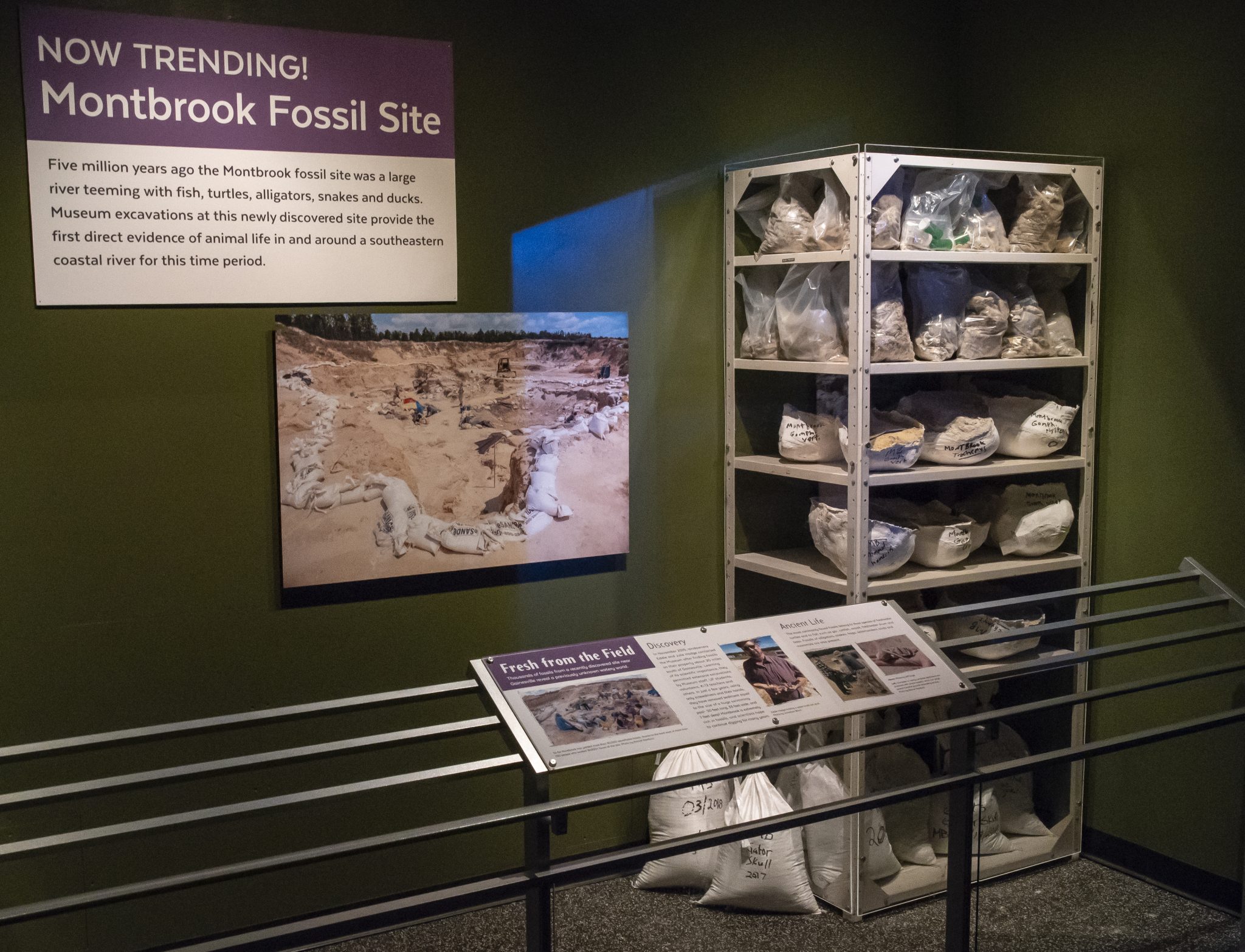
The skeleton is a composite of many individuals of the same species from two
fossil sites, Coleman 2A (Sumter County) and Haile 21A (Alachua County), as well
as a few parts (the ribs) from a domestic pig. Both localities were discovered
during limestone mining operations and they were available for excavation only
for short periods of time in 1966 (Coleman 2A) and 1983 - 1984 (Haile 21A).
Other fossil remains from these sites include sabercats, wolves, groundsloths,
horses, and bats. The Haile 21A site was affectionately referred to as 'Hog Heaven'
by museum staff because of the great numbers of Platygonus that met their
fate there.
|
All of the fossil material was collected by FLMNH staff during various expeditions
to the sites in 1966 (Coleman 2A) and 1983 - 1984 (Haile 21A). The ribs were
acquired by FLMNH staff at a museum pig roast in 1999 and the preparation,
reconstruction, and articulation were done by Steve and Suzan Hutchens in 1999-2000.
| |
|
Bibliography
Gidley, J. W. 1920. Pleistocene peccaries from the Cumberland Cave deposit. Proceedings of the United States National Museum, 57:651-678.
Hulbert, R., (in press). Fossil Vertebrates of Florida. University Presses of Florida. (expected publication date January 2001)
Kurtén, B. and E. Anderson. 1980. Pleistocene Mammals of North America. Columbia University Press, New York, 442 pp. (peccaries - pp. 295-301).
McKenna, M. C. and S. K. Bell. 1997. Classification of mammals above the species level. Columbia University Press, New York, 631 pp. (peccaries - pp. 397-399).
Nowak, R. M. 1999. Walker's Book of Mammals, vol. II. Johns Hopkins University Press, London. 1936 pp. (peccaries - pp. 1063-1067).
Sowls, L. K. 1984. The Peccaries. The University of Arizona Press, Tuscon, 251 pp.
Vaughan, T. A. 1986. Mammalogy. Harcourt Brace Jovanovich College Publishing, Orlando, FL. 196 pp.
Woodburne, M. O. 1969a. A late Pleistocene occurrence of the collared peccary, Dicotyles tajacu, in Guatemala. Journal of Mammalogy, 50:121-125.
Woodburne, M. O. 1969b. Systematics, biogeography, and evolution of Cynorca and Dyseohyus (Tayassuidae). Bulletin of American Museum of Natural History, 141: 1-355.
Wright, D. B. 1998. Tayassuidae, pp. 389-400. In: Janis, C. M., K. M. Scott, and L. L. Jacobs (eds), Evolution of Tertiary Mammals of North America. Cambridge University Press, Cambridge, United Kingdom. 691 pp.
Written by Dr. G. C. Gould - FLMNH
|