VENOMOUS
Other common names
Eastern Coralsnake, Coralsnake
Basic description
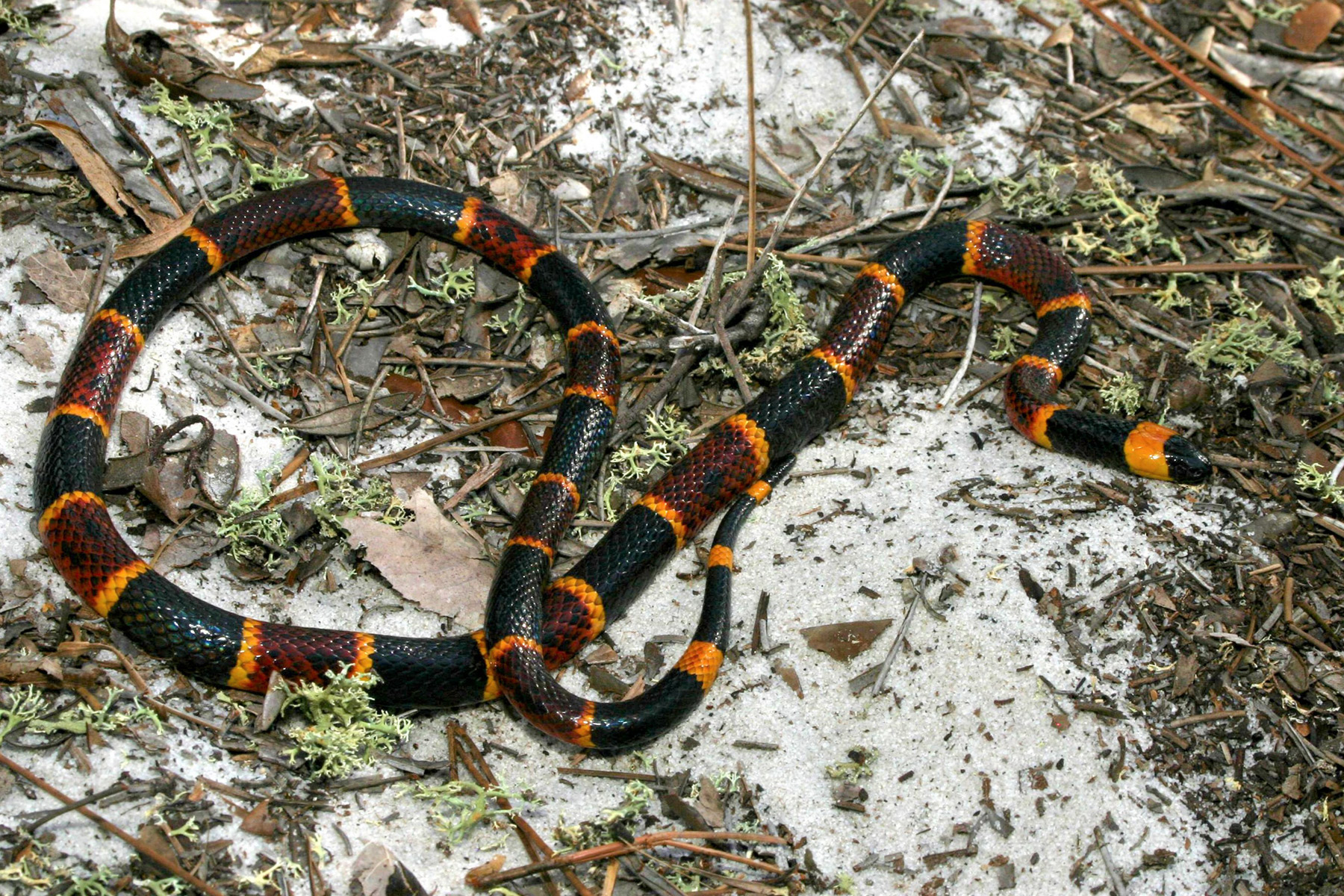
Most adult Harlequin Coralsnakes are about 20-30 inches (51-76 cm) in total length. This is a thin-bodied snake with alternating red and black rings separated by narrower yellow rings. The small head is not distinct from the neck and has a rounded black snout followed by a broad yellow band behind the eyes. The coloration of juveniles is the same as described for adults.
Range in Florida
Harlequin Coralsnakes are found throughout Florida and in every county. They also occur on Key Largo in the Northern Florida Keys.
Assessment of risk to people and pets
VENOMOUS Bites from Harlequin Coralsnakes can be very dangerous to people and pets, but bites from this species are extremely rare. The victim should seek immediate medical care from a physician or hospital experienced in treating snakebites. Harlequin Coralsnakes are not aggressive and avoid direct contact with people and pets. Virtually all bites occur when the snakes are intentionally molested.
Comparison with other species
Scarlet Kingsnake (Lampropeltis elapsoides) Non-venomous Scarlet Kingsnakes have red, black, and yellow (or white) rings down the body. However, the narrow yellow rings only contact the black rings, not the red rings as in Harlequin Coralsnakes. The rings completely encircle the body as in Harlequin Coralsnakes. They have red snouts.
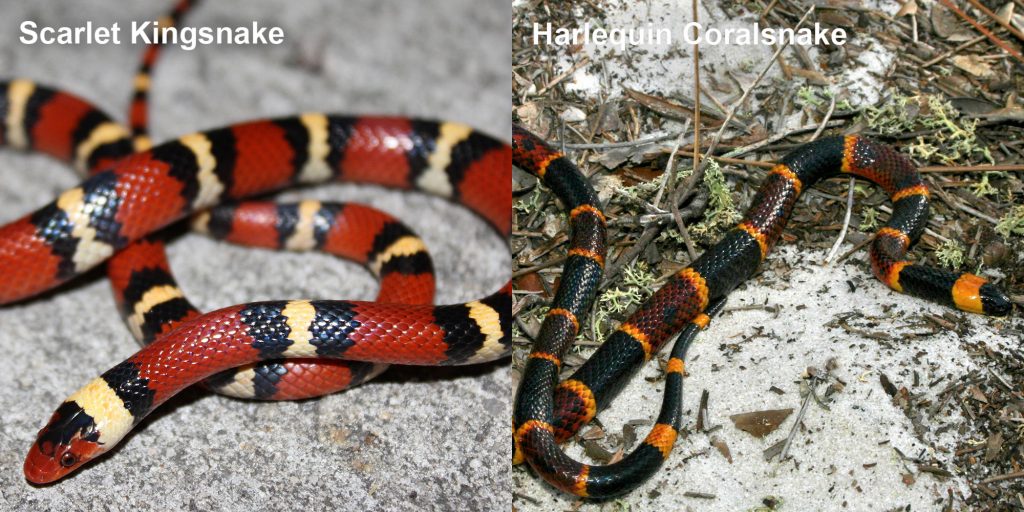
Scarlet Kingsnake. Photo courtesy of Luke Smith.
Scarletsnake (Cemophora coccinea) Non-venomous Scarletsnakes have red, black, and yellow (or white) rings down the body. However, the narrow yellow rings only contact the black rings, not the red rings as in Harlequin Coralsnakes. Unlike Harlequin Coralsnakes, the rings do not completely encircle the body; the belly is a cream white color and unpatterned. They have red snouts that are somewhat pointed.
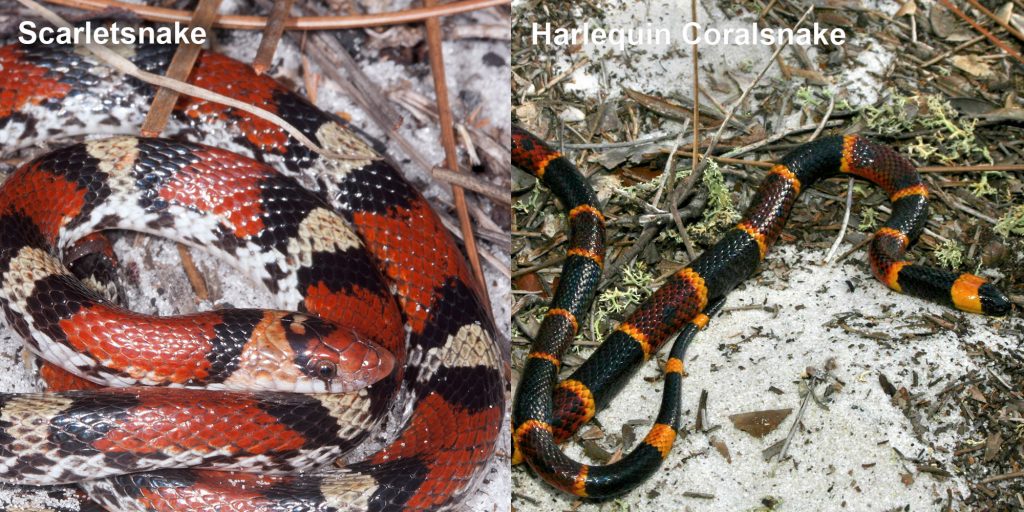
Scarletsnake. Photo courtesy of Luke Smith.
Share your observations
You can help scientists better understand the biology and distribution of this species by sharing your observations. Send photos or videos of interesting observations, along with associated information, by emailing the herpetology staff at the Florida Museum for documentation in the Museum’s Herpetology Master Database. You can also post your observations on iNaturalist.
Additional helpful information
Do you have snakes around your house? Learn how to safely co-exist with snakes.
Still have questions about snakes or identifications? Feel free to email the herpetology staff at the Florida Museum with your questions or feedback about this profile.
Banner photo courtesy of Todd Pierson. Please credit any photographers on the page and see our copyright policy.