Cottonmouth, Cottonmouth Moccasin, Water Moccasin, Moccasin
Basic description
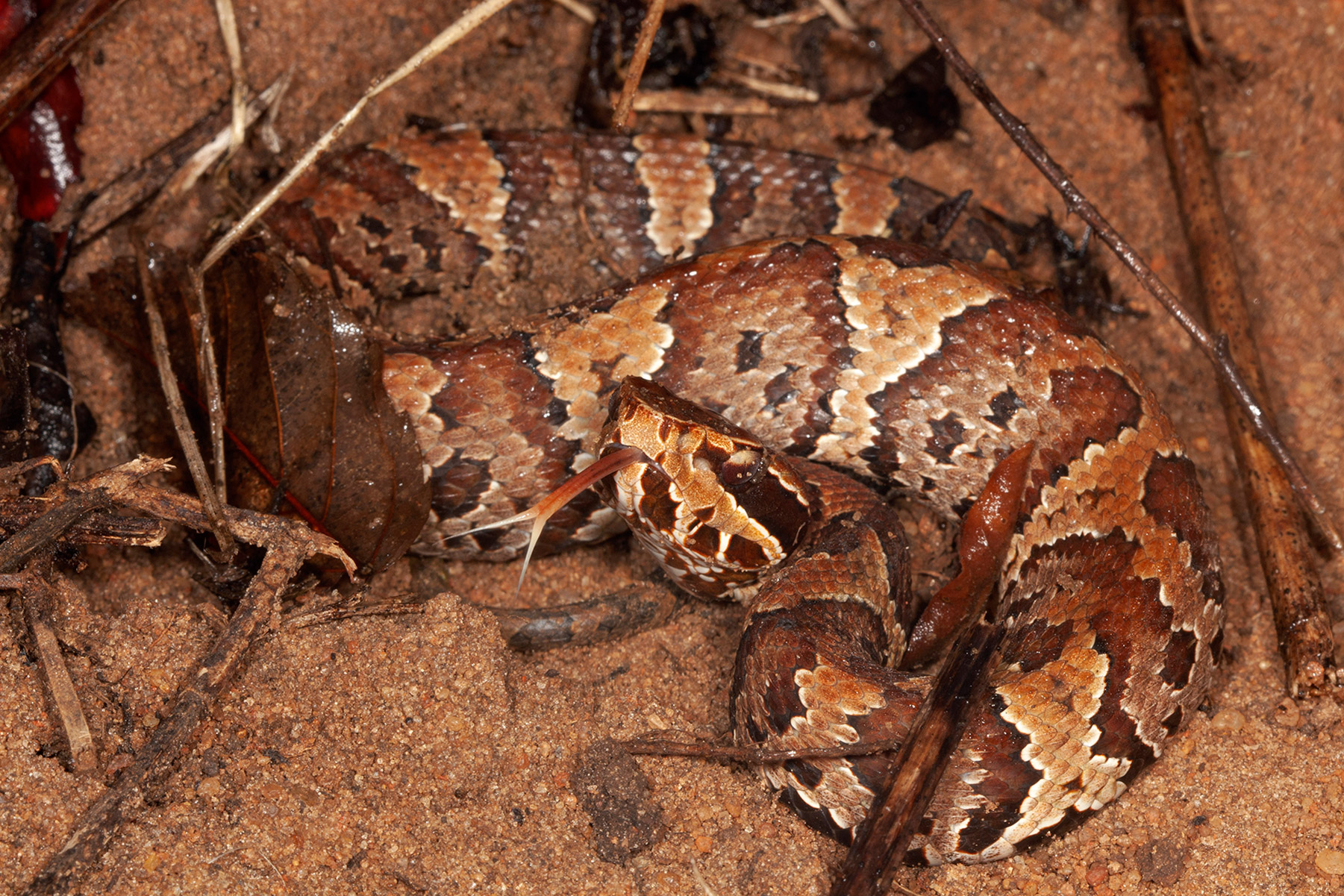
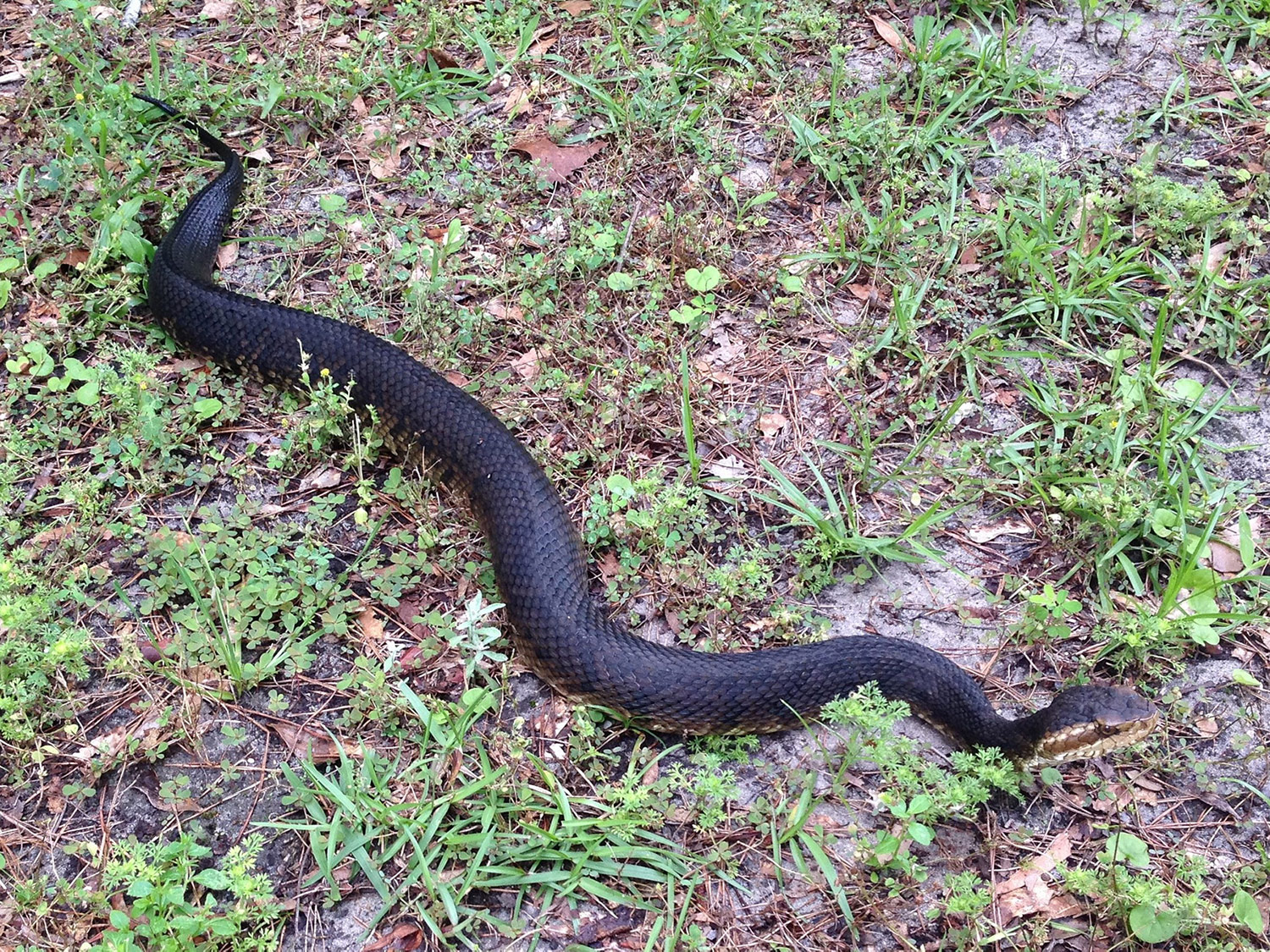
The average adult Florida cottonmouth is 30-48 inches (76-122 cm) in total length. This snake is heavy bodied with a pattern of light brown and dark brown crossbands containing many dark spots and speckles. The pattern darkens with age so adults may become uniformly black. The eye is camouflaged by a broad, dark, facial stripe. The color pattern of juvenile cottonmouths is much lighter than in adults, and newborns have a sulfur-yellow tail tip.
Juvenile color pattern of the Florida Cottonmouth. Photo courtesy of Todd Pierson.
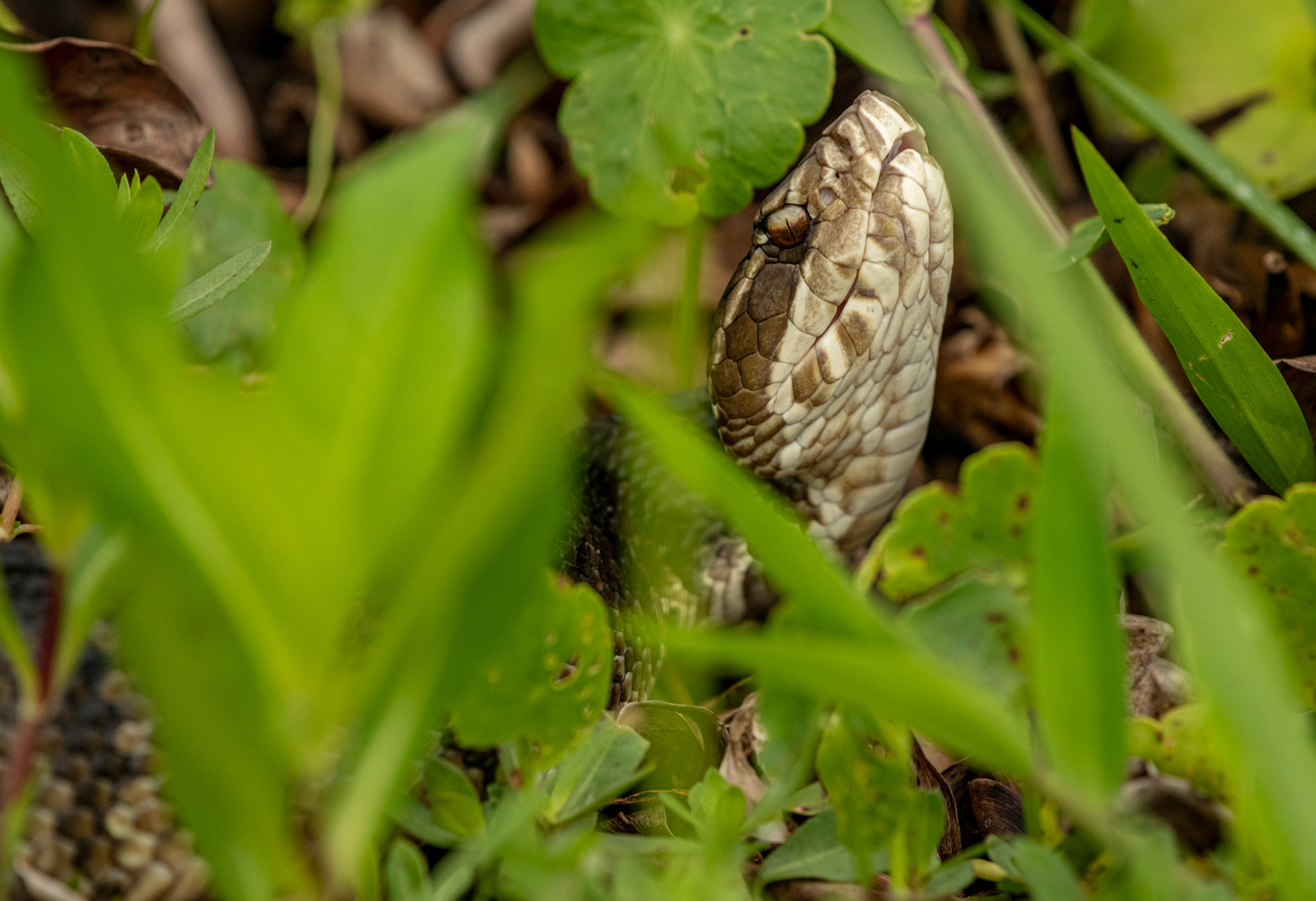
Adult Florida Cottonmouth close up of head showing eye, nostril, and pit organ. Photo courtesy of Kristen Grace.
Photo courtesy of Coleman Sheehy.
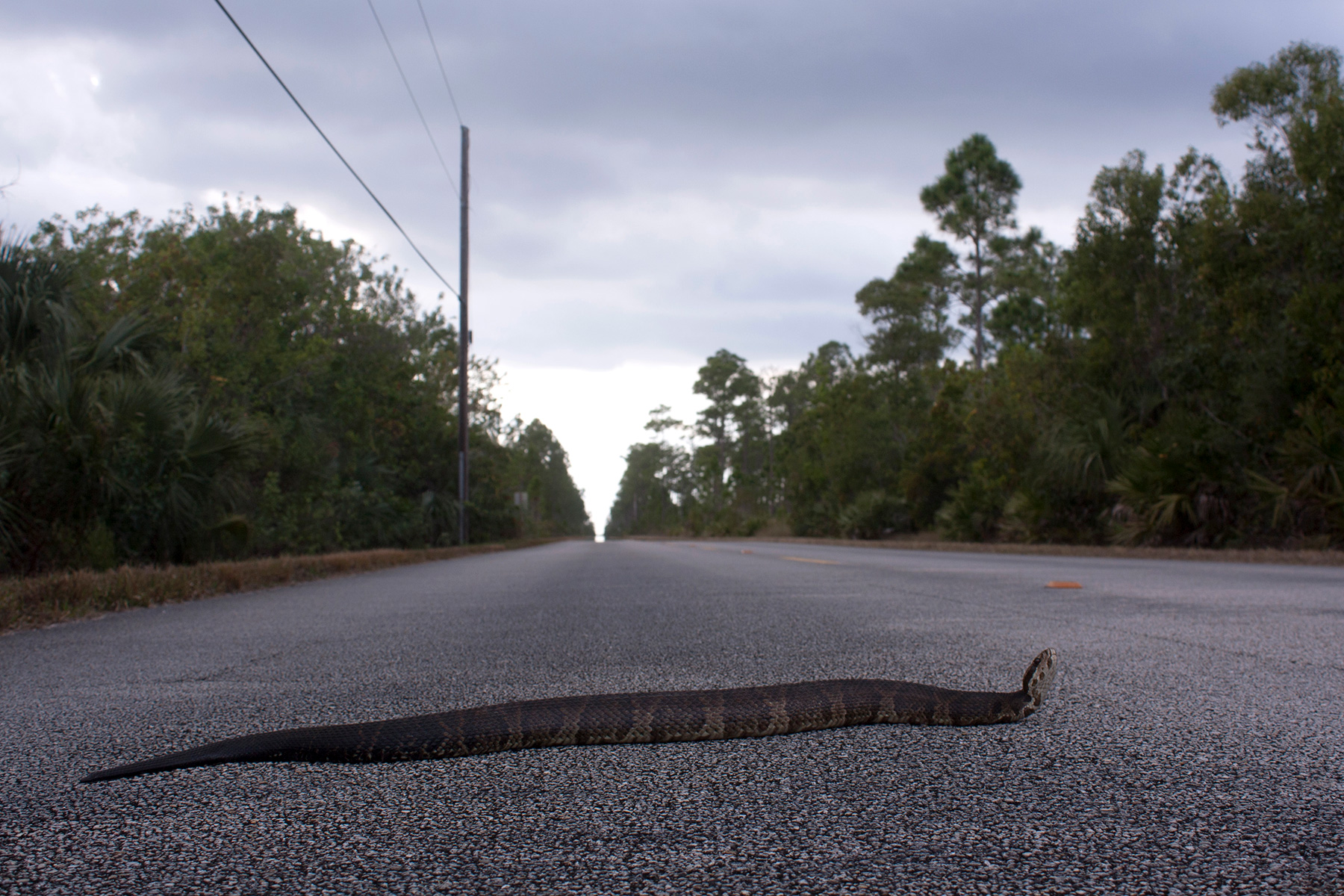
Adult Florida Cottonmouth crossing road with typical head-up posture. Photo courtesy of Todd Pierson.
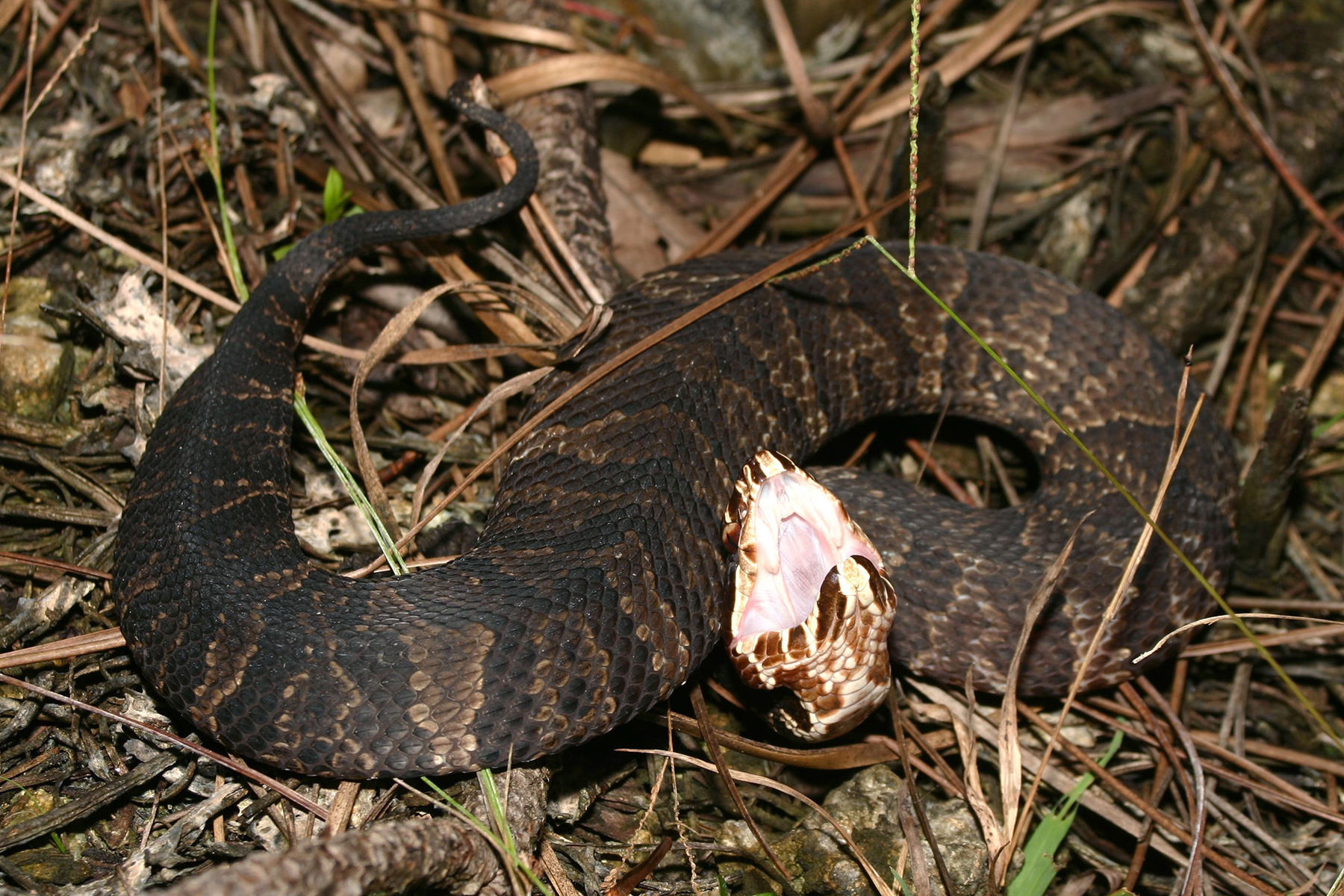
Adult Florida Cottonmouth with open mouth defensive display. Photo courtesy of Todd Pierson.
Range
Cottonmouths are found throughout Florida and in every county. They also occur on many nearshore islands including the Upper Florida Keys and several islands in the Gulf of Mexico in Levy (e.g., Cedar Keys) and Franklin (e.g., Dog, St. George, and St. Vincent islands) counties.
Assessment of risk to people and pets
VENOMOUS Cottonmouth bites can be very dangerous to people and pets. The victim should seek immediate medical care from a physician or hospital experienced in treating snakebites. Cottonmouths are not aggressive and avoid direct contact with people and pets. Most bites occur when the snakes are intentionally molested or accidentally stepped on.
Comparison with other species
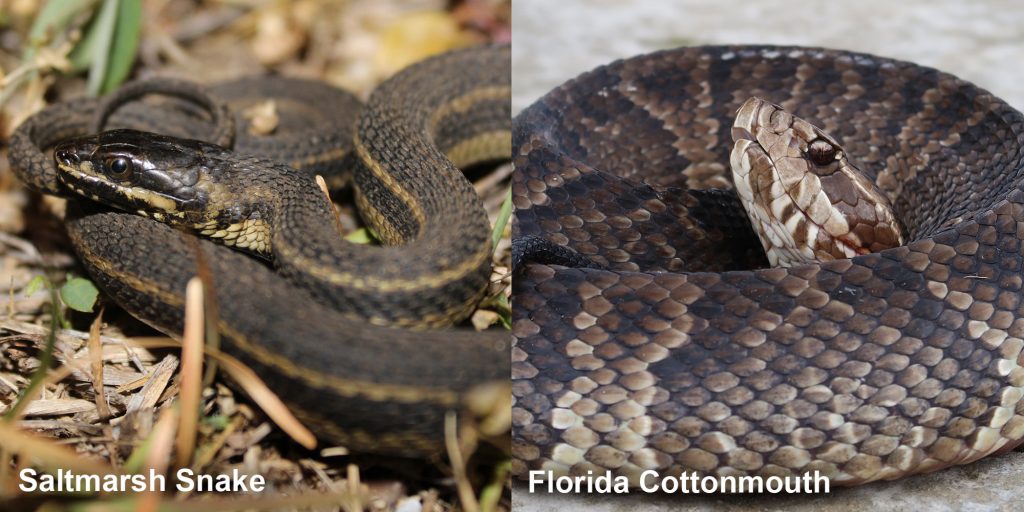
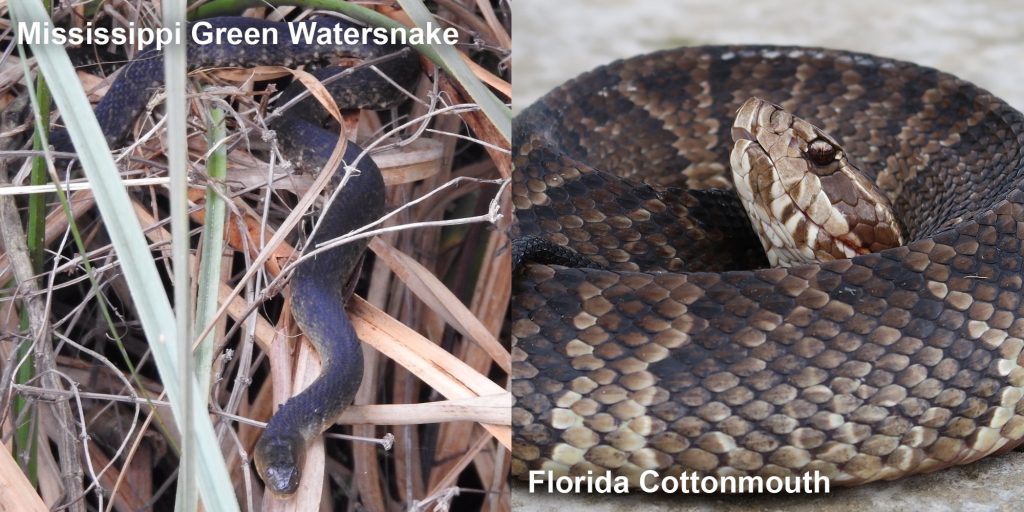
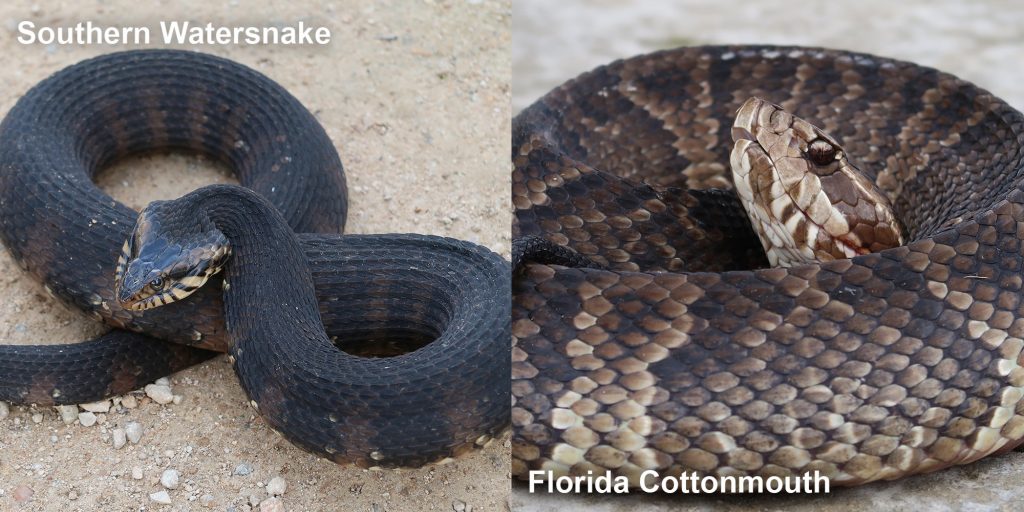
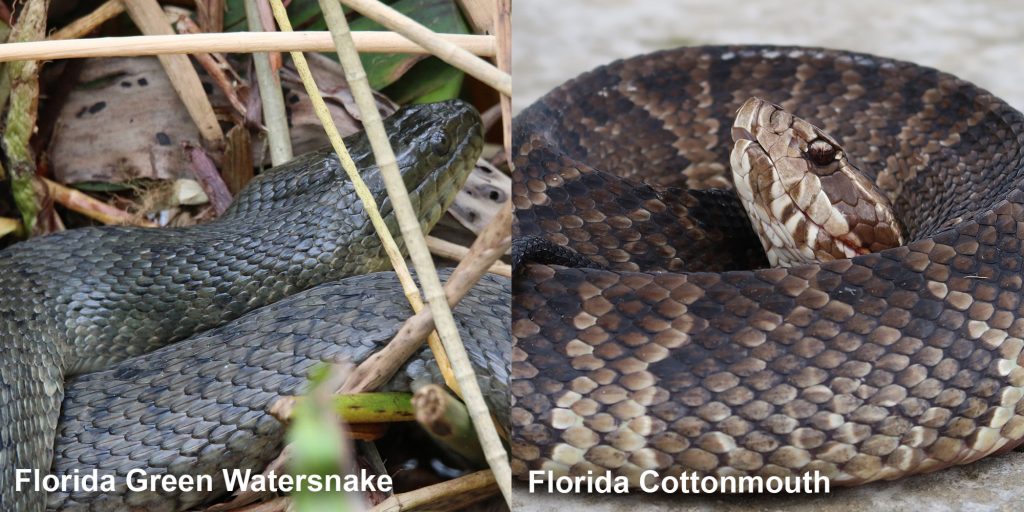
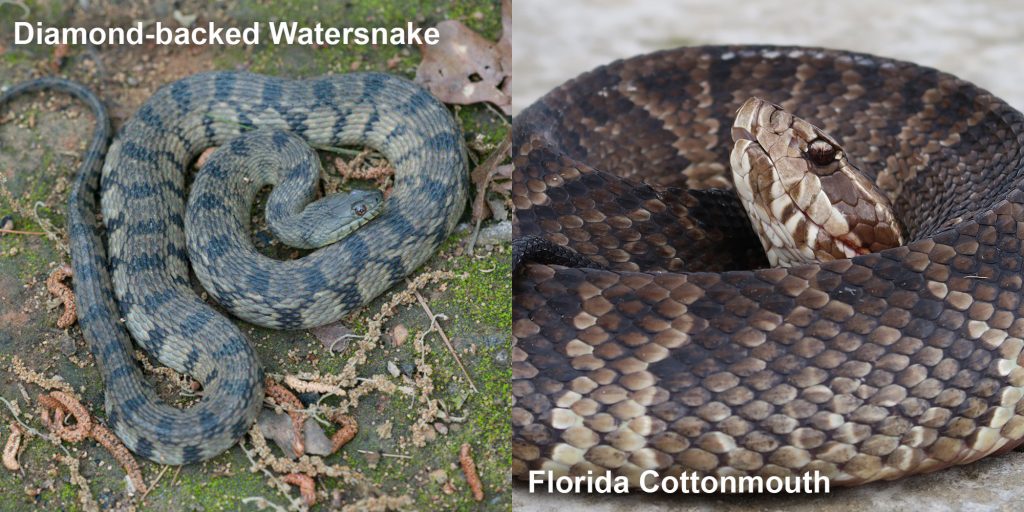
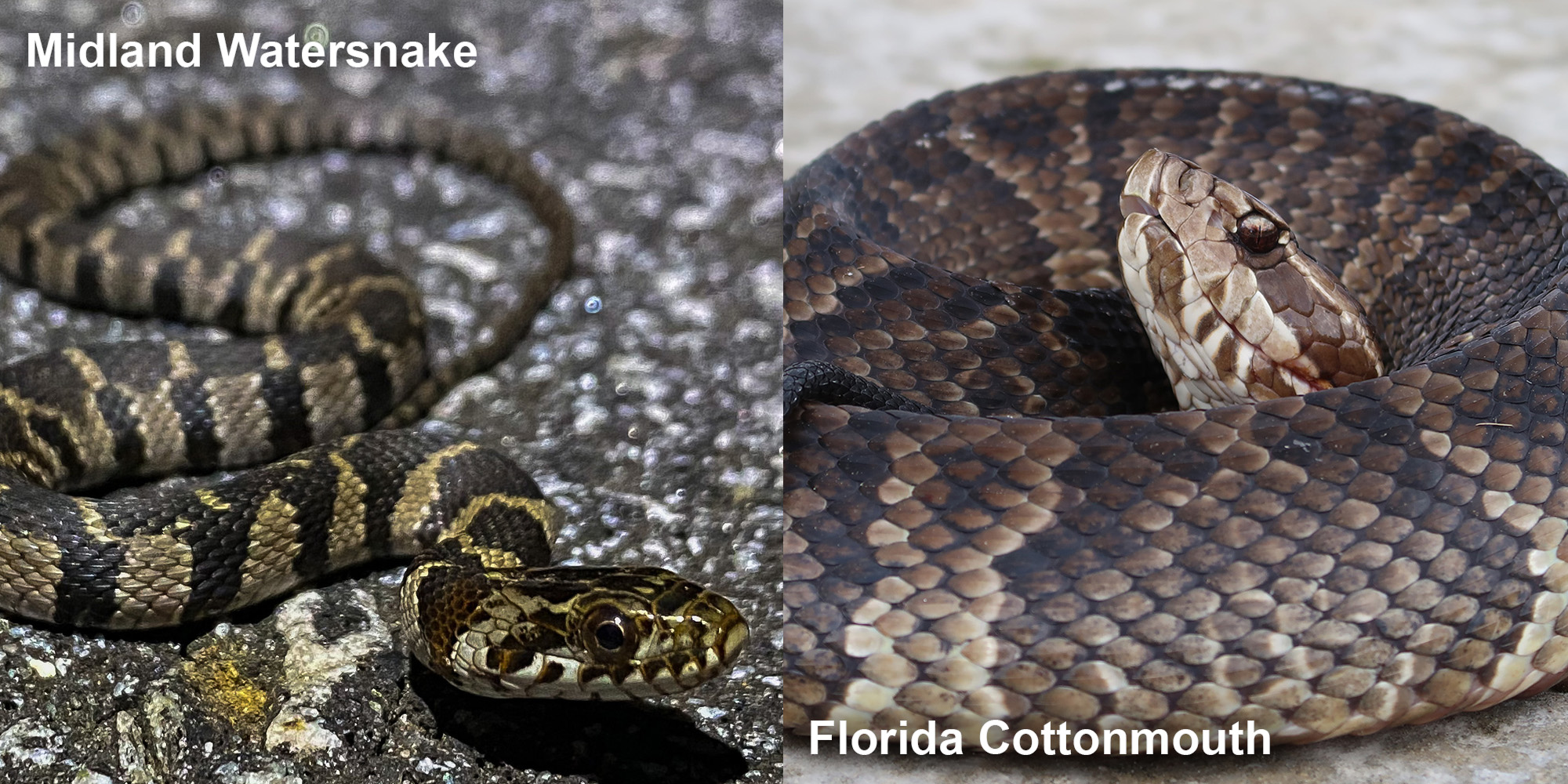
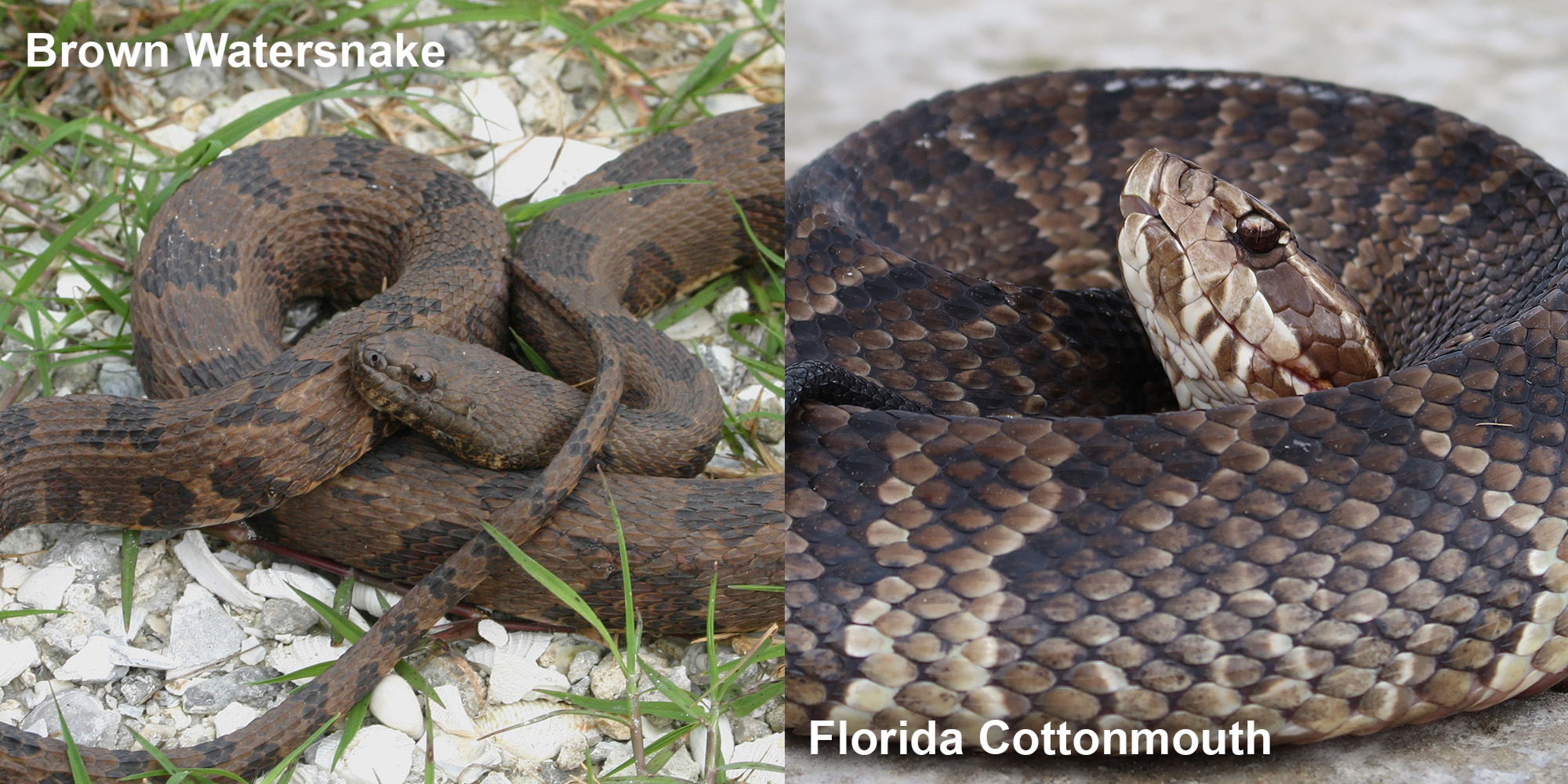
There are eight species of non-venomous watersnakes (species in the genus Nerodia) in Florida that overlap with cottonmouths in distribution and habitat, and all of them resemble cottonmouths. However, there are some differences you can look for in general to help distinguish cottonmouths from watersnakes:
If the head is viewed from directly above, the eyes of cottonmouths cannot be seen, whereas the eyes of watersnakes are visible.
Cottonmouths have vertically elliptical (cat-like) pupils whereas watersnakes have round pupils.
Cottonmouths have a facial pit organ between the nostril and the eye, whereas watersnakes do not have this organ.
Watersnakes usually have thin dark vertical lines on the sides of the face near the mouth, whereas the cottonmouths have no such dark lines.
Lastly, cottonmouths typically rest with their heads elevated off the ground and tilted upwards at an angle, whereas watersnakes typically do not rest with their heads tilted upwards at an angle.
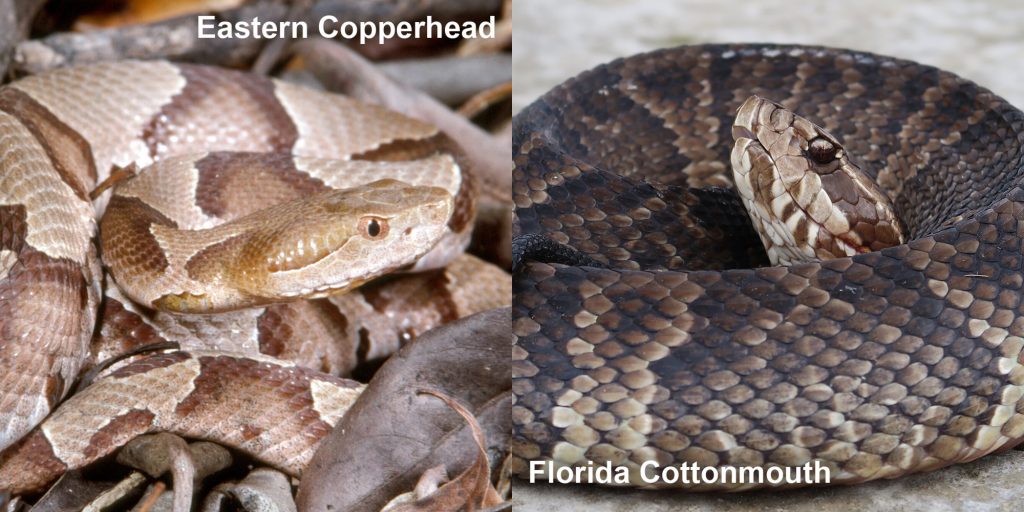
Eastern Copperhead (Agkistrodon contortrix)Venomous Brightly-colored juvenile Florida Cottonmouths are sometimes mistaken for the Eastern Copperhead (Agkistrodon contortrix), which occurs in Florida only in the Panhandle. The dark crossbands on the body of juvenile cottonmouths have numerous dark spots and speckles, whereas the dark crossbands on copperheads have no dark spots or at most only one. Adult copperheads maintain their juvenile color pattern, whereas adult cottonmouths are typically uniformly dark with very little discernable pattern. Each eye of the copperhead is not obscured by the dark facial band typical of the cottonmouth.
Eastern Copperhead. Photo courtesy of bobbyfingers/iNaturalist Florida Cottonmouth. Photo courtesy of Luke Smith.
Here is a list of the species of watersnakes in Florida:
Adult Brown Watersnake. Photo courtesy of Todd Pierson. Florida Cottonmouth. Photo courtesy of Luke Smith.
The average adult Florida Cottonmouth is 30-48 inches (76-122 cm) in total length, with a record length of 74.5 inches (189 cm). This snake is heavy bodied with a pattern of light brown and dark brown crossbands containing many dark spots and speckles. The pattern darkens with age, so adults may become uniformly black with only a faint pattern. The dorsal scales of the body are keeled (each scale has a prominent raised ridge). The eye is camouflaged by a broad, dark, facial stripe. The top of the head between the eyes is covered with large plate-like scales. The pupil is vertically elliptical (cat-like). There is a deep facial pit organ located between the nostril and the eye. The eyes cannot be seen when viewed from above. The tip of the snout has two dark vertical lines. Juvenile cottonmouths have prominent reddish-brown crossbands on a brown ground color, with dark spots in the dark bands. The color pattern of juvenile cottonmouths is much lighter than in adults, and newborns have a sulfur-yellow tail tip.
Florida Cottonmouths can potentially be found in or near any wetlands or waterway in the state, including springs, rivers, lakes, ponds, saltmarshes, swamps, sloughs, reservoirs, retention pools, canals, and roadside ditches. These snakes often wander far from water and have occasionally been found in bushes and trees. Several of the islands they inhabit contain hydric hammock and lack permanent sources of freshwater.
When threatened, a cottonmouth will usually attempt to retreat. If further agitated, it may respond by coiling its body and opening its mouth to exposed white interior. This behavior is what gave rise to the common name “cottonmouth”. This is not a strike, however, but rather a display intended to scare away a potential threat. If further provoked, these snakes may release foul-smelling musk from glands within the base of the tail and quickly vibrate the tip of the tail to produce a buzzing sound. However, they are not rattlesnakes. Striking is only used in defense as a last resort. Contrary to common folklore, these snakes are not aggressive and do not chase people away.
Cottonmouths are opportunistic generalists that feed on a wide range of prey including insects, fish, frogs, salamanders, small turtles, snakes (including other cottonmouths), lizards, baby alligators, birds, small mammals, and carrion. Populations of cottonmouths living on islands in the Cedar Keys feed primarily by scavenging marine fish carrion dropped by colonial nesting waterbirds. Juvenile cottonmouths have a bright sulfur-yellow tail tip, which they raise and wiggle like a caterpillar to lure prey within striking range. This yellow color fades and the caudal luring behavior typically ceases after about a year.
In Florida, females typically give birth to around 1-20 live young between August and October. Competing males engage in combat dances when trailing females during the breeding season.
No subspecies are currently recognized. However, data suggest the Panhandle to be a hybridization zone between the Florida cottonmouth (Agkistrodon conanti) and the northern cottonmouth (Agkistrodon piscivorus).
Cottonmouths are typically nocturnal, becoming active shortly before dark. However, they can occasionally be seen active during the day.
Head shape is not a reliable way to identify cottonmouths. Cottonmouths do typically have a large head that is triangular and distinct from the neck, whereas most non-venomous snakes in Florida have smaller and narrower heads. However, many non-venomous snakes will commonly flatten and expand their heads to appear wider and triangular as a defensive behavior. Whether this behavior is due to mimicry is not clear, but it does make head shape unreliable for identification purposes.
Although cottonmouths occur throughout Florida, they are not nearly as abundant as the eight species of harmless watersnakes (species in the genus Nerodia) that occur in much the same habitats. Unfortunately, many watersnakes are killed every year by Florida residents who mistake them for cottonmouths.
The open mouth threat display of cottonmouths has led to the widespread belief that they are aggressive snakes. However, this behavior is entirely defensive. These snakes only want to be left alone and allowed to escape.
According to folklore, cottonmouths lie waiting on tree limbs overhanging water so they can drop into boats. However, this is not true. Furthermore, these incidents are usually cases of mistaken identity. Harmless Brown Watersnakes (Nerodia taxispilota) often bask on tree limbs overhanging the water. When frightened by a perceived threat, such as an approaching boat, they typically escape by dropping off the limb and into the water where they can hide. Occasionally the watersnake’s attempt to flee is too slow and it accidentally falls into the boat instead of the water.
Alachua, Baker, Bay, Bradford, Brevard, Broward, Calhoun, Charlotte, Citrus, Clay, Collier, Columbia, De Soto, Dixie, Duval, Escambia, Flagler, Franklin, Gadsden, Gilchrist, Glades, Gulf, Hamilton, Hardee, Hendry, Hernando, Highlands, Hillsborough, Holmes, Indian River, Jackson, Jefferson, Lafayette, Lake, Lee, Leon, Levy, Liberty, Madison, Manatee, Marion, Martin, Miami-Dade, Monroe, Nassau, Okaloosa, Okeechobee, Orange, Osceola, Palm Beach, Pasco, Pinellas, Polk, Putnam, Saint Johns, Santa Rosa, Sarasota, Seminole, Sumter, Taylor, Union, Volusia, Wakulla, Walton, Washington
Upper Florida Keys, Middle Florida Keys
If you have a new or interesting observation for this species, please email the herpetology staff at the Florida Museum.
Burbrink, F.T. and T.J. Guiher. 2015. Considering gene flow when using coalescent methods to delimit lineages of North American pitvipers of the genus Agkistrodon. Zoological Journal of the Linnean Society. 173(2): 505–526. https://doi.org/10.1111/zoj.12211
Ernst, C.H. and E.M. Ernst. 2003. Snakes of the United States and Canada. Smithsonian Institution Press, Washington, DC. 668 pp.
Krysko, K.L., K.M. Enge, and P.E. Moler. Amphibians and Reptiles of Florida. 2019. University of Florida Press, Gainesville, Florida. 706 pp.
Powell, R., R. Conant, and J.T. Collins. 2016. Peterson Field Guide to Reptiles and Amphibians of Eastern and Central North America. Fourth edition. Houghton Mifflin Harcourt Publishing Company, Boston and New York. xiv + 494 pp.
Wharton, C.H. 1969. The cottonmouth moccasin on Sea Horse Key, Florida. Bulletin of the Florida State Museum, Biological Sciences. 14(3): 227–272.
Still have questions about snakes or identifications? Feel free to email the herpetology staff at the Florida Museum with your questions or feedback on this profile.
Banner photo courtesy of Luke Smith. Please credit any photographers on the page and see our copyright policy.