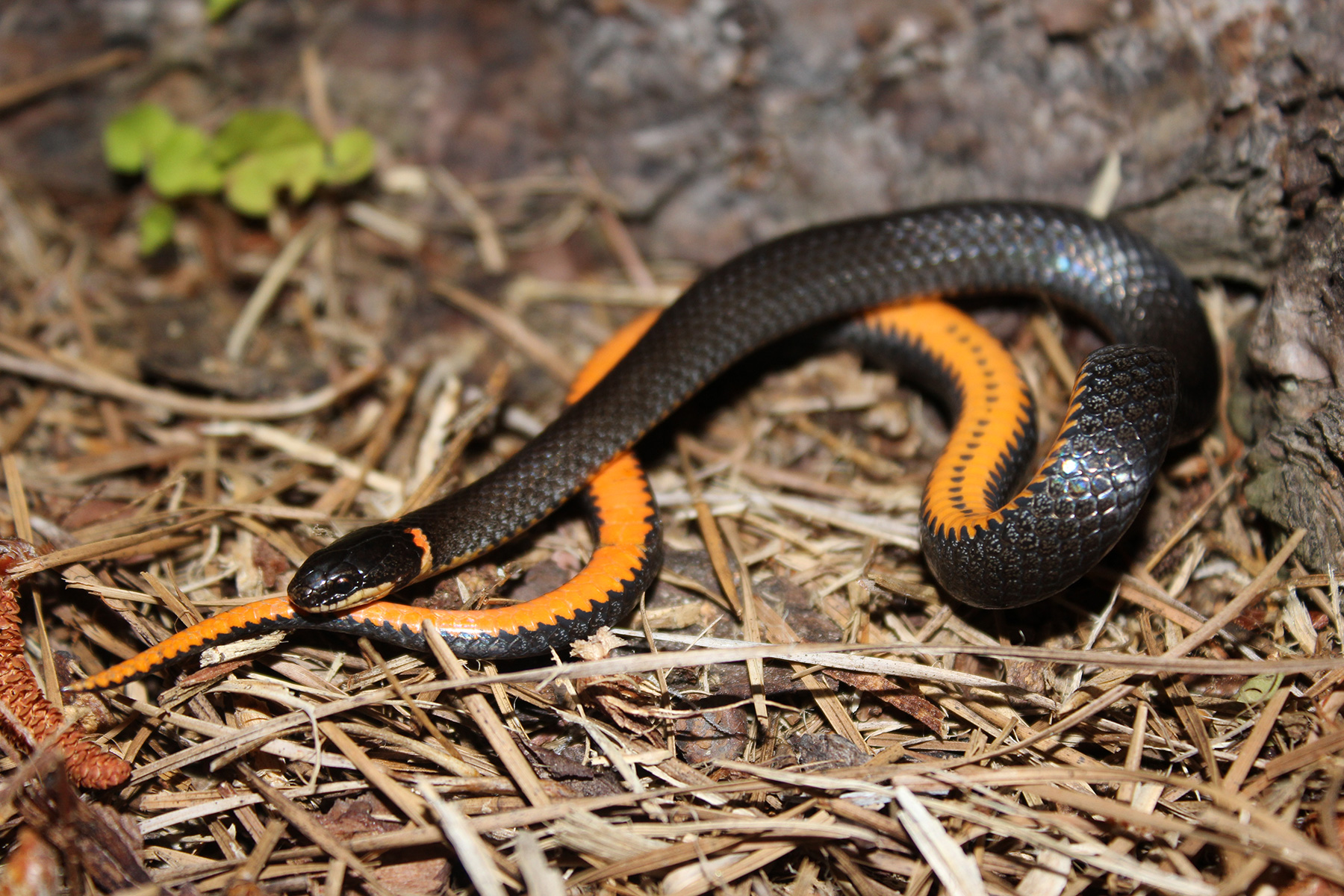
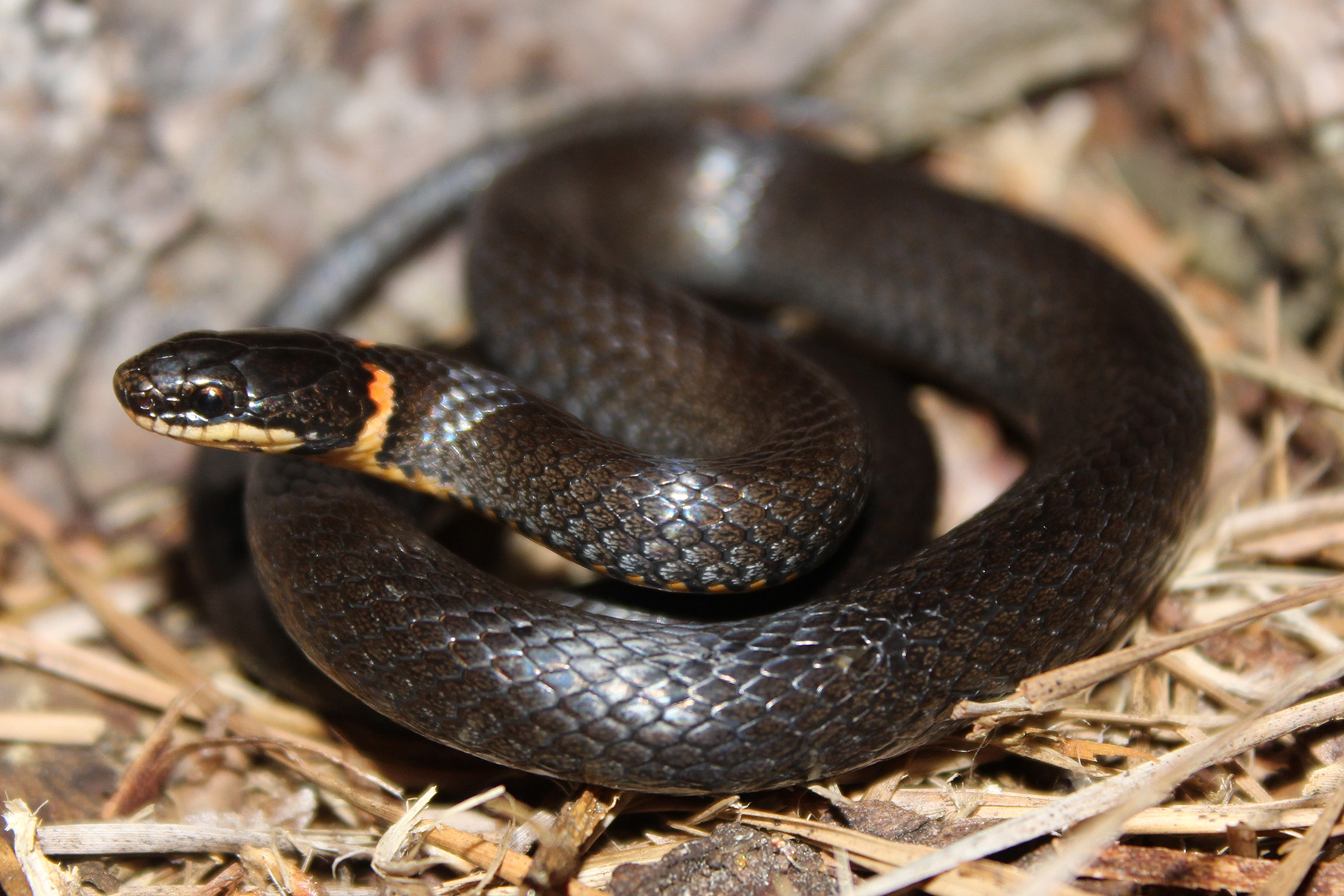
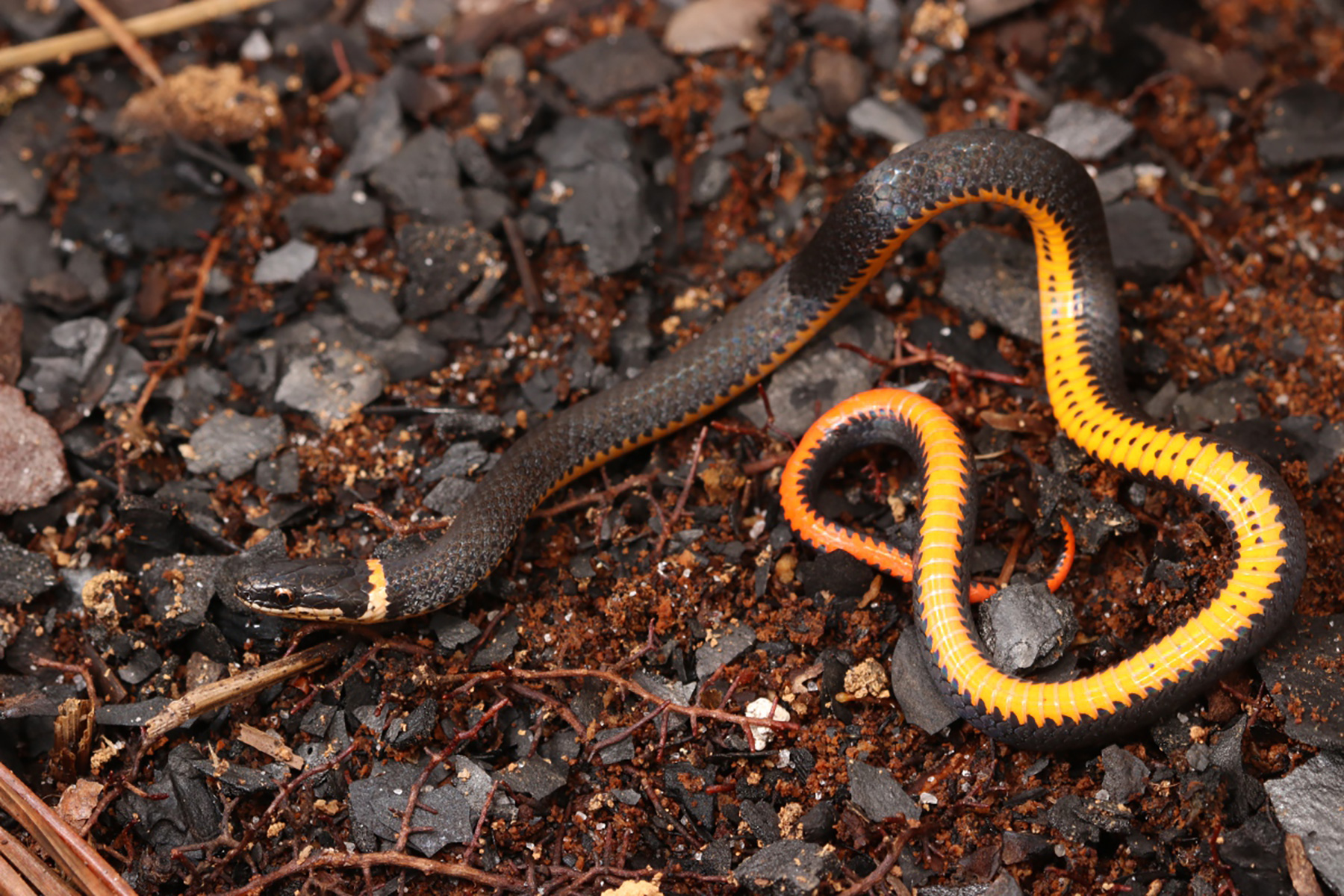
Most adult Ring-necked Snakes are about 8-14 inches (21-36 cm) in total length. Adults are small and slender with a black or slate gray body and a yellowish ring across the neck, which may be incomplete or missing. The belly and underside of the tail are bright yellow, orange, or red. Juvenile coloration is similar to that described for adults.
Ring-necked Snake showing belly pattern. Photo courtesy of Luke Smith.
Coiled Ring-necked Snake. Photo courtesy of Luke Smith.
Ring-necked Snake. Photo courtesy of Noah Mueller.
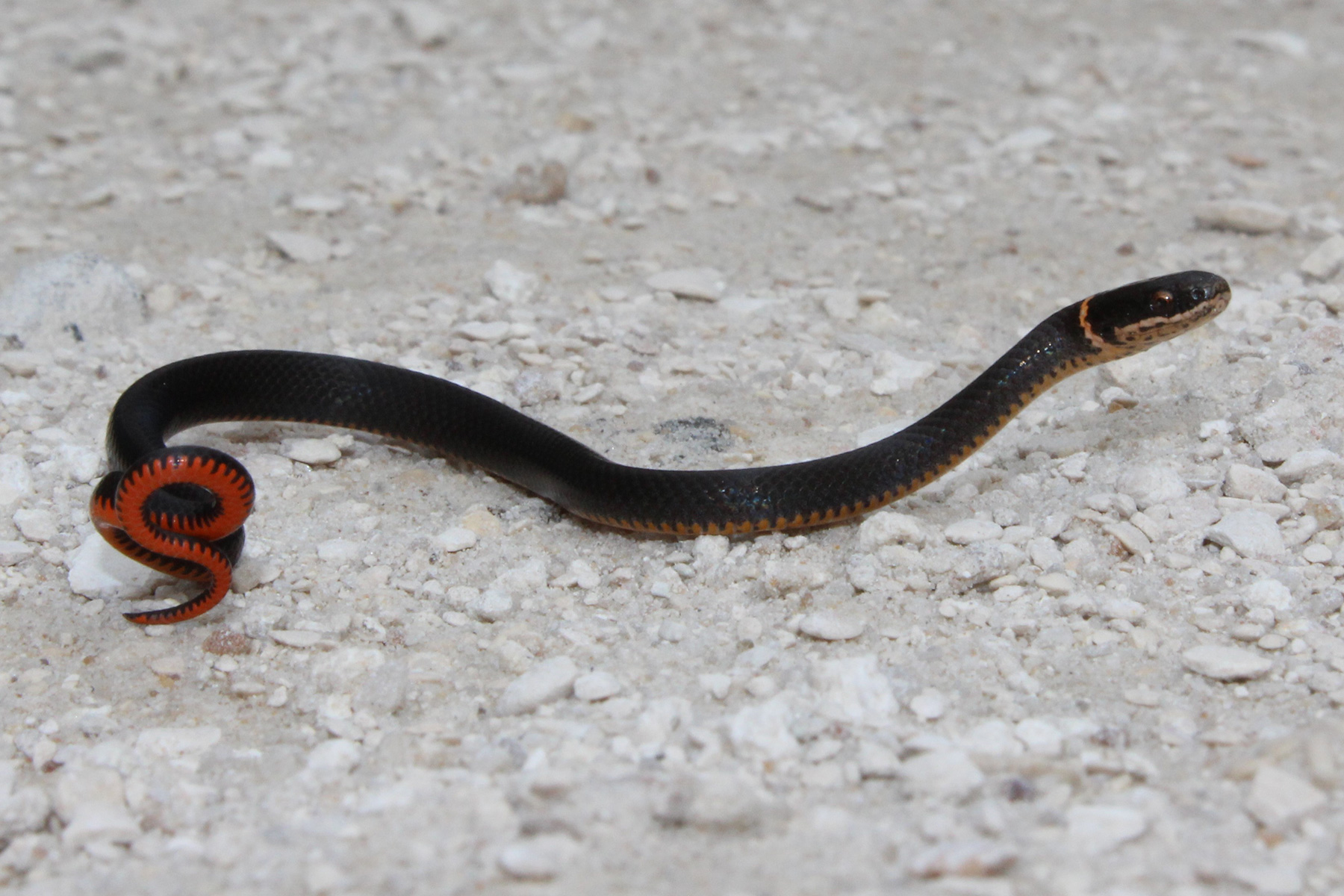
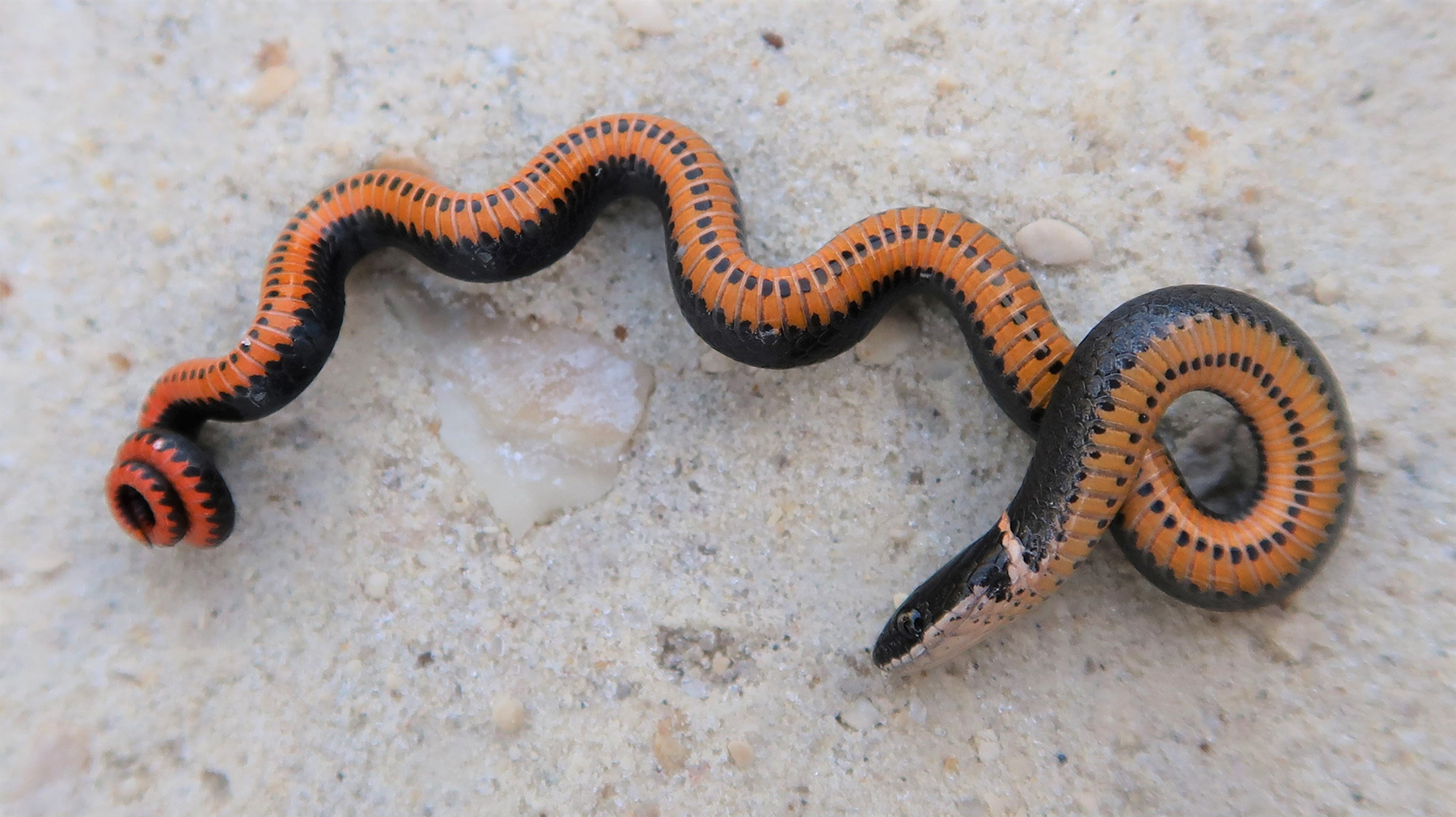
Ring-necked Snake showing tail-curling defense behavior. Photo courtesy of Luke Smith.
Ring-necked Snake showing tail-curling defense behavior. Photo courtesy of Luke Smith.
Range in Florida
Ring-necked Snakes are found throughout mainland Florida in every county. They also occur on the Florida Keys.
Assessment of risk to people and pets
Non-venomous. Ring-necked Snakes are not dangerous to people or pets.
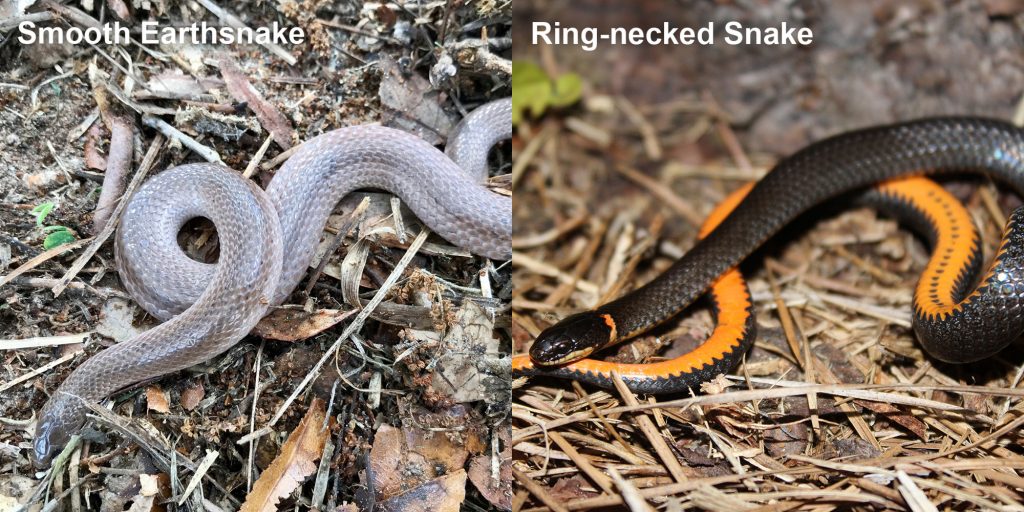
Smooth Earthsnake. Photo courtesy of cassiethegardener/iNaturalist Ring-necked Snake showing belly pattern. Photo courtesy of Luke Smith.
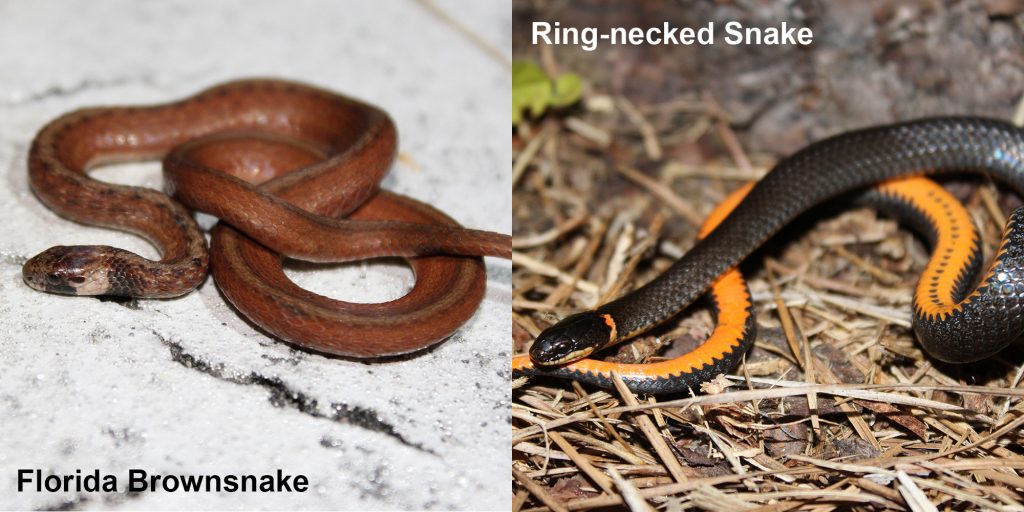
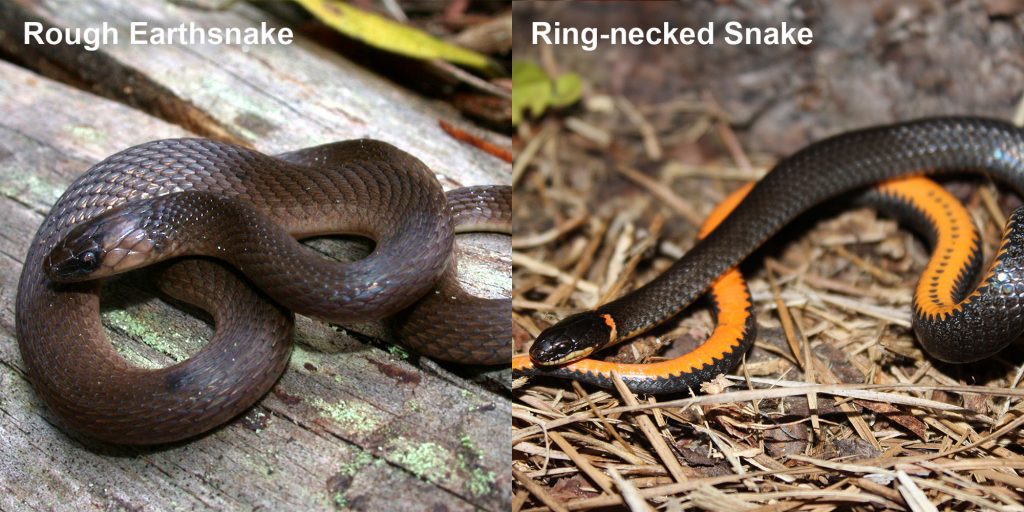
Most adult Ring-necked Snakes in Florida are about 8-14 inches (21-36 cm) in total length. Adults are small and slender with a black or slate gray body and a yellow, cream, or orange ring across the neck. The neck ring may be incomplete, and snakes in the Lower Florida Keys may lack a ring entirely. The belly is bright yellow, orange, or red with a single row of black half-moon markings down the center. The underside of the tail is typically bright red in the peninsula or yellow in the Panhandle. The scales are smooth, and there are 15 dorsal scale rows at midbody. The pupil is round. Juvenile coloration is similar to that described for adults.
In peninsular Florida, Ring-necked Snakes are commonly found in meadows, prairies, pinelands, hardwood hammocks, and melaleuca stands. In the Florida Keys, they occur mainly in pinelands, tropical hardwood hammocks, and around limestone outcroppings. Adults and juveniles of this species are often found in suburban neighborhoods where development encroaches into favorable habitats.
These mild-mannered snakes typically do not bite in defense. If captured or molested, Ring-necked Snakes will often squirm vigorously and release foul-smelling musk from two glands in the base of the tail. If further molested, they will often roll their tail into a tight coil and elevate it to display the bright red or yellow coloration beneath, potentially as a startle display.
Ring-necked Snakes are nocturnal (active at night) predators and feed primarily on small lizards, snakes, salamanders, frogs, toads, earthworms, slugs, and insects. These snakes are not constrictors. Larger prey are slowly immobilized using a mildly toxic venom that is delivered by two slightly elongated teeth at the rear of the mouth. However, smaller prey are often quickly swallowed alive.
In Florida, females lay around 2-7 eggs in moist areas such as underneath or inside rotting logs. They typically hatch in late summer or early fall.
Key Ring-necked Snake (Diadophis punctatus acricus) The Key Ring-necked Snake is found only on the Lower Florida Keys including Big Pine Key, Little Torch Key, and Middle Torch Key. It is not found outside of Florida. The ring around the neck is often indistinct or completely absent in these snakes. Due to its very small range, this subspecies is listed as a Threatened Species in the state of Florida.
Southern Ring-necked Snake (Diadophis punctatus punctatus) The Southern Ring-necked Snake is found throughout Florida, including the Upper and Middle Florida Keys.
Ring-necked Snakes can be locally abundant in parts of their range, including in residential areas. However, these small and secretive snakes are rarely seen unless they are disturbed from their hiding places during yardwork or heavy rains. Otherwise, they are typically found by actively searching for them under rocks, logs, or other surface cover.
Ring-necked Snakes are frequently found in Florida swimming pools. They crawl in to get a drink and then cannot climb out because they are too small to reach the lip of the pool. If you find one in your pool, lift it out with the leaf skimmer or a dipnet and release in the woods where it can get back to eating things you do not want in your garden.
County data coming soon.
If you have a new or interesting observation for this species, please email the herpetology staff at the Florida Museum.
Ernst, C.H. and E.M. Ernst. 2003. Snakes of the United States and Canada. Smithsonian Institution Press, Washington, DC. 668 pp.
Krysko, K.L., K.M. Enge, and P.E. Moler. 2019. Amphibians and Reptiles of Florida. University of Florida Press, Gainesville, Florida. 706 pp.
Myers, C.W. 1965. Biology of the ringneck snake, Diadophis punctatus, in Florida. Bulletin of the Florida State Museum, Biological Sciences 10:43-90.
Powell, R., R. Conant, and J.T. Collins. 2016. Peterson Field Guide to Reptiles and Amphibians of Eastern and Central North America. Fourth edition. Houghton Mifflin Harcourt Publishing Company, Boston and New York. xiv + 494 pp.
Still have questions about snakes or identifications? Feel free to email the herpetology staff at the Florida Museum with your questions or feedback on this profile.
Banner photo courtesy of Luke Smith. Please credit any photographers on the page and see our copyright policy.