Chain Kingsnake, Common Kingsnake, Eastern King Snake
Basic description
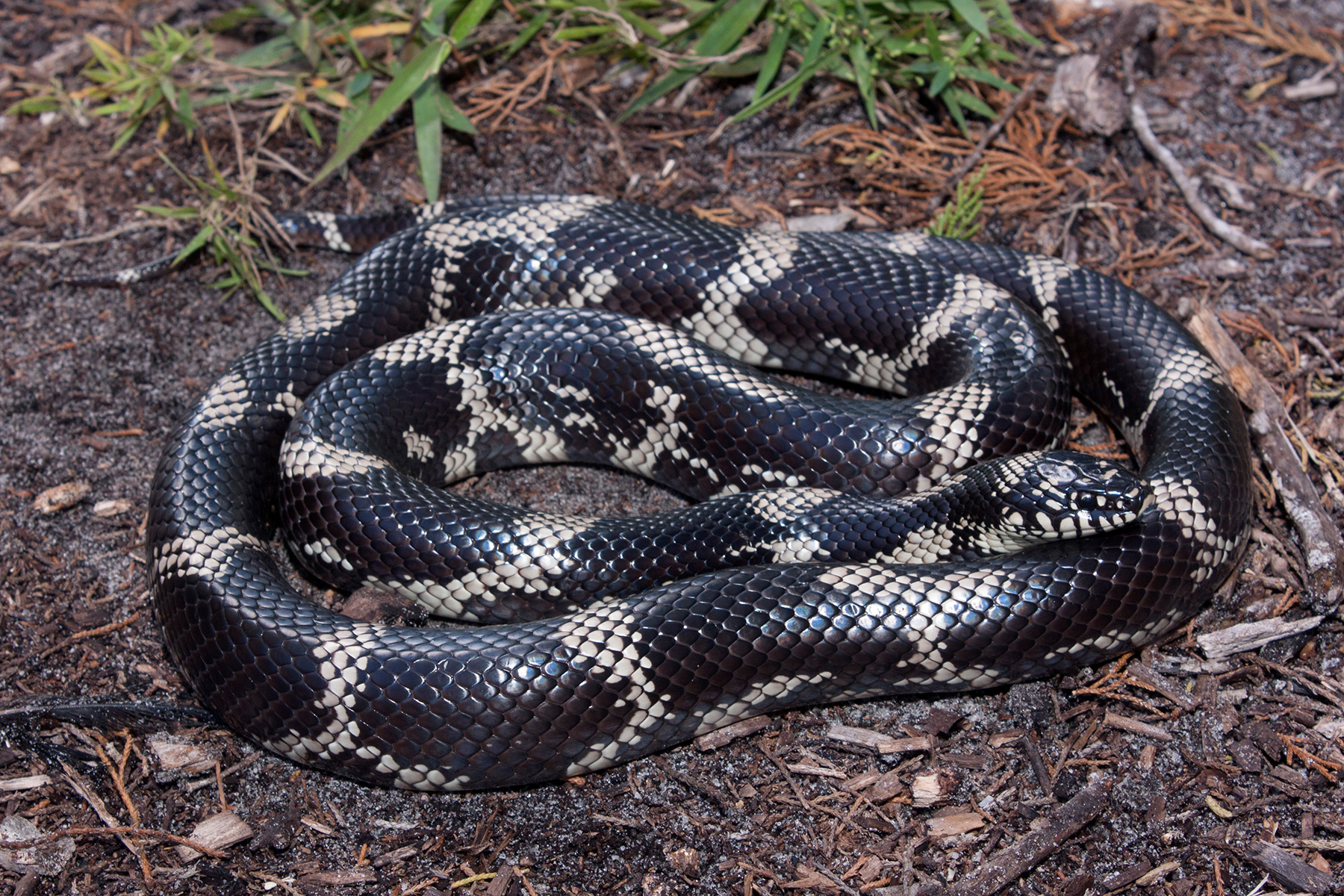
Most adult Eastern Kingsnakes are about 36-48 inches (90-122 cm) in total length. These snakes are solid black to chocolate brown, with several narrow white to yellowish crossbands down the back and a narrow chain-like pattern on the sides. The neck is indistinct and the scales are smooth and shiny. Juveniles resemble adults in color and pattern.
Eastern Kingsnake. Photo courtesy of Todd Pierson.
Range in Florida
Eastern Kingsnakes are found north of a line from Pinellas County to Flagler County and west into the Panhandle, excluding the eastern Apalachicola lowlands south of Telogia Creek. They are occasionally found on barrier islands in the Gulf of Mexico (e.g., the Cedar Keys). Eastern Kingsnakes are also known to interbreed with other kingsnake species throughout large portions of their range.
Assessment of risk to people and pets
Non-venomous. Eastern Kingsnakes are not dangerous to people or pets, but they occasionally bite to defend themselves. These snakes avoid direct contact with people and pets. Virtually all bites occur when people intentionally bother the snakes.
Comparison with other species
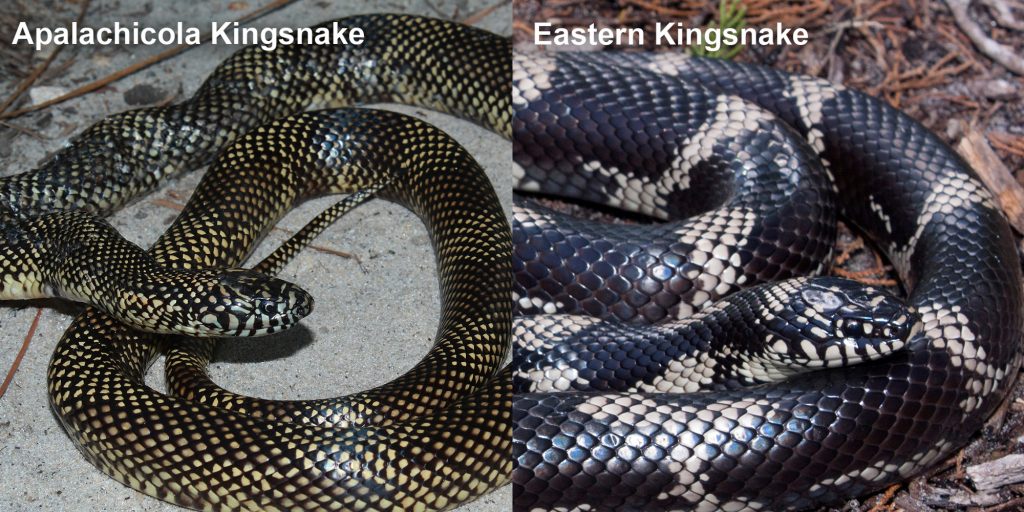
Apalachicola Kingsnake (Lampropeltis meansi)Non-venomous Apalachicola Kingsnakes have either fewer than 26 wide crossbands with considerably lightened interbands or they are non-banded (striped or patternless). They typically have 21 scale rows at midbody.
Apalachicola Kingsnake. Photo courtesy of jakescott/iNaturalist Eastern Kingsnake. Photo courtesy of Todd Pierson.
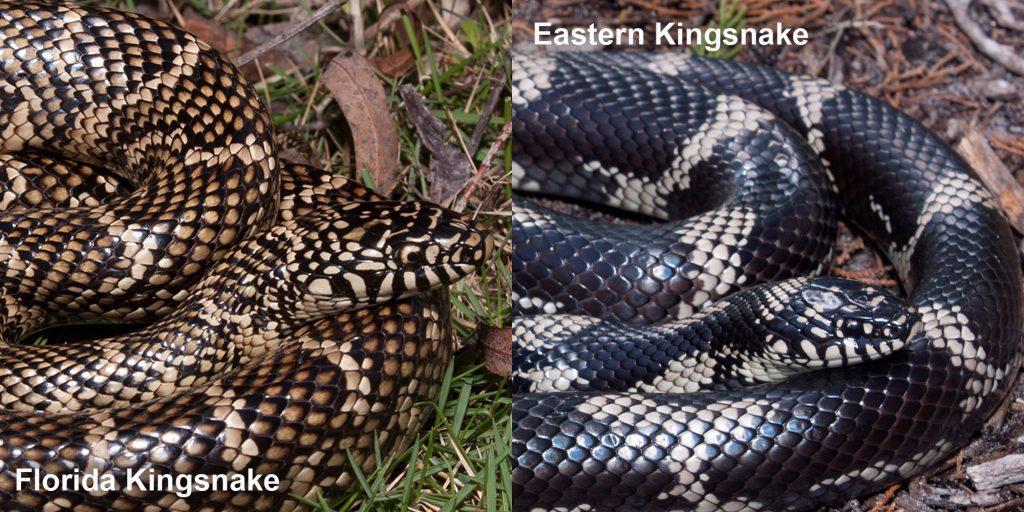
Florida Kingsnake (Lampropeltis floridana)Non-venomous Florida Kingsnakes have more than 34 light crossbands on the body, lightening of the black interband scales, a degenerate lateral chain-like pattern, and usually 23 scale rows at midbody.
Florida Kingsnake. Photo courtesy of Todd Pierson. Eastern Kingsnake. Photo courtesy of Todd Pierson.
Most adult Eastern Kingsnakes are about 36-48 inches (90-122 cm) in total length. These snakes are solid black to chocolate brown, with 19-32 white to yellowish, narrow (1.5-2.5 body scale rows) crossbands down the back and a chain-like pattern on the sides. The belly may have a checkerboard or solid black pattern. The neck is indistinct, and the pupil is round. The scales are smooth and shiny, and there are usually 21 scale rows at midbody. Juveniles resemble adults in color and pattern.
Eastern Kingsnakes are found in pinelands, hardwood hammocks, cypress strands, prairies, marshes, estuaries, and along the edges of streams and lakes. These snakes remain uncommon throughout their range, but they are occasionally found in suburban neighborhoods where development encroaches into favorable habitats.
When approached, Eastern Kingsnakes will typically flee for shelter. However, if they are cornered, they may strike at the attacker and rapidly vibrate the tip of the tail, which produces a buzzing sound in leaf litter. If grabbed or pinned, they may bite and chew while releasing a foul-smelling musk from a pair of glands in the base of the tail. Nonetheless, these snakes are not aggressive and they typically seldom bite.
Eastern Kingsnakes have a broad diet that includes small mammals, birds and their eggs, amphibians, lizards, turtles and their eggs, and other snakes, including venomous snakes and other kingsnakes. Their preferred prey appear to be reptiles and their eggs. Larger prey are typically killed by constriction, whereas smaller prey and eggs are swallowed immediately.
In Florida, females lay around 3-30 white eggs, which typically hatch between June and September. The eggs are often laid in rotting logs, rock crevices, loose debris, or underground in mammal burrows.
Eastern Kingsnakes often interbreed with Florida Kingsnakes (Lampropeltis floridana) in parts of the northern peninsula and with Apalachicola Kingsnakes (Lampropeltis meansi) in parts of the Panhandle. The resulting hybrids often have varying intermediate color patterns between the species involved.
Eastern Kingsnakes consume many species of venomous snakes and appear to be immune to their venom. They can even consume snakes longer than themselves by folding the prey over itself in their stomachs as it is being swallowed.
Numbers of Eastern Kingsnakes in Florida have declined dramatically over the past several decades. Reasons for the declines appear to be due to the combined effects of habitat loss and fragmentation, road mortality, pollution, introduced red fire ants, and overcollection for the pet trade.
County data coming soon.
If you have a new or interesting observation for this species, please email the herpetology staff at the Florida Museum.
Ernst, C.H. and E.M. Ernst. 2003. Snakes of the United States and Canada. Smithsonian Institution Press, Washington, DC. 668 pp.
Krysko, K.L., K.M. Enge, and P.E. Moler. 2019. Amphibians and Reptiles of Florida. University of Florida Press, Gainesville, Florida. 706 pp.
Krysko, K.L., L.P. Nuñez, C.E. Newman, and B.W. Bowen. 2016. Phylogenetics of kingsnakes, Lampropeltis getula complex (Serpentes: Colubridae), in eastern North America. Journal of Heredity 108: 1-13.
Powell, R., R. Conant, and J.T. Collins. 2016. Peterson Field Guide to Reptiles and Amphibians of Eastern and Central North America. Fourth edition. Houghton Mifflin Harcourt Publishing Company, Boston and New York. xiv + 494 pp.
Pyron, R.A. and F.T. Burbrink. 2009. Systematics of the Common Kingsnake (Lampropeltis getula; Serpentes: Colubridae) and the burden of heritage in taxonomy. Zootaxa 2241: 22-32.
Still have questions about snakes or identifications? Feel free to email the herpetology staff at the Florida Museum with your questions or feedback on this profile.
Banner photo courtesy of Todd Pierson. Please credit any photographers on the page and see our copyright policy.