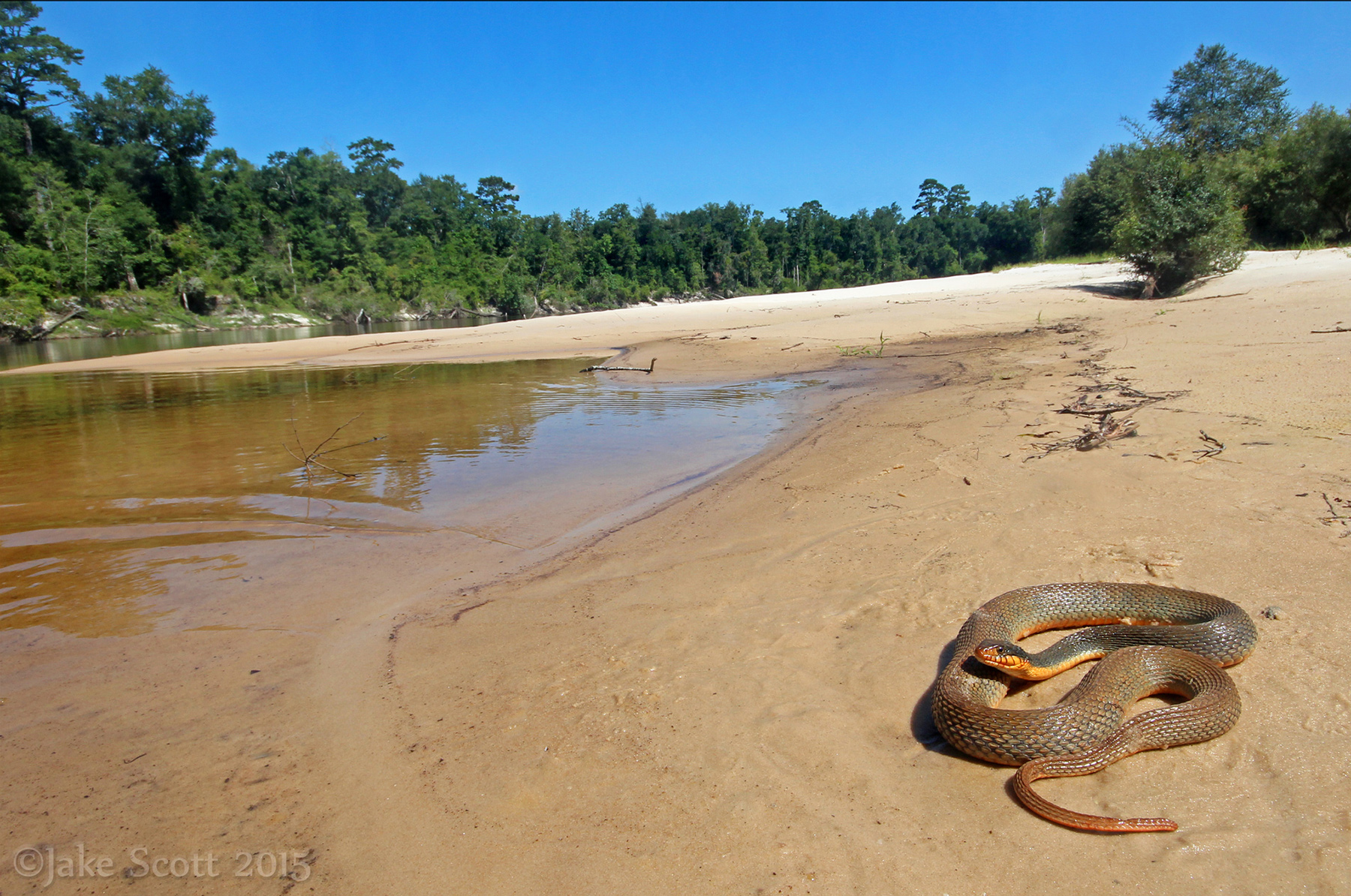
Most adult Plain-bellied Watersnakes are about 30-48 inches (76-122 cm) in total length. Adults are thick-bodied and are uniform greenish gray or reddish-brown in color with no patterning on the back. The belly, neck, and lip scales are almost uniform yellow or reddish-orange. Juveniles are grayish-brown with distinct dark crossbands and blotches. The juvenile pattern fades into the uniform adult coloration within about one year.
Plain-bellied Watersnake in its natural habitat. Photo courtesy of Jake Scott/iNaturalist
Range
Plain-bellied Watersnakes are found primarily in the Panhandle west of the Ochlockonee River. However, an apparently separate population is found east of the Panhandle in parts of the Santa Fe River and Suwannee River.
Assessment of risk to people and pets
Non-venomous. Plain-bellied Watersnakes are not dangerous to people or pets, but they will readily bite to defend themselves. These snakes are not aggressive and avoid direct contact with people and pets. Virtually all bites occur when the snakes are intentionally molested.
Comparison with other species
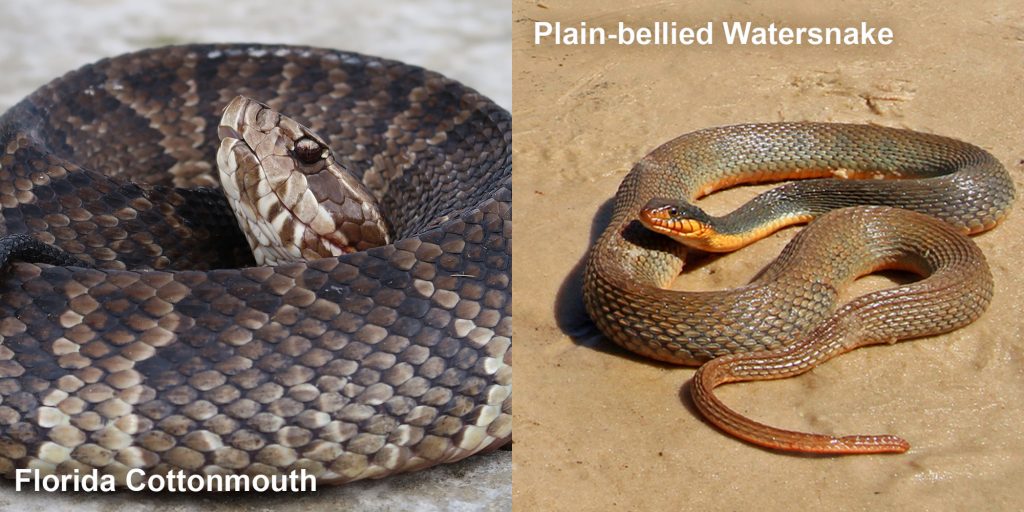
Florida Cottonmouth (Agkistrodon conanti)Venomous If the head is viewed from above, the eyes of cottonmouths cannot be seen while the eyes of watersnakes are visible. Cottonmouths have vertically elliptical (cat-like) pupils, whereas watersnakes have round pupils. Cottonmouths have a facial pit between the nostril and the eye, whereas watersnakes do not.
Florida Cottonmouth. Photo courtesy of Luke Smith. Plain-bellied Watersnake in its natural habitat. Photo courtesy of Jake Scott/iNaturalist
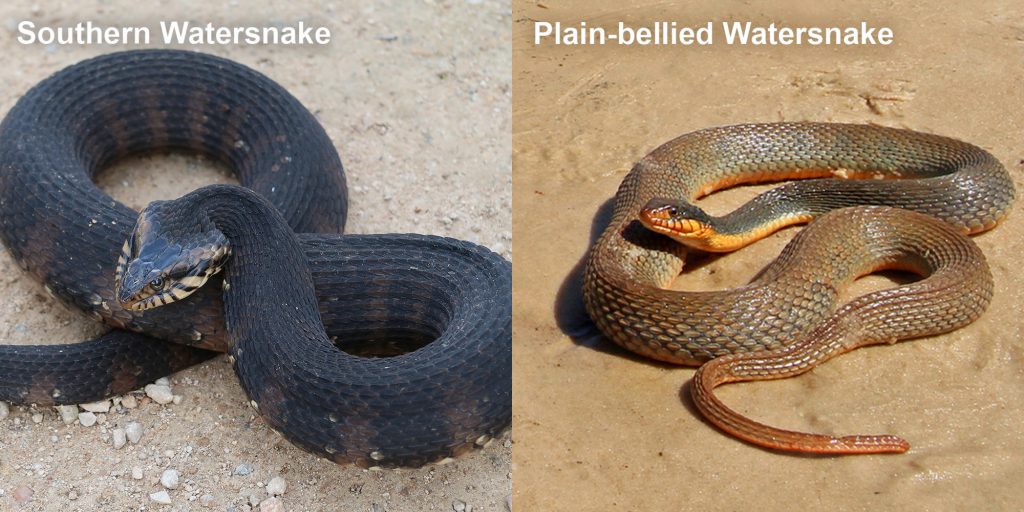
Southern Watersnake (Nerodia fasciata)Non-venomous Southern Watersnakes have broad black, brown, or red crossbands (often bordered with black) down the back and a dark stripe that extends from the eye to the angle of the jaw.
Dark adult southern watersnake performing defensive head flattening. Photo courtesy of Luke Smith. Plain-bellied Watersnake in its natural habitat. Photo courtesy of Jake Scott/iNaturalist
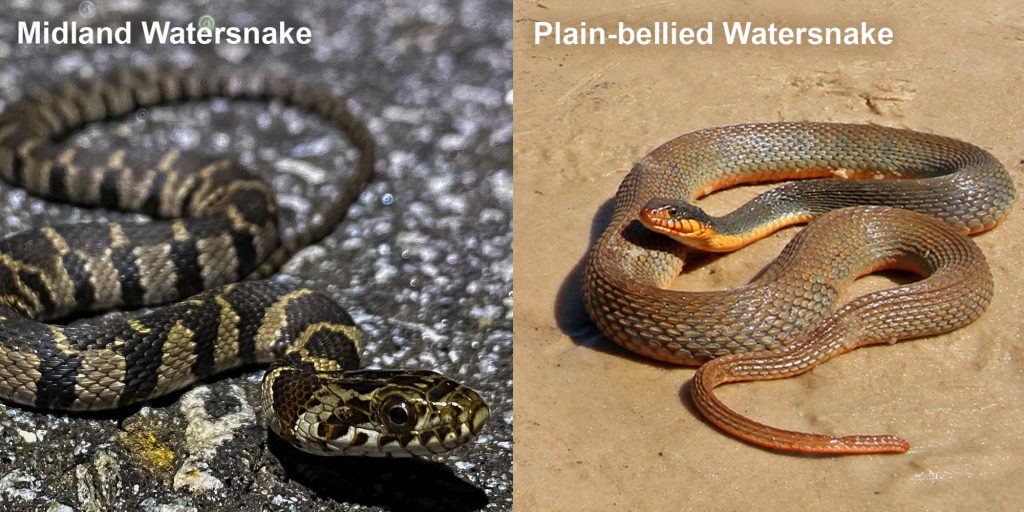
Midland Watersnake (Nerodia sipedon pleuralis)Non-venomous Midland Watersnakes have fewer than 30 darker brown crossbands near the neck, which break up into alternating blotches further down the body, and the belly is yellowish marked with two rows of half-moons.
Midland Watersnake. Photo courtesy of hunterewgley/iNaturalist Plain-bellied Watersnake in its natural habitat. Photo courtesy of Jake Scott/iNaturalist
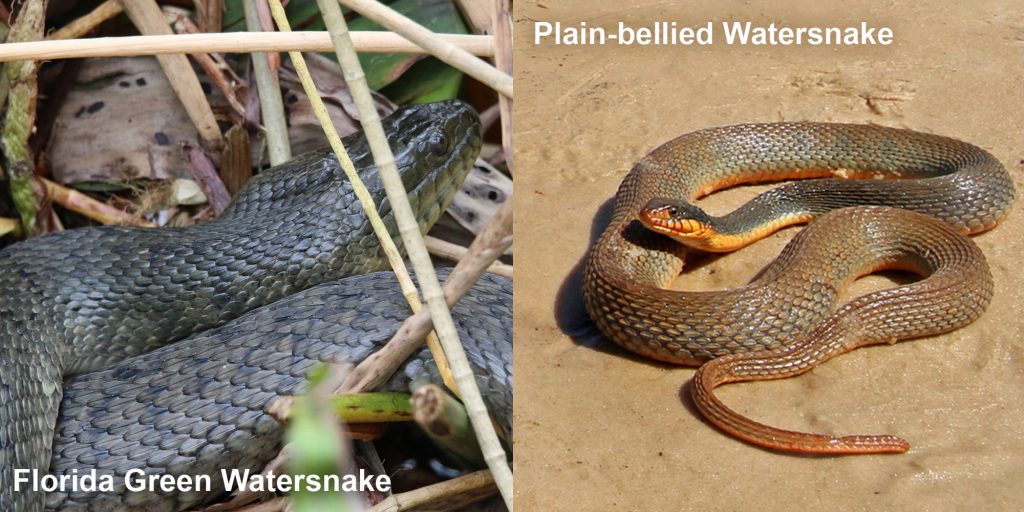
Florida Green Watersnake (Nerodia floridana)Non-venomous Florida Green Watersnakes are dark green and have scales between the eye and the scales on the upper lip.
Florida Green Watersnake. Photo courtesy of johnjinjohny/iNaturalist Plain-bellied Watersnake in its natural habitat. Photo courtesy of Jake Scott/iNaturalist
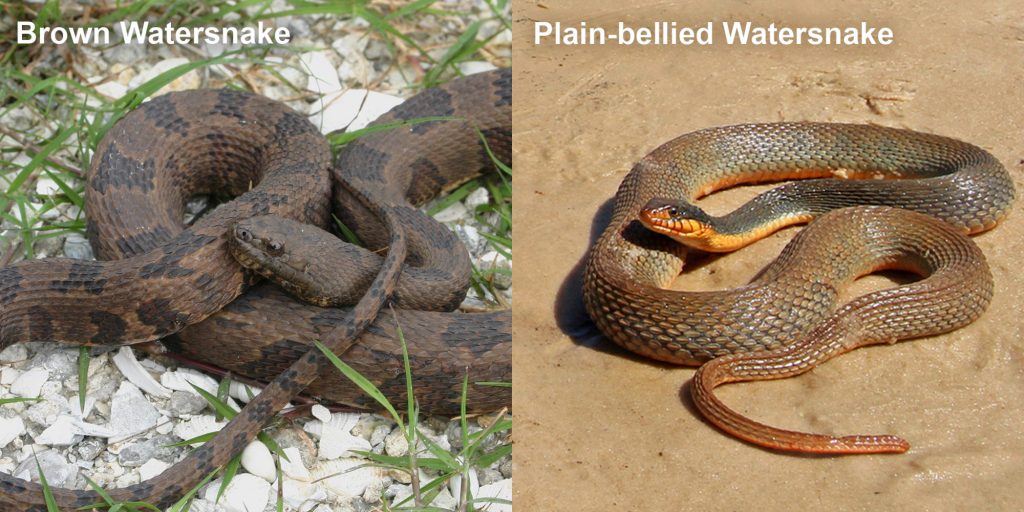
Brown Watersnake (Nerodia taxispilota)Non-venomous Brown Watersnakes have squarish dorsal blotches along the entire body.
Adult brown watersnake. Photo courtesy of Todd Pierson. Plain-bellied Watersnake in its natural habitat. Photo courtesy of Jake Scott/iNaturalist
Most adult Plain-bellied Watersnakes are about 30-48 inches (76-122 cm) in total length, with a record length of 64.4 inches (163.6 cm). Adults in the western Panhandle are greenish gray in color with faint to no markings on the back. The belly, neck, and lip scales are almost uniform yellow. Adults east of the Panhandle are reddish-brown with no patterning on the back. The belly, neck, and lip scales are reddish-orange. These are thick-bodied snakes with strongly keeled scales arranged in 23 rows at midbody. The pupil is round. Juveniles are grayish-brown with distinct dark crossbands and blotches, and they have pale yellow or pinkish bellies. The juvenile pattern fades into the uniform adult coloration within about one year.
In Florida, Plain-bellied Watersnakes can be found in rivers, lakes, ponds, swamps, springs, and cypress strands.
When approached, Plain-bellied Watersnakes will typically flee for shelter or into the water. However, if they are cornered, both juveniles and adults will strike at the attacker. If grabbed or pinned, they will typically flatten their head and body, bite the attacker, and release a foul-smelling musk from a pair of glands in the base of the tail. Nonetheless, these snakes are not aggressive, and striking is only used in defense as a last resort.
Plain-bellied Watersnakes feed primarily on amphibians and freshwater fishes. These snakes are not constrictors and overpower their prey by simply grabbing it in their jaws and quickly swallowing it alive.
In Florida, females typically give live birth to 2-55 young in late summer or early fall.
Although active mainly at night, Plain-bellied Watersnakes may be found during the day basking on banks or on limbs of trees and shrubs extending over the water.
Unfortunately, many watersnakes are killed every year by Florida residents who mistake them for cottonmouths. Although cottonmouths occur throughout Florida, they are not nearly as abundant as the eight species of harmless watersnakes (species in the genus Nerodia) that occur in many of the same habitats. If you see a snake in or near the water, most likely it is a harmless watersnake, and it is best for everyone involved to simply leave it alone.
County data coming soon.
If you have a new or interesting observation for this species, please email the herpetology staff at the Florida Museum.
Ernst, C.H. and E.M. Ernst. 2003. Snakes of the United States and Canada. Smithsonian Institution Press, Washington, DC. 668 pp.
Gibbons, J.W. and M.E. Dorcas. 2004. North American Watersnakes: A Natural History. University of Oklahoma Press, Norman, Oklahoma. 438 pp.
Krysko, K.L., K.M. Enge, and P.E. Moler. 2019. Amphibians and Reptiles of Florida. University of Florida Press, Gainesville, Florida. 706 pp.
Powell, R., R. Conant, and J.T. Collins. 2016. Peterson Field Guide to Reptiles and Amphibians of Eastern and Central North America. Fourth edition. Houghton Mifflin Harcourt Publishing Company, Boston and New York. xiv + 494 pp.
Still have questions about snakes or identifications? Feel free to email the herpetology staff at the Florida Museum with your questions or feedback on this profile.