Florida Rough Greensnake, Northern Rough Greensnake, Rough Green Snake, Green Snake
Basic description
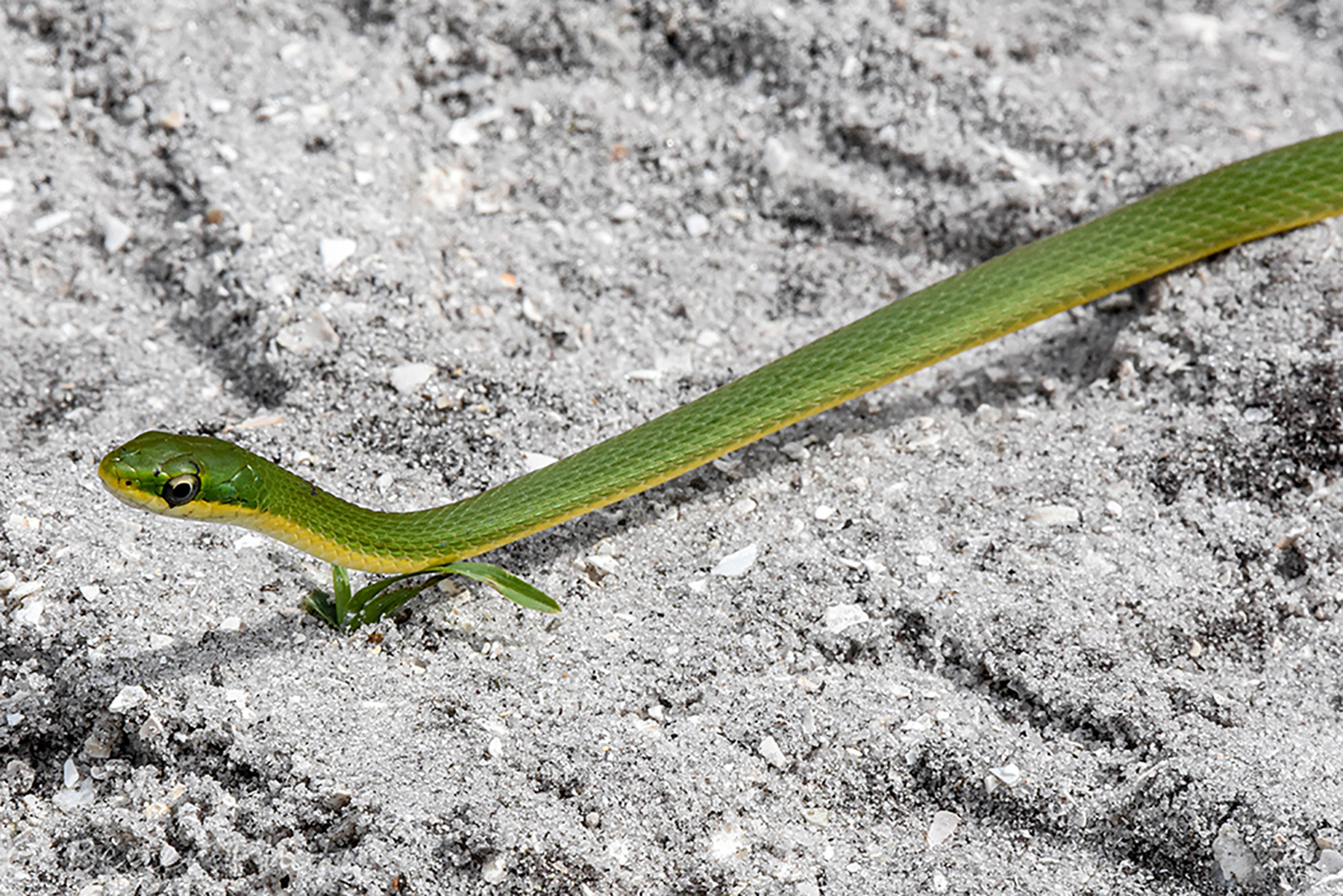
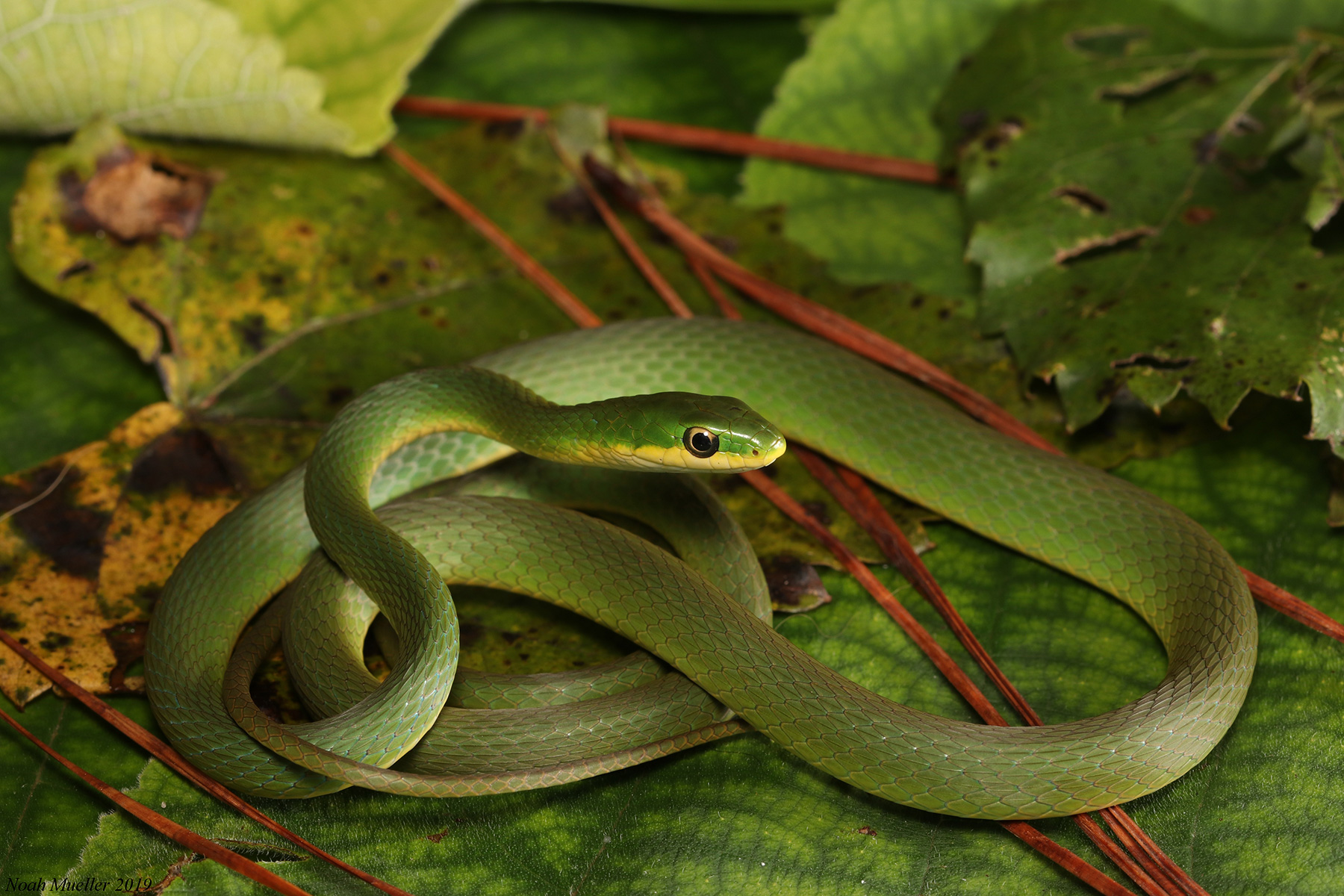
Most adult Rough Greensnakes are about 14-33 inches (35-82 cm) in total length. This is a long and slender bright green snake with a cream to yellow belly. The belly color extends onto the chin and lips. Juvenile coloration is similar to adults but not as vivid.
Rough Greensnake. Photo courtesy of Bester Photo.
Rough Greensnake. Photo courtesy of Noah Mueller.
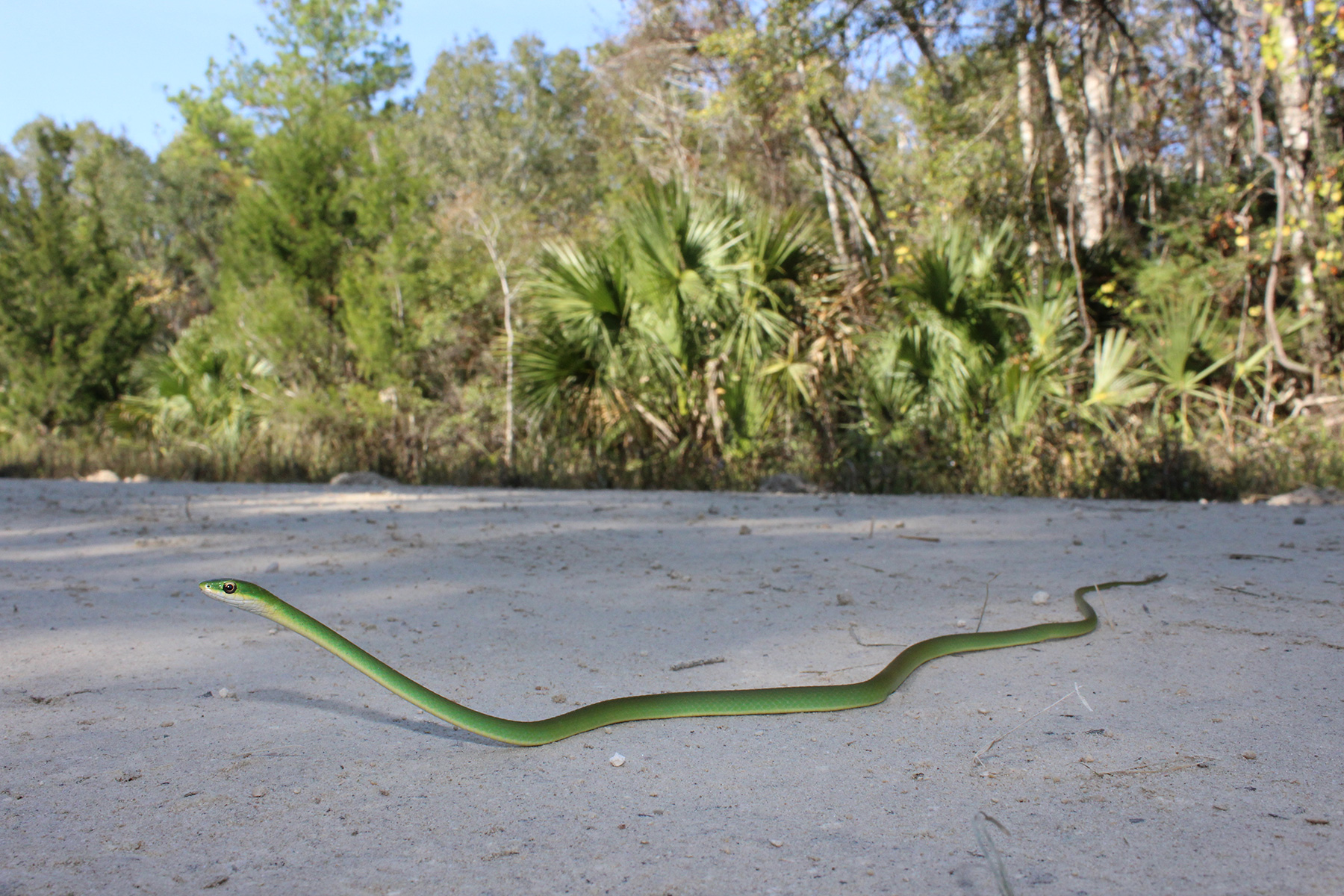
Rough Greensnake in its natural habitat. Photo courtesy of Luke Smith.
Range in Florida
Rough Greensnakes are found throughout mainland Florida in every county. They also occur throughout the Florida Keys.
Assessment of risk to people and pets
Non-venomous. Rough Greensnakes are not dangerous to people or pets. The snakes are not aggressive and avoid direct contact with people and pets.
Comparison with other species
There are no other (native) bright green snakes in Florida.
Most adult Rough Greensnakes are about 14-33 inches (35-82 cm) in total length, with a record length recorded of 46 inches (116 cm). This is a long and slender bright green snake with a cream to yellow belly. The belly color extends onto the chin and lips. The body scales are strongly keeled (each scale has a prominent raised ridge), and they are arranged in 17 scale rows at midbody. The tail is extremely long and thin. The pupils are round. Juvenile coloration is similar to adults but not as vivid.
Rough Greensnakes are often found in mixed hardwood and bottomland forest as well as hardwood hammocks. They are fairly abundant in maritime forest and dune meadows of Atlantic coast barrier islands. These snakes primarily live in trees and prefer densely leafed trees and shrubs, often at the edges of fields and around ponds. Adults of this species are often found in suburban neighborhoods where development encroaches into favorable habitats.
When approached, Rough Greensnakes will typically freeze and sway as if perhaps mimicking a branch blowing in the wind. If further threatened, they will quickly flee for shelter among the dense foliage in which they live. If captured, Rough Greensnakes will often squirm and release foul-smelling musk from two glands in the base of the tail. Occasionally when threatened, they will open their mouth to display the dark interior, but these snakes rarely if ever bite in defense.
Rough Greensnakes are diurnal (active during the daytime) predators and feed on a wide variety of spiders and insects. These snakes are not constrictors. Prey are slowly stalked, grasped quickly, repositioned, and swallowed alive head first.
Females lay around 1-14 white eggs, which typically hatch between July and August. The eggs are often laid inside rotting logs and stumps, under rocks, or in tree holes or other cavities well above the ground. However, much of what is known about the reproductive biology of Rough Greensnakes comes from parts of their range outside of Florida.
Northern Rough Greensnake (Opheodrys aestivus aestivus) Northern Rough Greensnakes occur in the northern peninsula and Panhandle. The scales in the second midbody row of dorsal scales are usually not keeled, and these snakes are slightly smaller than Florida Rough Greensnakes.
Florida Rough Greensnake (Opheodrys aestivus carinatus) Florida Rough Greensnakes occur in the central and southern peninsula and in the Florida Keys. The scales in the second midbody row of dorsal scales are usually keeled, and these snakes are slightly larger than Northern Rough Greensnakes.
Superb camouflage involving both coloration and behavior renders Rough Greensnakes extremely difficult to spot among the vegetation in which they live. As a result, even healthy populations of these bright green snakes can easily go unnoticed.
County data coming soon.
If you have a new or interesting observation for this species, please email the herpetology staff at the Florida Museum.
Ernst, C.H. and E.M. Ernst. 2003. Snakes of the United States and Canada. Smithsonian Institution Press, Washington, DC. 668 pp.
Krysko, K.L., K.M. Enge, and P.E. Moler. 2019. Amphibians and Reptiles of Florida. University of Florida Press, Gainesville, Florida. 706 pp.
Plummer, M.V. 1981. Habitat utilization, diet and movements of a temperate arboreal snake, Opheodrys aestivus. Journal of Herpetology 15: 425-432.
Powell, R., R. Conant, and J.T. Collins. 2016. Peterson Field Guide to Reptiles and Amphibians of Eastern and Central North America. Fourth edition. Houghton Mifflin Harcourt Publishing Company, Boston and New York. xiv + 494 pp.
Still have questions about snakes or identifications? Feel free to email the herpetology staff at the Florida Museum with your questions or feedback on this profile.
Banner photo courtesy of Noah Mueller. Please credit any photographers on the page and see our copyright policy.