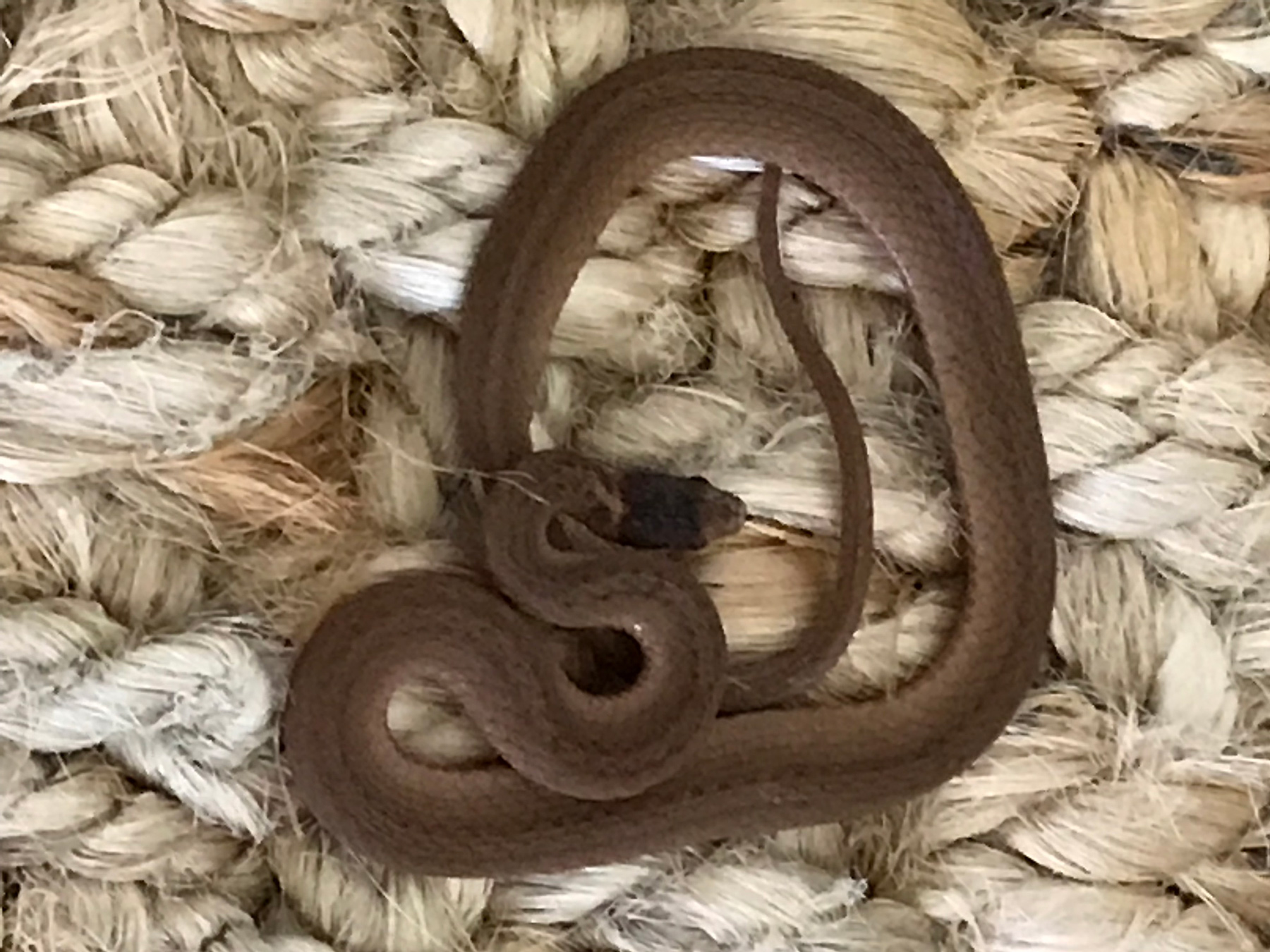
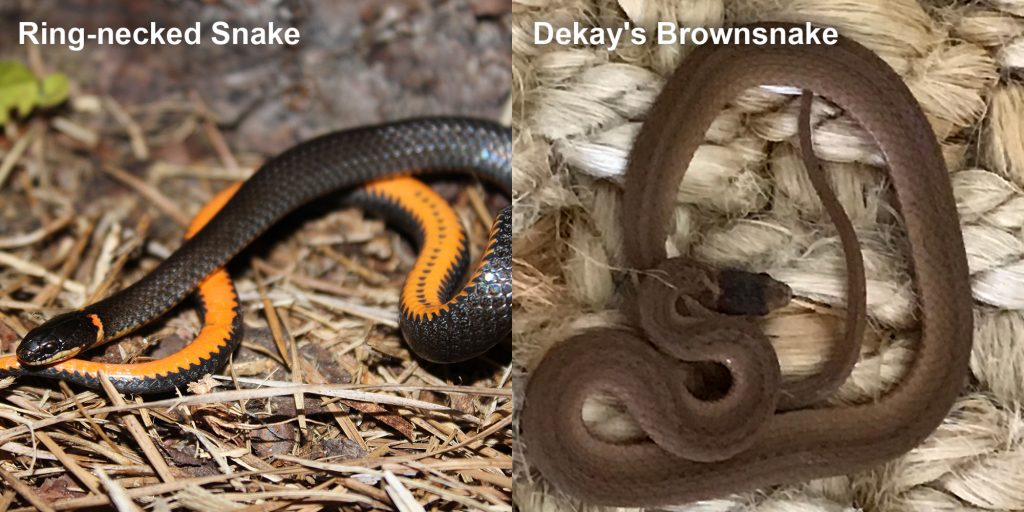
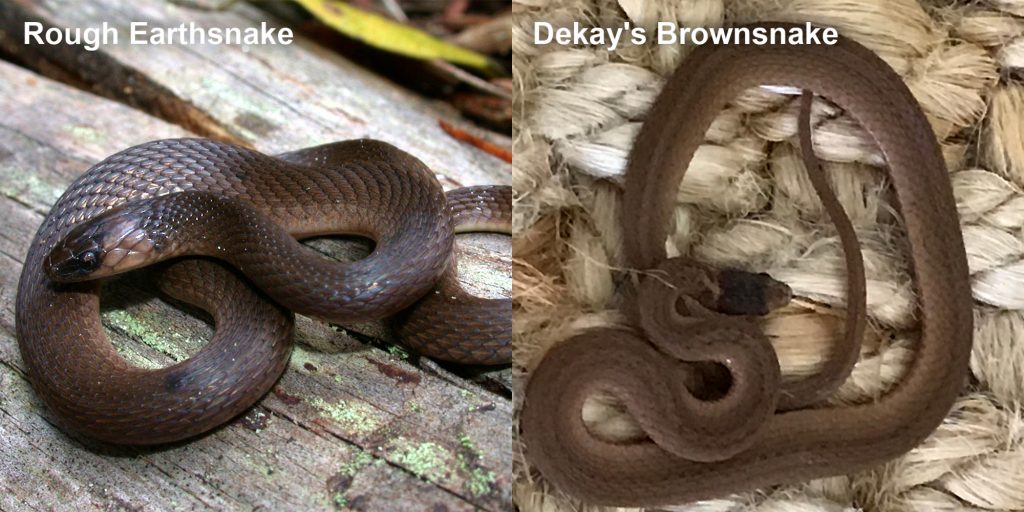
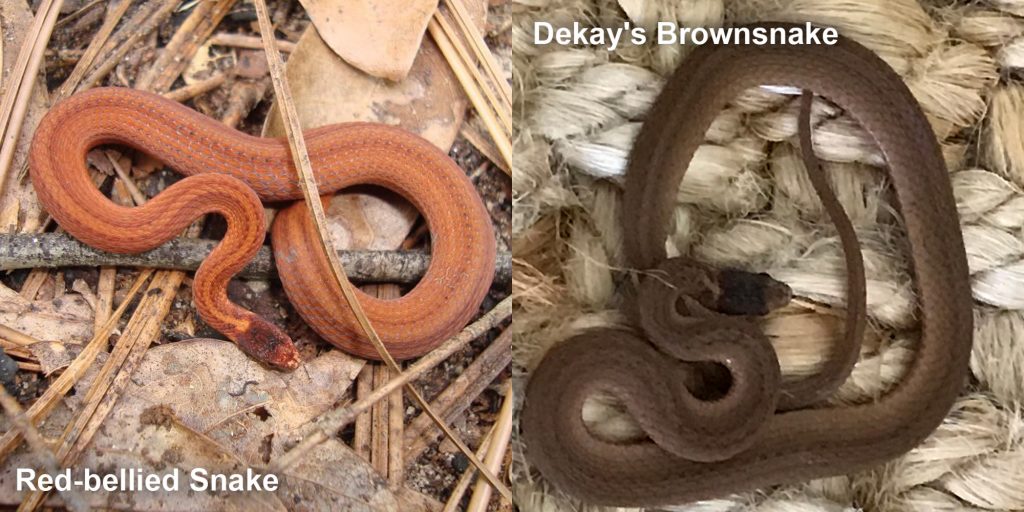
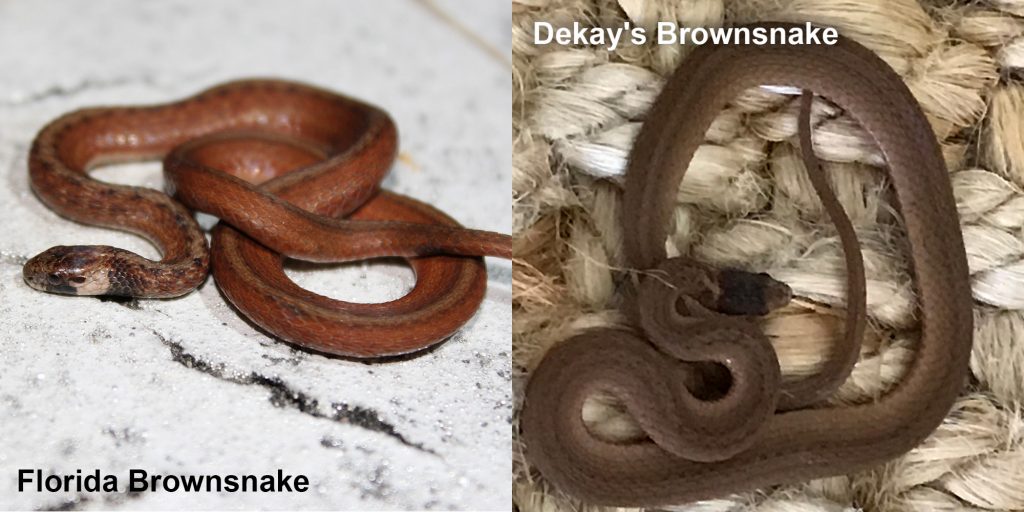
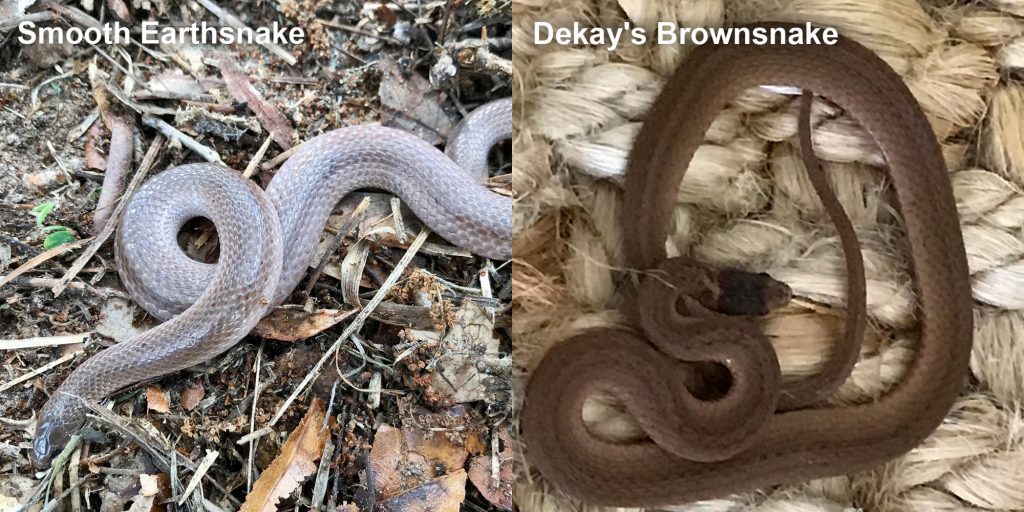
Most adult Dekay’s Brownsnakes are about 9-13 inches (23-33 cm) in total length. These snakes are small, thin, and may be grayish-brown or light brown. Adults have a faint light stripe running down the middle of the back that is boarded on both sides by parallel rows of small black spots, which may be connected across the back. The back of the neck and top of the head are dark brown, and there is a light band across the back of the head. Juveniles are dark brown with a whitish band across back of head.
Adult Dekay’s Brownsnakes in Florida are about 9-13 inches (23-33 cm) in total length, with a record length recorded of 20.8 inches (52.7 cm). These snakes are small, thin, and may be grayish-brown or light brown. Adults have a faint light stripe running down the middle of the back that is boarded on both sides by parallel rows of small black spots, which may be connected across the stripe on the back. The back of the neck and top of the head are dark brown, and there is a light band across the back of the head between the darker areas. The upper lip scales are whitish except for a small dark marking under each eye. The belly is tannish to pinkish, often with black dots along the edges. The scales on the back are keeled (each scale has a prominent raised ridge) and arranged in 17 scale rows at midbody. The pupil is round. Juveniles are dark brown with a whitish band across back of head.
Dekay’s Brownsnakes are commonly found in most terrestrial and wetland habitats throughout their range. However, these secretive snakes often remain hidden beneath leaflitter, logs, rocks, or other surface cover. Adults and juveniles of this species are often found in suburban neighborhoods where development encroaches into favorable habitats.
These inoffensive snakes typically do not bite in defense, but stressed snakes will rarely strike with the mouth closed as a bluff. If captured or molested, Dekay’s Brownsnakes will often squirm vigorously, flatten their bodies, and release foul-smelling musk from two glands in the base of the tail.
Dekay’s Brownsnakes are typically active at night and early evening, and they feed primarily on earthworms and slugs. However, they will occasionally eat snails, small fish, frogs, tadpoles, frog eggs, spiders, insects, and insect larvae. These snakes are not constrictors. Prey are typically grasped, quickly repositioned, and swallowed alive.
In Florida, females give live birth to around 3-41 young in late summer or early fall. The newborns are tiny and only measure about 4 in (10 cm) in total length.
Dekay’s Brownsnakes can be locally abundant in parts of their range, including in residential areas. However, these small and secretive snakes are rarely seen unless they are disturbed from their hiding places during yardwork or heavy rains. Otherwise, they are typically found by actively searching for them under rocks, logs, or other surface cover.
County data coming soon.
If you have a new or interesting observation for this species, please email the herpetology staff at the Florida Museum.
Ernst, C.H. and E.M. Ernst. 2003. Snakes of the United States and Canada. Smithsonian Institution Press, Washington, DC. 668 pp.
Krysko, K.L., K.M. Enge, and P.E. Moler. 2019. Amphibians and Reptiles of Florida. University of Florida Press, Gainesville, Florida. 706 pp.
Powell, R., R. Conant, and J.T. Collins. 2016. Peterson Field Guide to Reptiles and Amphibians of Eastern and Central North America. Fourth edition. Houghton Mifflin Harcourt Publishing Company, Boston and New York. xiv + 494 pp.
Still have questions about snakes or identifications? Feel free to email the herpetology staff at the Florida Museum with your questions or feedback on this profile.