Ribbon Snake, Blue-striped Ribbonsnake, Peninsula Ribbonsnake, Common Ribbonsnake
Basic description
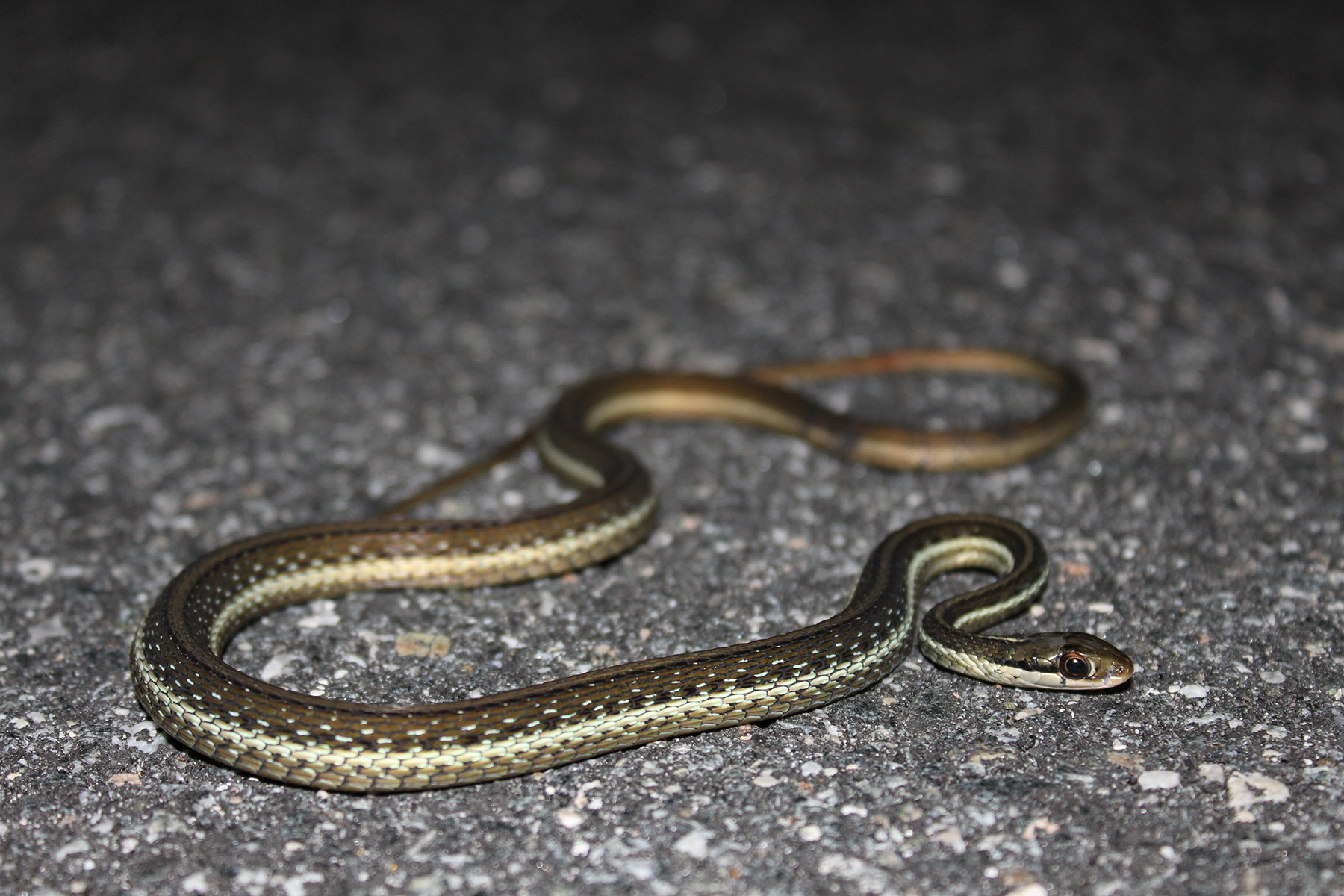
Most adult Eastern Ribbonsnakes are about 18-26 inches (46-66 cm) in total length. These are extremely slender snakes with three thin light-colored stripes running the length of the body. Adults have a background color of brown, olive-black or bluish-black with one thin stripe running down the middle of the back and one stripe running along each side. The stripes vary in color and are typically yellow, tannish-brown, blue, or whitish-green. However, stripes are absent in some individuals. The tail is long and thin. The head is only slightly distinct from the neck. The eyes are large and prominent. There is a distinct white spot in front of each eye. The coloration of juveniles is similar to that described for adults.
Eastern Ribbonsnake. Photo courtesy of Luke Smith.
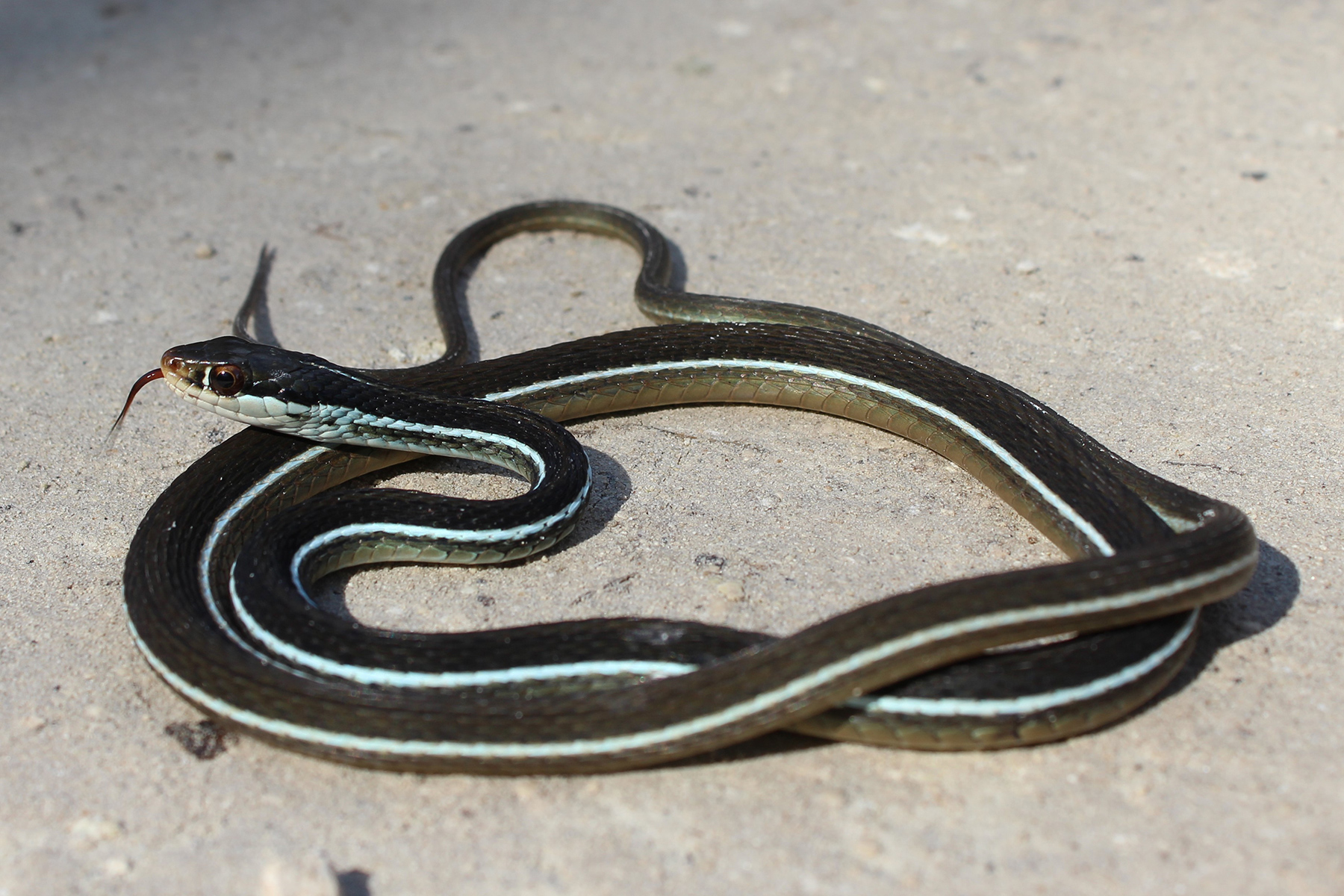
Blue-striped subspecies of the Eastern Ribbonsnake. Photo courtesy of Luke Smith.
Range in Florida
Eastern Ribbonsnakes are found throughout mainland Florida in every county. Although they are found in the Florida Keys, they appear to be absent in the Middle Keys.
Assessment of risk to people and pets
Non-venomous. Eastern Ribbonsnakes are not dangerous to people or pets, and they rarely bite to defend themselves. These docile snakes are not aggressive and avoid direct contact with people and pets. Eastern Ribbonsnakes are not dangerous to people or pets, and they rarely bite to defend themselves. These docile snakes are not aggressive and avoid direct contact with people and pets.
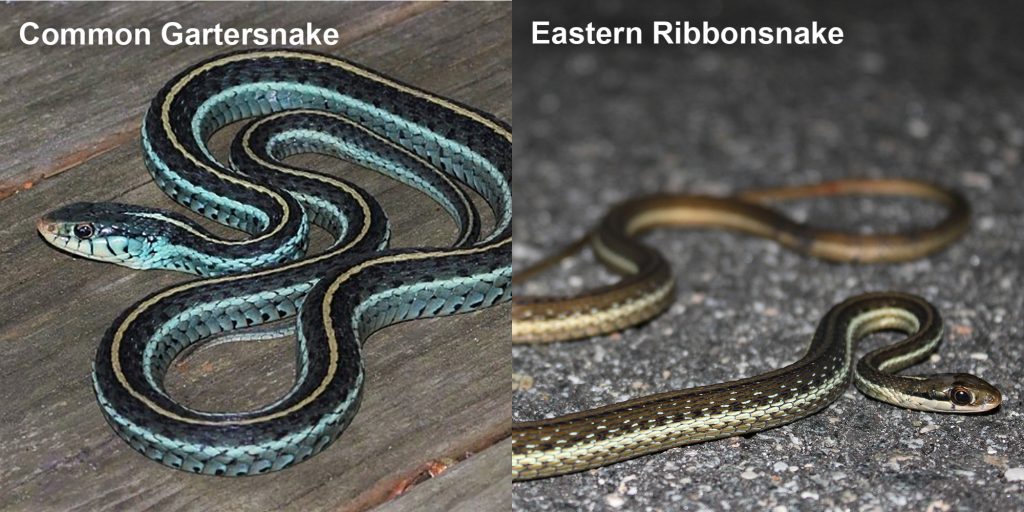
Common Gartersnake. Photo courtesy of Noah Mueller. Eastern Ribbonsnake. Photo courtesy of Luke Smith.
Most adult Eastern Ribbonsnakes are about 18-26 inches (46-66 cm) in total length, with a record length of 41 inches (104 cm). These are extremely slender snakes with three thin light-colored stripes running the length of the body. Adults have a background color of brown, olive-black or bluish-black with one thin stripe running down the middle of the back and one stripe running along each side on scale rows 3 and 4 above the belly. The stripes vary in color and are typically yellow, tannish-brown, blue, or whitish-green. However, stripes are absent in some individuals. Light-colored flecking may be visible along the sides of the body between the back and side stripes. The body scales are keeled (each scale has a prominent raised ridge) and arranged in 19 dorsal rows at midbody. The belly is uniform yellowish-green and without any markings. The tail is long and thin. The head is only slightly distinct from the neck. The upper lip scales are white and unmarked. The eyes are large and prominent, and the pupil is round. There is a distinct white spot in front of each eye. The tongue is bright red with a black tip. The coloration of juveniles is similar to that described for adults.
Eastern Ribbonsnakes can be found in pinelands, hardwood hammocks, cypress strands, prairies, marshes, bogs, and any wet grassy habitats, especially along the edges of any standing or flowing bodies of water. Adults and juveniles of this species are often found in suburban neighborhoods where development encroaches into favorable habitats.
When approached, ribbonsnakes will typically flee for shelter or into the water, relying on speed and agility to avoid capture. If grabbed or pinned, they will thrash about and release a foul-smelling musk from a pair of glands in the base of the tail. Rarely will they attempt to bite in defense as a last resort.
Eastern Ribbonsnakes are typically diurnal (active during the day) and feed mostly on frogs, salamanders, and freshwater fishes. Ribbonsnakes are not constrictors and overpower their prey by simply grabbing it in their jaws and quickly swallowing it alive.
In Florida, females give live birth to 3-26 young between July and September.
Blue-striped Ribbonsnake (Thamnophis saurita nitae) Blue-striped Ribbonsnakes primarily occur in Florida along the Gulf coast from eastern Wakulla County in the Panhandle south to Hernando County in the central peninsula. However, individuals are occasionally found outside of that main Gulf-coast area. It is not understood why individuals in this area are blue!
Peninsula Ribbonsnake (Thamnophis saurita sackenii) Peninsula Ribbonsnakes are found throughout most of mainland Florida east of the Apalachicola River, with the possible exception of the Gulf coast region from eastern Wakulla County in the Panhandle south to Hernando County in the central peninsula. They occur in the Florida Keys with the possible exception of the Middle Keys.
Common Ribbonsnake (Thamnophis saurita saurita) In Florida, Eastern Ribbonsnakes occur in the Panhandle west of the Apalachicola River.
County data coming soon.
If you have a new or interesting observation for this species, please email the herpetology staff at the Florida Museum.
Ernst, C.H. and E.M. Ernst. 2003. Snakes of the United States and Canada. Smithsonian Institution Press, Washington, DC. 668 pp.
Krysko, K.L., K.M. Enge, and P.E. Moler. Amphibians and Reptiles of Florida. 2019. University of Florida Press, Gainesville, Florida. 706 pp.
Powell, R., R. Conant, and J.T. Collins. 2016. Peterson Field Guide to Reptiles and Amphibians of Eastern and Central North America. Fourth edition. Houghton Mifflin Harcourt Publishing Company, Boston and New York. xiv + 494 pp.
Rossman, D.A., N.B. Ford, and R.A. Seigel. 1996. The Garter Snakes: Evolution and Ecology. First edition. University of Oklahoma Press, 336 pp.
Still have questions about snakes or identifications? Feel free to email the herpetology staff at the Florida Museum with your questions or feedback on this profile.
Banner photo courtesy of Luke Smith. Please credit any photographers on the page and see our copyright policy.