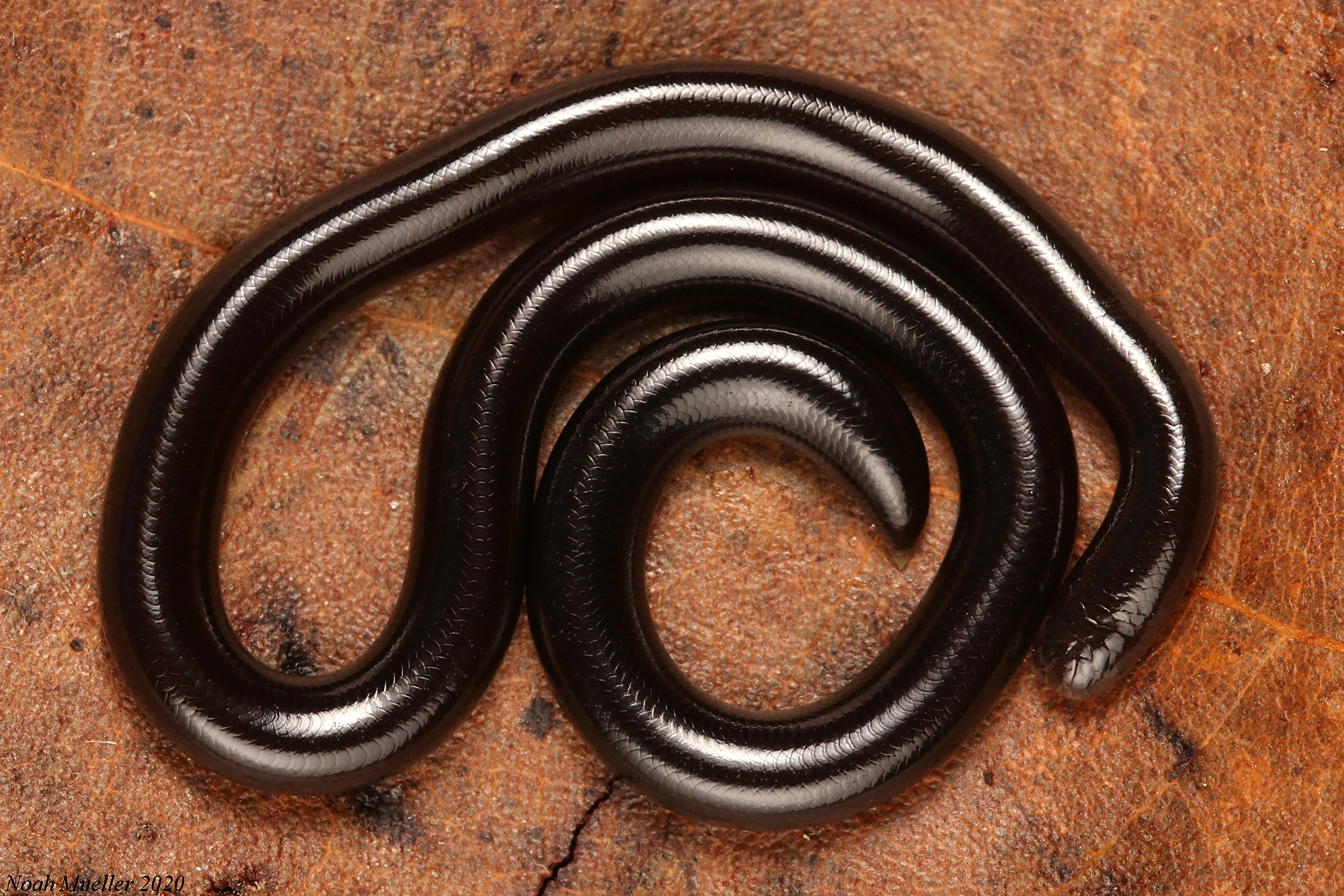
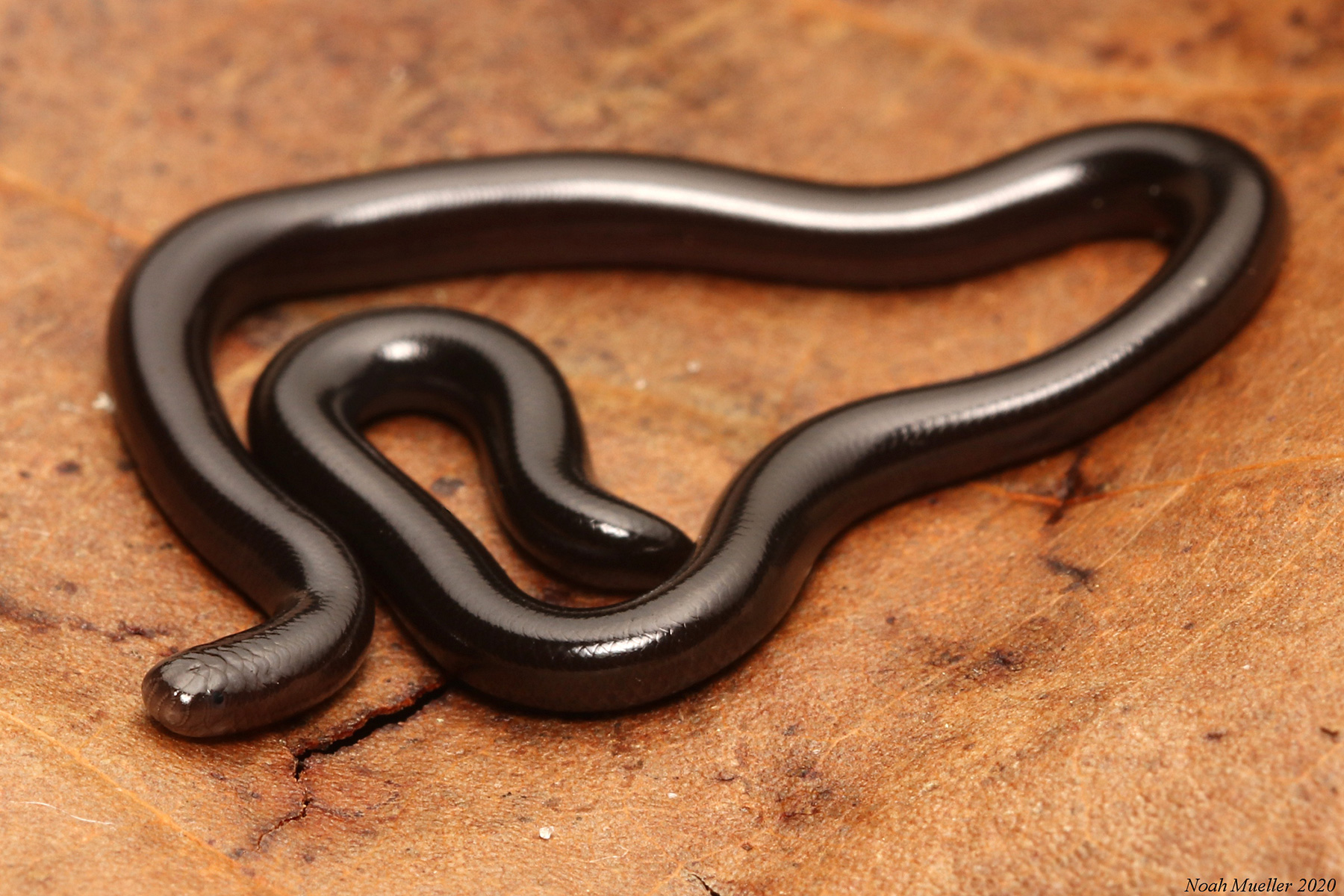
Most adult Brahminy Blindsnakes are about 4.4–6.5 inches (11.2–16.5 cm) in total length. These snakes are small, thin, and shiny silver gray, charcoal gray, or purple. The head and tail both appear blunt and can be difficult to distinguish from each other. Juvenile coloration is similar to that of adults.
Brahminy Blindsnake. Photo courtesy of Noah Mueller.
Brahminy Blindsnake. Photo courtesy of Noah Mueller.
Range in Florida
Brahminy Blindsnakes are a non-native species from southern Asia that was first reported in Miami, Florida in the 1970s. They have now been found from Key West north throughout much of the peninsula, and there are isolated records from the Panhandle.
Assessment of risk to people and pets
Non-venomous. Brahminy Blindsnakes are not dangerous to people or pets.
Comparison with other species
None, but Brahminy Blindsnakes are frequently mistaken for earthworms. Although both are shiny, if you look carefully you will see that earthworms are segmented (i.e., they have rings around the body) and Brahminy Blindsnakes are not segmented. Also, if you look closely at the head, you can see these snakes stick out their tiny tongues while being held.
Most adult Brahminy Blindsnakes are about 4.4–6.5 inches (11.2–16.5 cm) in total length, with a record length recorded of 6.8 inches (17.3 cm). These snakes are small, thin, and shiny silver gray, charcoal gray, or purple. The head and tail both appear blunt and can be difficult to distinguish from each other. The neck is indistinct, and the eyes are reduced to small patches of dark pigment beneath the scales. The tail is tipped with a tiny pointed spur. The head scales are similar in size and shape to body scales. The belly is grayish to brown, and the belly scales are not enlarged. The scales on the body are tiny, smooth, and shiny, and there are 14 scale rows along the entire body. Juvenile coloration is similar to that of adults.
Brahminy blindsnakes are excellent burrowers and can be found in loose soil and leaf litter, sawdust piles, rotting logs, and beneath rocks and other surface debris. However, these snakes are occasionally found in trees. Adults and juveniles are often found in urban and agricultural areas, where they can be locally abundant.
During the hot summer months in Florida, we receive numerous reports from people finding small, shiny black, thread-like snakes on the floors inside their houses, especially the bathrooms. People are understandably surprised to see them because these snakes are not native to Florida and because they typically live their lives hidden underground or under debris. These snakes are called Brahminy Blindsnakes or Flowerpot snakes (Indotyphlops braminus) because they often get accidentally transported in the soil of potted plants. These non-venomous and harmless snakes were introduced into Miami in the 1970s and have since expanded their range to currently include at least 34 Florida counties! It’s important to note that these tiny snakes are totally harmless to people and pets. However, we certainly understand that their presence inside a house can make some people uncomfortable.
So why are these tiny snakes entering peoples’ houses? And what can be done about it? There are three main reasons why you might find blindsnakes in your house: shelter, food, and accidental transport.
Shelter – Certain areas of houses (e.g., spaces between walls and under carpet or other flooring) can provide good hiding places for these tiny snakes. Bathrooms are especially comfortable for them since these areas are often warm with high humidity. If blindsnakes are entering your house from outside, it is important to carefully locate and seal any outside openings that would allow them to enter. Remove any surface items or debris near your house that would serve as hiding places.
Food – Once inside your house, these snakes might survive and reproduce if there is food available. Blindsnakes eat termites and the eggs and pupae of ants. Therefore, if you are seeing several of these snakes inside, it is possible that you have ants or termites living in or near your house as well. It might be helpful to call a pest control company to search for these insects. Removing the ants and termites would not only help with removing the blindsnakes, but it would also help your house.
Accidental transport – If you still seeing blindsnakes in your house and are sure your house is well sealed and that you don’t have any ants or termites in or near your house, it’s possible that you are accidentally bringing the snakes into your house yourself. The snakes often hide undetected in potting soil and concealed around the roots of plants. So if you have brought potted plants into your house, they could have contained these tiny snakes, which subsequently crawled out of the pot and into your house. A careful check of your plants might reveal the source!
We hope you find this information helpful. If you have any further questions, please contact us.
These tiny snakes do not bite in defense. If uncovered, Brahminy Blindsnakes will typically try to escape by burrowing. If captured, they may press the pointed but harmless tail tip against the attacker, and they may release foul-smelling musk from two glands in the base of the tail.
Brahminy blindsnakes feed on the eggs, larvae, and pupae of ants and termites.
This species is parthenogenetic (all individuals are females). Therefore, unfertilized eggs begin cell division without sperm from a male. Females can lay 1–8 eggs, and the offspring are genetically identical to the mother.
These snakes are unknowingly transported around the world in the soil of ornamental plants. As a result, these snakes are commonly found in gardens and potted plants, earning them the nickname “Flowerpot snakes.” In fact, Brahminy Blindsnakes have become the most wide-ranging terrestrial reptile species in the world.
Some people believe that this snake has a stinger on the tip of the tail. However, this is not the case. The pointy scale on the tip of the tail is completely harmless.
Alachua, Brevard, Broward, Charlotte, Citrus, Clay, Collier, Duval, Escambia, Franklin, Hendry, Highlands, Hillsborough, Indian River, Lake, Lee, Leon, Levy, Manatee, Marion, Miami-Dade, Monroe, Okaloosa, Orange, Palm Beach, Pasco, Pinellas, Polk, Saint Johns, Saint Lucie, Sarasota, Seminole, Sumter, Volusia
If you have a new or interesting observation for this species, please email the herpetology staff at the Florida Museum.
Ernst, C.H. and E.M. Ernst. 2003. Snakes of the United States and Canada. Smithsonian Institution Press, Washington, DC. 668 pp.
Krysko, K.L., K.M. Enge, and P.E. Moler. 2019. Amphibians and Reptiles of Florida. University of Florida Press, Gainesville, Florida. 706 pp.
Powell, R., R. Conant, and J.T. Collins. 2016. Peterson Field Guide to Reptiles and Amphibians of Eastern and Central North America. Fourth edition. Houghton Mifflin Harcourt Publishing Company, Boston and New York. xiv + 494 pp.
Still have questions about snakes or identifications? Feel free to email the herpetology staff at the Florida Museum with your questions or feedback on this profile.
Banner photo courtesy of Noah Mueller. Please credit any photographers on the page and see our copyright policy.