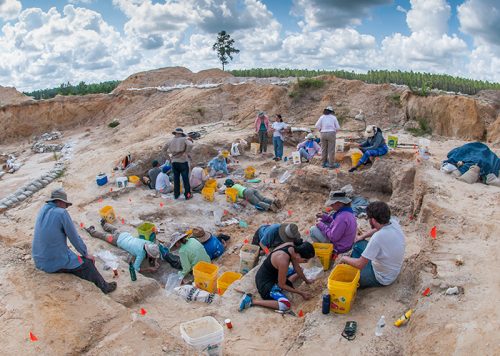
Fossil Collecting Localities in Florida


Locations


The fossil record of Florida stretches from some time in the Eocene Epoch about 50 million years ago to the tail end of the Pleistocene Epoch when the last North American glacier melted 8500 years ago. The oldest fossils in Florida are found in the Eocene limestones laid down when Florida was beneath a shallow sea. These limestones contain many invertebrate fossils as well as the occasional vertebrate fossil from the seacows, whales, and porpoises that swam the Eocene seas.

Near the end of the Oligocene Epoch, 25 or 30 million years, areas in north and central Florida began to rise above sea level for the first time. These new land areas were quickly occupied by terrestial animals that moved into them from the rest of continent both north and west of what is now Florida. There are in Florida only a small number of sites dating from the late Oligocene, and since the fauna from them are not well known, these sites are probably the most interesting in Florida. Oligocene sites are known from the Suwannee River, the Brooksville area, and localities in Pinellas and Hillsborough Counties.

By the early Miocene Epoch, 24 million years ago, larger areas of Florida were available to terrestrial inhabitation. This is shown by the increased number of Miocene sites found around the state. Thomas Farm, a site owned by the University of Florida, dates from the early Miocene, about 20 million years ago. It is a rich site with horses, camels, protoceratids, rhinos, dogs, amphicyons, and oreodonts. Lizards, turtles, snakes, and the oldest known alligator species, as well as birds, bats, and amphibians are known from the Thomas Farm site. The Bone Valley Formation sites in Polk and Hillsborough Counties are well known late Miocene sites. The Love site in Alacha County and fossils found in the Hawthorne Formation of North and Central Florida are Miocene as well.

Pliocene sites are generally found along the southwest Florida coast. A good example would be the shellpits near Sarasota. Port Charlotte also produces Pliocene material as does certain locations along the Santa Fe River, but as a rule, Pliocene sites are not as common as Miocene or later Pleistocene sites.

Pleistocene sites are probably the most common type of fossil site in Florida. That is not surprising since at times during the Pleistocene, Florida's land area was almost twice the present area. Most caves, quarries, and rivers in Florida produce Pleistocene fossils. The east coast, from the St. Johns River above Jacksonville to West Palm Beach, has long been a rich area for Pleistocene fossils.

Have a look at the following articles on collecting in different types of sites in Florida. The majority of the fossils found in Florida probably come from the state's rivers. A close second would be the mines and quarries of the state. Phosphate mines from the vast Bone Valley Formation in Polk, Hillsborough, and Hardee Counties produce prodigeous numbers of fossils. Shellpits on the southwest coast and coastal marls of the east coast also produce many fossils. At the bottom of the list are beaches and caves. Both types of localities have added substantially to Florida's fossil record.


Cave Collecting

The state of Florida is a vast karst region. Named after an area near Trieste in Yugoslavia, karst is an area where the underlying rock is primarily carbonate in nature, either limestone or dolomite. Groundwater and carbon dioxide which combine to produce a weak solution of carbonic acid, will, over long periods of time dissolve and carve out numerous voids in the carbonate rock. These voids are known commonly as caves, sink-holes, solution tubes, or other named features of carbonate rock. Anyone who has ever visited a cave or limerock quarry is familiar with the numerous, interlocking fissures, voids, and channels that can be seen in exposed limestone walls.

In Florida, the oldest limestones, which underlie the entire state, are the Eocene limestones laid down more than 40 million years ago. In a few areas, younger limestones, such as the Suwannee limestone which dates from the Oligocene, lie on top of the Eocene limestone. Since, cave formation, and other limestone dissolution features are ongoing processes, we can find caves and other features which date from Pleistocene all the way back to the Eocene. Caves, sinkholes, solution tubes and other karst features attract animals in numerous ways. Some animals such as snakes, bats, birds, rodents, and raccoons, and many predators find shelter in them. Others hunt for food in the caves. There are even unintentional visitors to caves---those who fall into them---and those who are dragged there as dinner.

With all this biological traffic occurring in and out of caves and other karst features, it is not surprising that these locations have become rich repositories for fossils. Sediments cones formed from silt and soil runoff from surface openings into caves, or other karst features invariably produce fossils, large and small. A cave near Newberry, in Alachua County, has sediment cones which have yielded many late Pleistocene animals. One particularly large cone is beneath a blocked opening that once led to the ground surface. In the sediments of this unique cone were found the usual tortoises and armadillos, animals which seem overly prone to such mishaps, but in this particular case the sediments yielded some surprising visitors---several baby mastodons that had fallen into the opening.

Fossils are found in other areas of caves as well as sediment cones. A Pleistocene bear, dire wolf, or cat that had once used the cave as a den could have left its own bones there to be covered by silts and organic detritus which find their way into caves. In the limestone, itself, can be found both invertebrate and marine vertebrate fossils.

As well a variety of locations where fossils are found in caves, there are also various kinds of fossil preservation found within a cave. Late Pleistocene fossils recovered from sediment cones of Florida caves may be composed of collagen-rich sub fossil bone that is soft, punky and often very damp. Other bones may be exposed to the drip of calcium rich water in some caves and become extremely hard and highly mineralized. Preservation of invertebrates and marine vertebrates found in the limestone is generally quite good.

Each type of fossil preservation may require its own special collection techniques. The silty sand and clays found in sediment cones is usually friable and can be dug with small hand tools. Protective jackets made with plaster bandages work well for removing bones from the sediment cones. Since bones from these deposits tend to be very soft, it might be necessary in some cases to apply a consolidant to harden the bone before removal. As a rule, the damp specimens and high humidities found in Florida caves preclude the use of acetone based hardeners such as Butvar 76 or Acryloid B-72. Instead, water based resins such as Rhoplex or Acrysol are most compatible with the damp bone. Acrysol is especially good as a damp environment consolidant since it can be easily re-dissolved later with acetone or plain ethanol. At that point, a routine hardener such as Butvar or Acryloid B-72 can be applied to the specimen.

One method developed by Dan Chaney, from the Smithsonian, to collect extremely fragile fossils is the PEG method. It is a method of last resort, because once PEG is applied to a specimen, no other glues or hardeners will adhere to it or be absorbed. PEG or polyethylene glycol, also called Carbowax, is a water soluble wax used to preserve wooden artifacts. It also has a very low melting temperature, ca. 115 degrees F. Chaney melted PEG in a small can over a Sterno heat source, then brushed or poured the melted wax over the fragile specimen. The wax cools in minutes and a plaster jacket is then applied. The specimen is then flipped over, matrix removed, and more hot wax applied, and more plaster bandage to complete the jacket. Back in the lab, excess wax can be removed by placing absorbent paper towels over the specimen and heating in an oven.

Collecting the harder, more mineralized specimens from the limestone, or the calcified, or silicified specimens under drip or moving water will require use of hammer, chisel, and protectective goggles, techniques used in surface collecting. Common sense would suggest that only specimens which can be removed from a cave should be excavated. Like the proverbial boat built in the basement, excavating and jacketing a mammoth skull in a cave is an exercise in futility if the entrance to the cave is barely large enough for a person to exit.

Caving can be dangerous. Individuals who want to collect fossils in caves should be trained in the rules and procedures of safe caving. Contact a branch of the Florida Speleological Society (P.O. Box 12581, Gainesville, FL 32604-2581) for more information . Remember that caves, as well as being unique, irreplaceable geological features, are fragile ecosystems that can be permanently harmed by your activities. Leave them as you found them.

Butvar, Acrysol, Acryloid B-72, and Carbowax are available from:

Conservation Materials Ltd. 1165 Marietta way Sparks, NV 89431 Tel: (702) 331-0582
Here are some helpful references:
Chaney, D.S. 1988. Techniques used in collecting fossil veretebrates on the Antarctic Peninsula. GSA Memoir 169.21-24.
Grady, Frederick. 1994. "Collecting in Caves" in Vertebrate Paleontological Techniques, Vol. 1, Edited by Patrick Leiggi and Peter May, Cambridge Univ. Press
--------------------. 1981. The Hamilton Cave Jaguar. Potomac Caver 24(4):3.
--------------------. 1981. Saber toothed cats from West Virginia caves. D.C. Speleograph 37(9):9

Back to Fossil Collecting Localities in Florida Page

Back to Paleontological Resources Main Page


topic under preparation

Back to Fossil Collecting Localities in Florida Page

Back to Paleontological Resources Main Page