Staff Spotlight
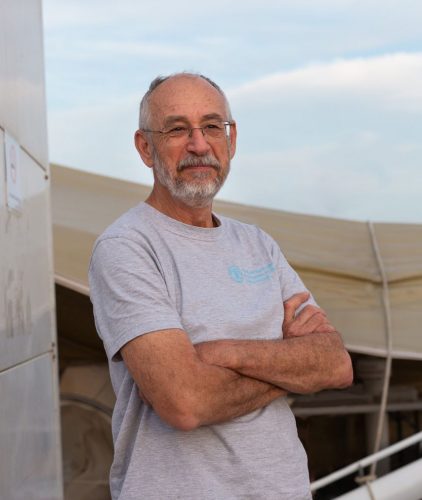
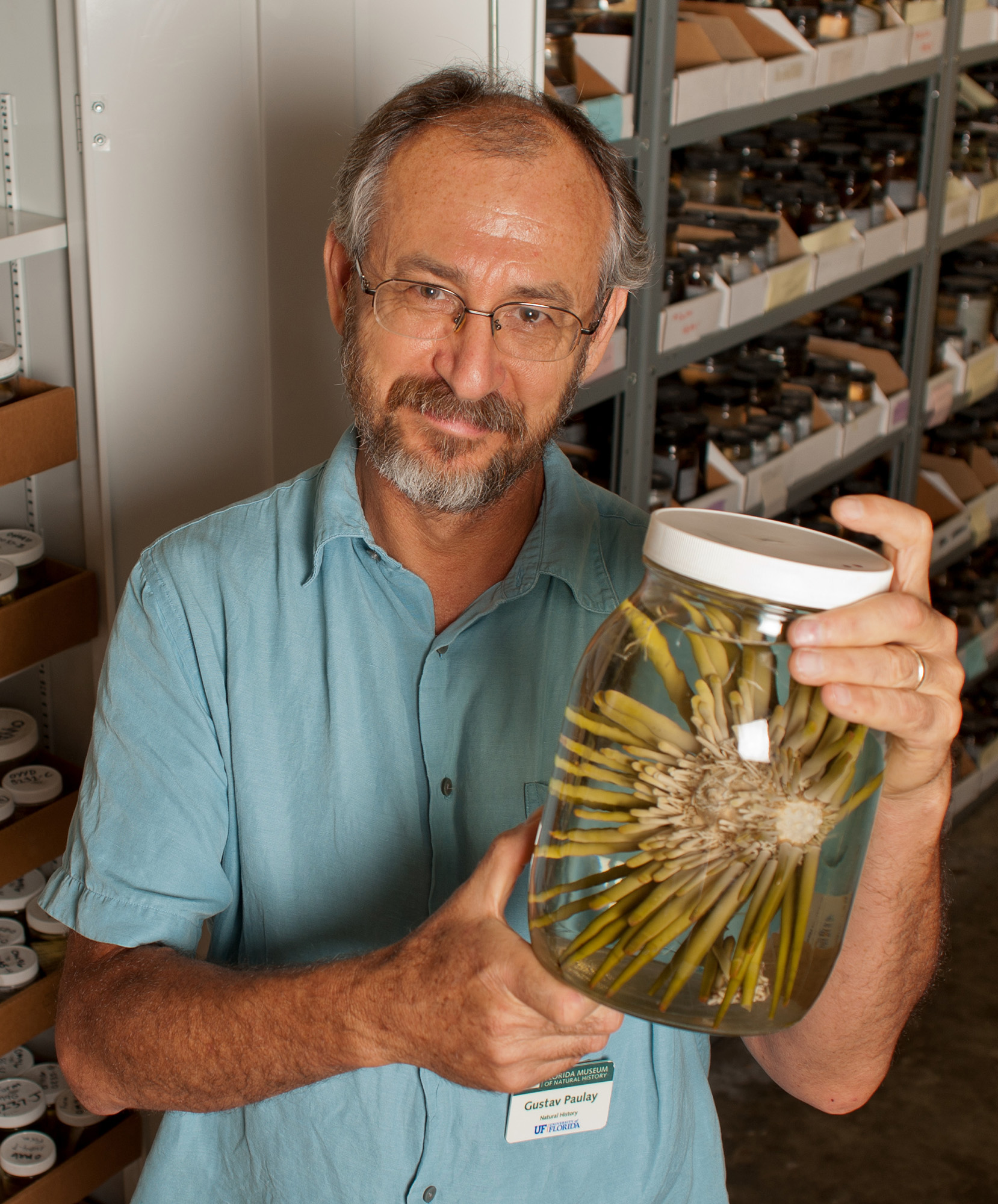
Dr. Gustav Paulay
Curator of Marine Malacology
278 Dickinson Hall
Museum Road & Newell Drive
Gainesville, FL 32611
(352) 273-1948
Email: paulay@flmnh.ufl.edu
Ph.D. University of Washington, 1988
FLMNH Invertebrate Zoology (Malacology & Marine Invertebrates)
Concurrent Appointments
Adjunct Associate Professor of Zoology
Research Interests
Biogeography, evolution, systematics, and natural history of invertebrates. Marine biodiversity and biogeography, especially of tropics and coral reefs. Dynamics of species diversity and distributions; marine speciation. Large-scale marine biodiversity surveys. Island biology; marine and terrestrial biota of Pacific islands.
Ongoing Fieldwork
Our lab has an active field program on tropical coral reefs, with focus on the tropical Pacific. Field projects are focused on questions of biogeography and speciation on the one hand, and large-scale biodiversity surveys to document invertebrate species on the other. The former by its nature is pursued across as many islands and reefs as practical, throughout the Indo-west Pacific. The latter is focused on selected sites: Guam and neighboring islands in Micronesia, and Moorea and neighboring islands in Southeast Polynesia. All field work includes a substantial sampling component, with species documented by in situ photos, field notes, and preserved for morphological and genetic study. Focus is usually on cnidarians, mollusks, crustaceans, and echinoderms, although other phyla are also included.
Courses Taught
- Invertebrate Zoology - fall term, all years
- Advanced Invertebrate Zoology - fall term, all years
- Graduate/advanced undergrad reading group on biogeography, evolution & systematics, focused on marine invertebrates - fall and spring terms
Graduate Students
Machel Malay, Ph.D. Student
Email: mmalay - add "@ufl.edu" for full address
- Interested in the molecular systematics, taxonomy, speciation and biogeography of the
coral-dwelling barnacles (Balanomorpha: Pyrgomatidae). The Pyrgomatidae are a poorly-studied
family of balanomorph barnacles that have very successfully radiated as epizootic symbionts on living
corals; they are highly derived morphologically and some species have gone to the extreme of adopting
a completely parasitic and host-specific lifestyle. Coral barnacles exhibit remarkable trends in morphological
specialization for symbiosis including fusion and reduction of skeletal elements. These trends towards
morphological specialization are believed to be paralleled by evolutionary trends towards increasing host
specificity and restricted geographic ranges. However, these hypotheses have never been tested because
of a lack of a phylogenetic framework, a gap that I seek to fill in my dissertation research.
Machel's Research Page
François Michonneau, Ph.D. Student
Email: fmichon add "@flmnh.ufl.edu" for full address
- I'm broadly interested in the creation and maintenance of marine invertebrate biodiversity (systematics,
speciation, biogeography and community ecology). I've started my PhD in August 2006 as a trainee of the PEET
project "Sea cucumbers on coral reefs: systematics of aspidochirotid holothurians". This project aims to revise the
order Aspidochirotida thanks to a collaborative effort by using morphological and molecular systematics.
François's Research Page & Selected publications
John Starmer, Ph.D. Student
Email: jstarmer - add "@yahoo.com" for full address
- Interested in undertstanding how modern and historical processes interact
to create and limit biodiversity at local and regional scales. Studying
aspidochirote sea cucumber phylogenetics (Synallactidae, Holothuriidae, Stichopodidae)
with a focus on the stichopodids. Would like to determine if habitat specificity
influenced the group's ability to diversify in shallow water tropical versus
shallow-temperate and deep water environments.
John's Research Page & Selected Publications
Representative Publications
Fukami, H.; Budd, A. F.; Paulay, G.; Solé-Cava, A.; Iwao, K.; Knowlton, N. 2004. Conventional taxonomy obscures deep evolutionary divergence between Pacific and Atlantic corals. Nature 427: 832-835.
Paulay, G. (ed.) 2003. The marine biodiversity of Guam and the Marianas. Micronesica 35-36: 1-682.
Paulay, G., Meyer, C. 2002 Diversification in the tropical Pacific: comparisons between marine and terrestrial systems and the importance of founder speciation. Integrative & Comparative Biology 42: 922-934
Paulay, G.; Kirkendale, L. ; Lambert, G.; Meyer, C. 2002. Anthropogenic biotic interchange in a coral reef ecosystem: a case study from Guam. Pacific Science 56: 403-422
Paulay, G. 2001. Benthic ecology and biota of Tarawa Atoll lagoon: Influence of equatorial upwelling, circulation, and human harvest. Atoll Research Bulletin 487: 1-38
Paulay, G. 1997. Diversity and distribution of reef organisms. In: Birkeland, C. (ed.). Life and death of coral reefs. Chapman & Hall, NY, pp. 298-353
Paulay, G. 1996. Dynamic clams: changes in the bivalve fauna of Pacific islands as a result of sea level fluctuations. American Malacological Bulletin 12: 45-57
Paulay, G. 1994. Biodiversity on oceanic islands: its origin and extinction. American Zoologist 34: 134-144
Paulay, G., McEdward, L. R. 1990. A simulation model of island reef morphology: the effects of sea level fluctuations, growth, subsidence, and erosion. Coral Reefs 9: 51-62
Paulay, G. 1990. Effects of late Cenozoic sea-level fluctuations on the bivalve faunas of tropical oceanic islands. Paleobiology 16: 415-434
