From the Field to the Museum…
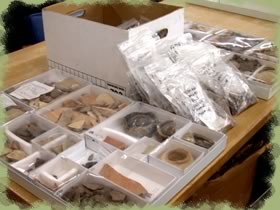 When artifacts are excavated in the field, they are put in bags marked with the precise location they came from. Once in the lab, however, they must be separated by material type, cleaned, re-labeled and put in acid-free containers.
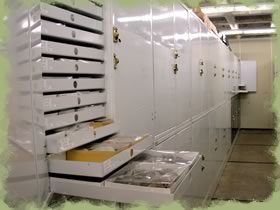 Once the artifacts are cleaned, sorted, recorded and put in containers, they are organized into these special museum storage cabinets. The St. Augustine collections take up 47 of these cabinets.
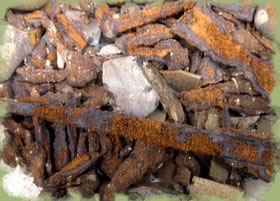 Without treatment, iron begins to deteriorate as soon as it is removed from the ground. Not all pieces can be conserved, since thousands of fragments are excavated, and treatment is very expensive for each artifact. Here is an example of what happened to untreated iron objects in less than ten years.
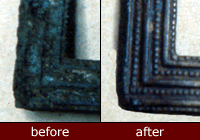 Conservators have developed many techniques to clean and stabilize objects so that they do not deteriorate further. Here you see a buckle from Ft. Mose, before and after conservation treatment.
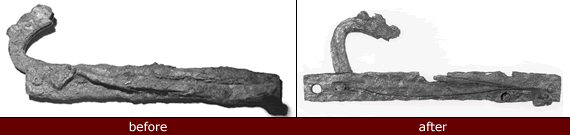 A sixteenth century matchlock musket lock from Augustine, before and after conservation.
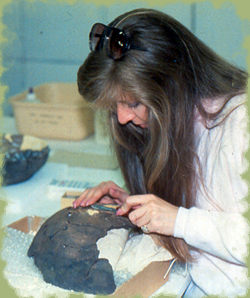 Only a few of the hundreds of thousands of pottery sherds excavated from sites can be reconstructed to form whole pots. When they can, it is a valuable clue to what people ate and how they cooked it, where they got their pots, and how they were made.