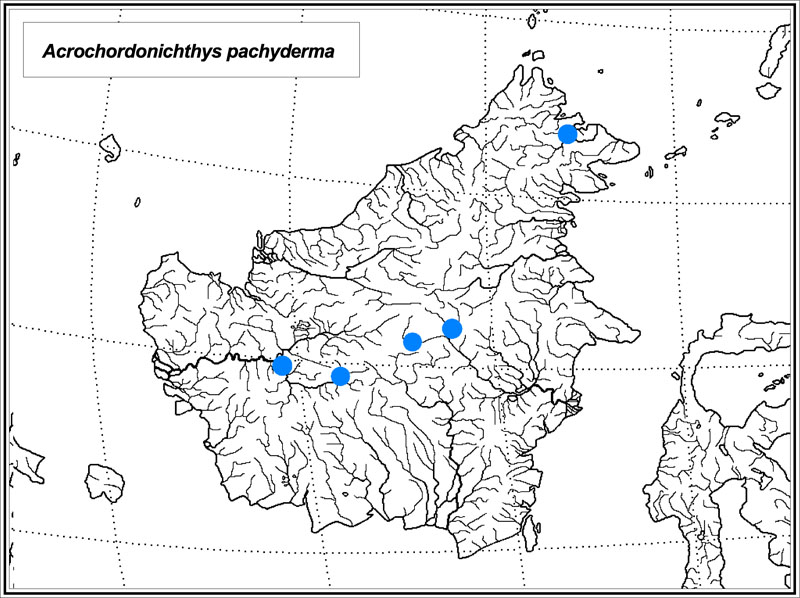
Kinabatangan River drainage in Borneo
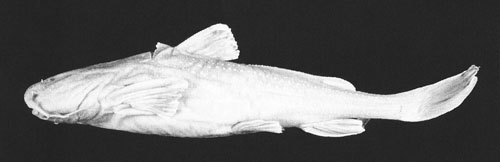
85.9 mm SL, FMNH 68007
Acrochordonichthys pachyderma Vaillant 1902
Identification: Acrochordonichthys pachyderma has a moderately compressed body, a wide head (24-28% SL), a comparatively deep caudal peduncle (5-6% SL), and an angular posterior margin on adipose fin. The head is covered with small, indistinct tubercles. Tubercles on the body are arranged in 5 or 6 horizontal rows on each side. The dorsal and ventral surfaces of the head and body are cream-colored, lacking spots. The dorsal, pectoral, pelvic and anal fins are cream-colored with 1-2 dark brown bands; one band is usually located at the base and the other at the edge of the fin. The cream-colored caudal fin has a dark brown band near the edge and a dark brown patch at the base of the caudal peduncle. The cream-colored or dark yellow barbels and pectoral spines sometimes have dark brown spots on the dorsal surfaces. The premaxillary toothband is not exposed when the mouth is closed. The stout pectoral spine lacks serrations on the posterior edge. There are 5 branchiostegal rays and 37 vertebrae.
Range: This species is found in the Kapuas, Mahakam and Kinabatangan River drainages of Borneo.
Habitat: A. pachyderma is found among woody debris in current in creeks and small to medium-sized rivers.
Similar species: A. rugosus, A. chamaeleon and A. falcifer have distinguishing coloration consisting of a dark brown body with many irregular light brown patches. A. rugosus and A. chamaeleon have serrations on the posterior edge of the pectoral spine.
Information from Ng, H. H. and P. K. L. Ng. 2001. A revision of the akysid catfish genus Acrochordonichthys Bleeker. Journal of Fish Biology 58: 386-418.