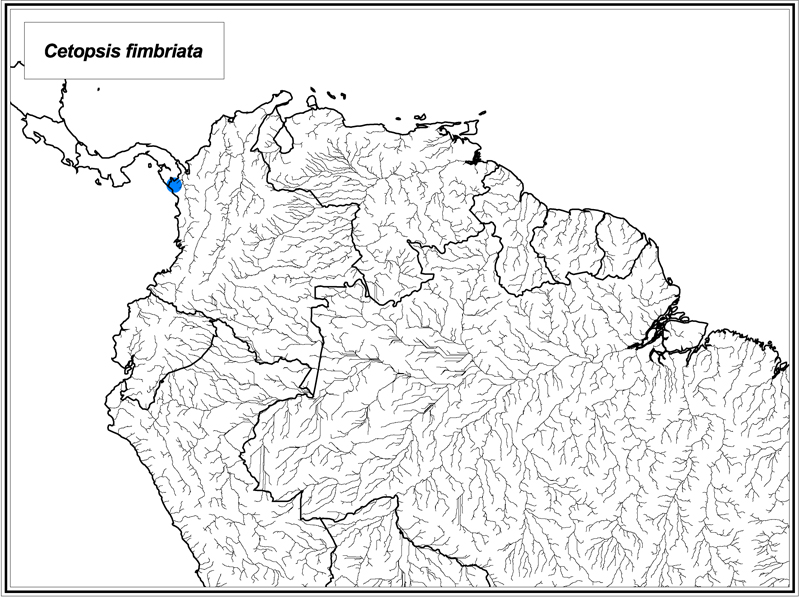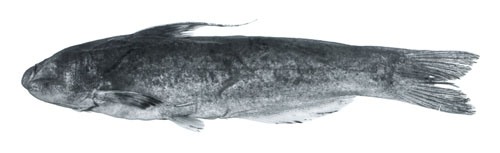
Reproduced from Vari, Ferraris and de Pinna (2005).
Cetopsis fimbriata Vari, Ferraris & de Pinna, 2005
Identification: Cetopsis fimbriata can be distinguished from all of its congeners by the combination of the presence of an eye, the conical teeth on the vomer and dentary, the rounded posterior nares which is distinctly separated from the contralateral nares by a distance greater than the width of the posterior nares, the presence of a dark, distal, margin along the anal fin, the dark distal margin of the pectoral fin, the absence of a dark humeral spot, the absence of a posteriorly-rounded, variably-developed, bilobed patch of dark pigmentation at the base of the caudal fin, and the presence of 46 to 48 total vertebrae, 25 to 28 total anal-fin rays, and 20 to 22 branched anal-fin rays. Maximum size: 103 mm SL.
Range: Cetopsis fimbriata is apparently endemic to the Rio Nercua, a tributary of the Rio Truando which flows into the Rio Atrato basin of the Caribbean Sea versant of northwestern Colombia.
Information from Vari, R. P., C. J. Ferraris Jr. & M. C. C. de Pinna. 2005. The Neotropical whale catfishes (Siluriformes: Cetopsidae: Cetopsinae), a revisionary study. Neotropical Ichthyology 3:127-238.