North American (or Bullhead) Catfishes
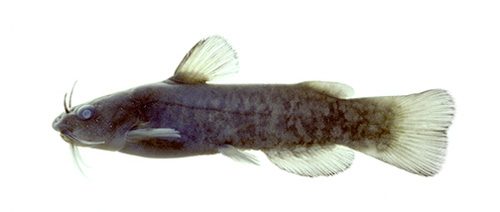
Etowah R., just above Yellow Cr. Rd., Cherokee Co., GA
51 mm SL, Collected 11-September 1982
With 49 species, Ictaluridae, the Bullhead Catfish family is the largest family of freshwater fishes endemic to North America. Bullhead catfishes are easy to recognize from other North American freshwater fishes. They have no scales, 4 pairs of barbels (“whiskers”) around the mouth, an adipose fin, stout spines at the dorsal and pectoral fin origins (except some cave species), and pelvic fins on the abdomen. Members of this family are active mainly at night in contrast to the other large groups of North American freshwater fishes – minnows, darters, and suckers — which are primarily active during daylight. Glandular cells in the skin surrounding the fin spines of some species, especially madtoms, contain venom, and a person can be “stung” by a catfish. Reaction to the sting of a madtom varies with the individual but is generally considered equivalent to a bee sting.
The Flathead and Blue Catfishes, the giants of the family at about 132 lb. (60 kg) and over 5 ft. (1.5 m) in length, and several other large species, especially the widely marketed Channel Catfish, are of major commercial, angling, and aquacultural value.
Ictalurids are organized into 7 genera:
- Ictalurus, 7 species including the familiar Channel Catfish
- Ameiurus, 7 species including the Yellow, Black and Brown Bullheads.
- Noturus, containing 30 small species known as madtoms
- Pylodictis, containing only the Flathead Catfish
- Satan and Trogloglanis, each containing 1 species of cave-inhabiting species in Texas
- Prietella, containing 2 species of cave-inhabiting species in Mexico