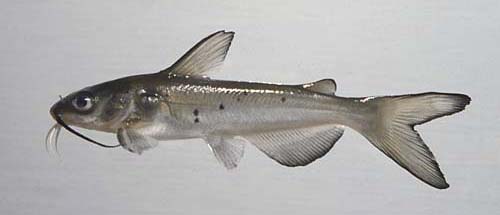
Juvenile from Tygarts Cr., Greenup Co., KY
93 mm SL, Collected 1-October 1982, INHS 87975
CHANNEL CATFISH
Ictalurus punctatus (Rafinesque 1818)
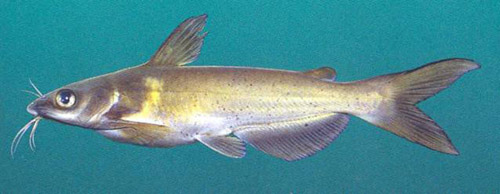
Identification: The Channel Catfish varies greatly in color. Most individuals have scattered black spots on a silver back and side. Very small individuals, which usually have black-tipped fins, and very large individuals, which are blue-black, lack dark spots. The Channel Catfish is white below, has white to dusky gray barbels, a rounded anal fin with 24-29 rays, and a slightly rounded predorsal profile. The air bladder lacks a distinct constriction. To 50 in. (127 cm) total length.
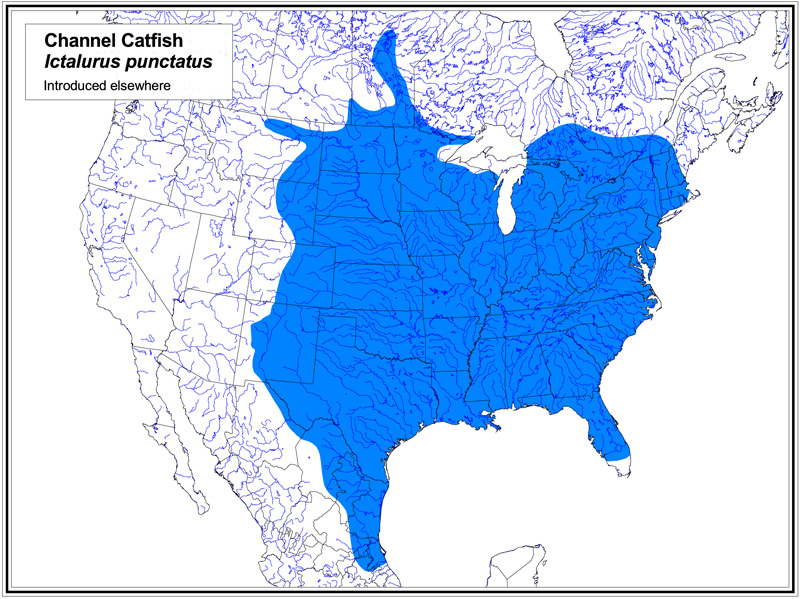
Range: The Channel Catfish is native to St. Lawrence-Great Lakes, Hudson Bay (Red R. drainage), and Missouri-Mississippi R. basins from southern Quebec to southern Manitoba and Montana south to the Gulf of Mexico. It also possibly is native on the Atlantic and Gulf Slopes from the Susquehanna River to the Neuse River, and from Savannah River to Lake Okeechobee, Florida, and west to northern Mexico and eastern New Mexico. It has been introduced throughout most of the U.S. and is common to abundant in most areas.
Habitat: The Channel Catfish lives in deep pools and runs over sand or rocky bottom in small to large rivers, and is found over sandy and rocky areas of lakes. The species is rarely found in upland, high-gradient streams.
Similar species: The Blue Catfish, I. furcatus, occurs over much of the range of the Channel Catfish but lacks dark spots on the body, and has a straight-edged anal fin with 30-35 rays and a straight predorsal profile. The Headwater Catfish, I. lupus, is nearly identical to the Channel Catfish but has a deeper caudal peduncle, and a broader head and mouth. The Yaqui Catfish, I. pricei, has a shorter pectoral spine, dorsal spine, and anal fin base.