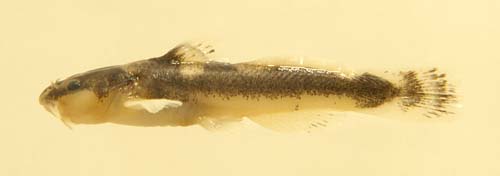
Adult from Tranier Cr., Weakley Co., TN
42 mm SL, Collected 28-October 1978
LEAST MADTOM
Noturus hildebrandi (Bailey & Taylor 1950)
Identification: The Least Madtom has a slender body and a flat head. The adipose fin is white or clear (individuals from southern Mississippi may have a dark blotch extending onto the fin base). The back is red-brown to black and has 4 white or light yellow oval areas. The caudal fin is dusky or has irregularly defined bars and a clear edge. The pectoral spine is short with 4-5 large teeth on the rear edge, and no teeth or small teeth on the front edge. The caudal fin is straight or slightly rounded and joined to the adipose fin with a small notch between the adipose and caudal fins. The anal fin has 12-17 rays. To 2 7 in. (6.9 cm) total length.
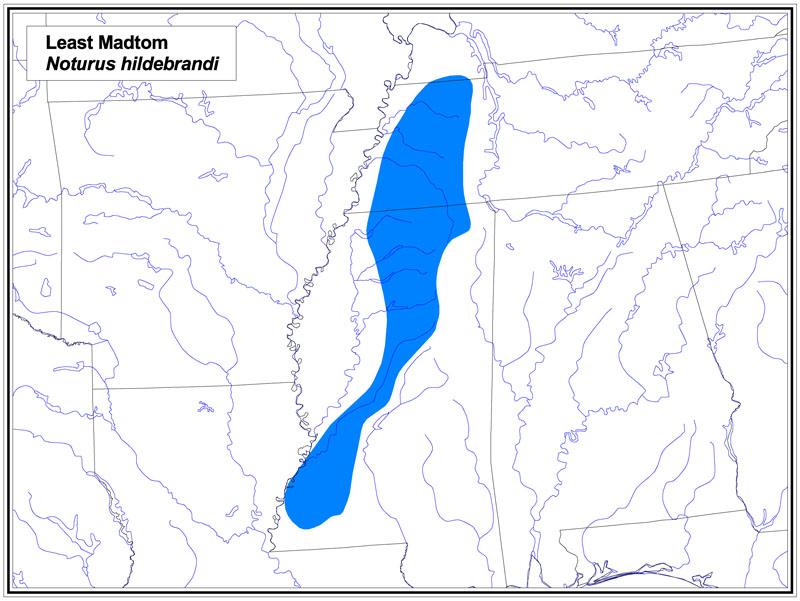
Range: The Least Madtom is found in tributaries of the Mississippi River from the North Fork Obion River in southwestern Kentucky to the Homochitto River in southern Mississippi. This species is common. Two subspecies of Noturus hildebrandi are recognized. N. h. lautus, in the Obion, Forked Deer, and Hatchie rivers in western Kentucky and Tennessee, has a shorter head and is strongly bicolored, brown to black above and white or yellow below. N. h. hildebrandi is found in the Homochitto River and Bayou Pierre in southern Mississippi, is distinguished from N. h. lautus by its longer head and dark blotches extending from the back onto the lower side. Intergrades occur in southwestern Tennessee and northern Mississippi.
Habitat: The Least Madtom inhabits rocky and sandy riffles and runs of clear lowland creeks and small rivers. It often is most common around woody debris.
Similar species: The Pygmy Madtom, Noturus stanauli, has a white snout and large teeth on the front edge of the pectoral spine. The Smoky Madtom, Noturus baileyi, has a more uniformly olive-brown body, including dark pigment on the lower side, and a dusky band in the adipose fin extending almost to the edge of the fin.