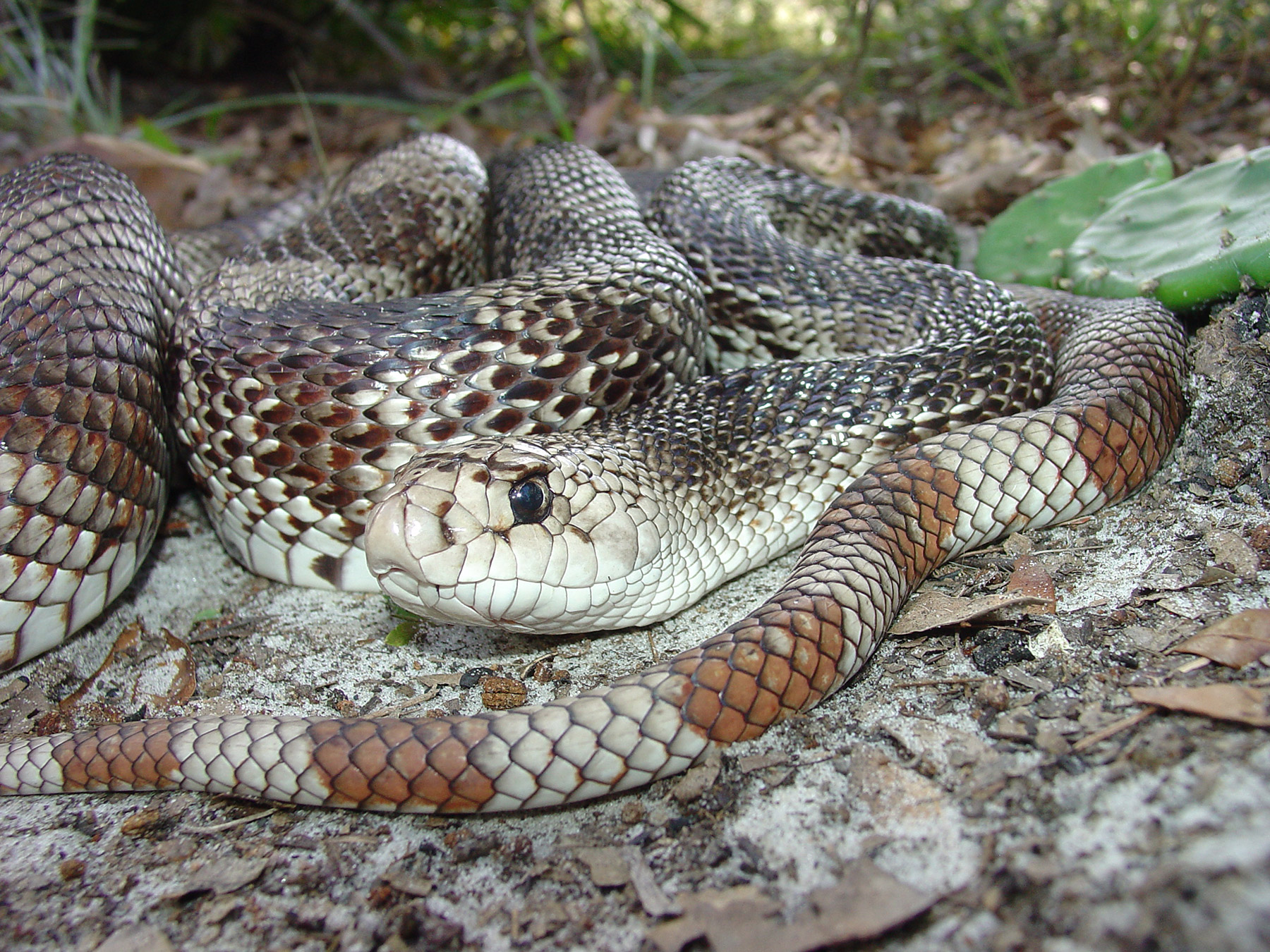
Most adult Eastern Pinesnakes are 48-66 inches (122-168 cm) in total length. These are large, thick-bodied snakes with an indistinct pattern of large reddish brown or dark tan blotches on a cream, tan, or brownish-gray ground color. The pattern of dark blotches is most distinct on the hind part of the body and the tail. Some individuals lack the blotched pattern giving them an overall light-colored appearance, whereas others may appear nearly all black. The juvenile color pattern is similar to adults but brighter and less obscured towards the head.
Florida Pinesnake. Photo courtesy of Dirk J. Stevenson
Range
Eastern Pinesnakes occur throughout the state, excluding the Florida Keys, the Everglades, extreme southwestern Florida, and immediately north of Lake Okeechobee.
Assessment of risk to people and pets
Non-venomous Eastern Pinesnakes are not dangerous to people or pets, but they will readily bite to defend themselves. These snakes are not aggressive and avoid direct contact with people and pets. Virtually all bites occur when the snakes are intentionally bothered.
Comparison with other species
Eastern Coachwhip (Masticophis flagellum)Non-venomous Eastern Coachwhips have a dark brown or black head and neck that transition into a tan body and tail. They lack the enlarged triangular rostral scale, and they have smooth scales.
Adult Eastern Coachwhip with black head and neck and tan body exhibiting periscoping behavior. Photo courtesy of Luke Smith. Eastern Pinesnake. Photo courtesy of Dirk J. Stevenson
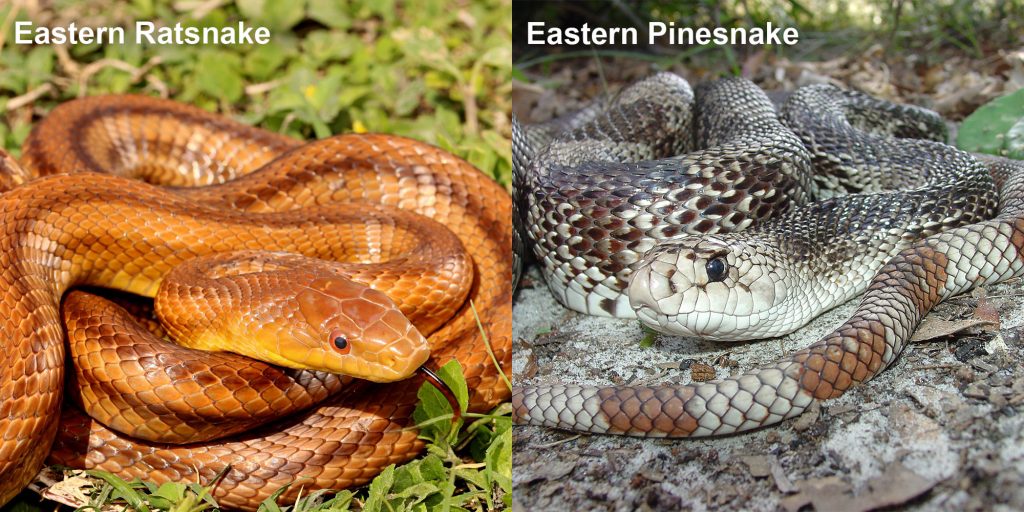
Eastern Ratsnake (Pantherophis alleghaniensis)Non-venomous Eastern Ratsnakes are yellow to gray with four dark longitudinal stripes, sometimes retaining the juvenile’s dark dorsal blotches. They lack an enlarged triangular rostral scale on the snout.
Eastern Ratsnake. Photo courtesy of Noah Mueller. Eastern Pinesnake. Photo courtesy of Dirk J. Stevenson
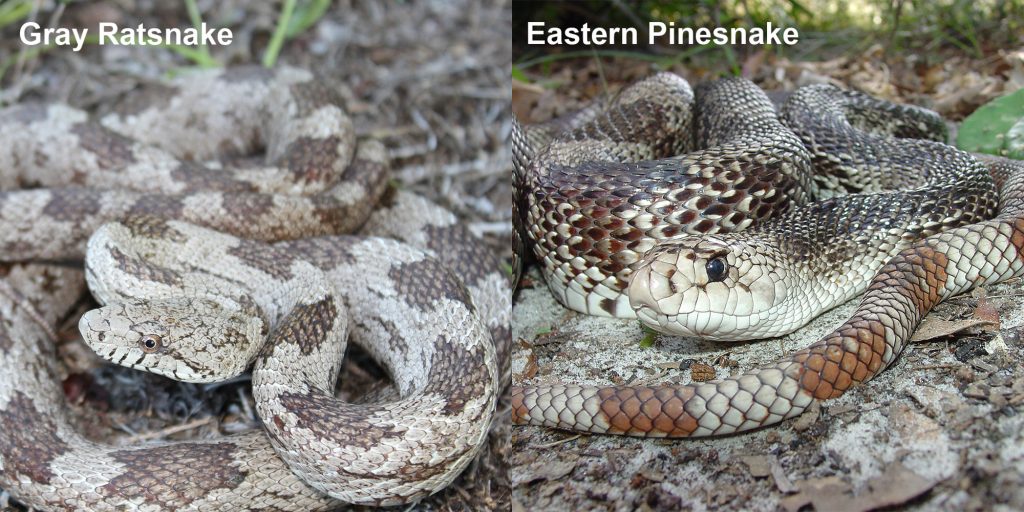
Gray Ratsnake (Pantherophis spiloides) Non-venomous Gray Ratsnakes may be white to gray with dark gray blotches, and they lack an enlarged triangular rostral scale on the snout.
Gray Ratsnake. Photo courtesy of Luke Smith. Eastern Pinesnake. Photo courtesy of Dirk J. Stevenson
Most adult Eastern Pinesnakes are 48-66 inches (122-168 cm) in total length, with a record length recorded of 90 inches (229 cm). These are large, thick-bodied snakes with an indistinct pattern of large reddish brown or dark tan blotches on a cream, tan, or brownish-gray ground color. The pattern of dark blotches is most distinct on the hind part of the body and the tail. Some individuals lack the blotched pattern giving them an overall light-colored appearance, whereas others may appear nearly all black. The belly is uniformly ashy gray. The scales on the body are strongly keeled (each scale has a prominent raised ridge). The pupils are round. The snout is somewhat pointed and covered by a large triangular, cone-shaped scale. There are four large scales on top of its snout rather than two as typically seen in many other species of snakes. The juvenile color pattern is similar to adults but brighter and less obscured towards the head.
Eastern Pinesnakes require dry sandy soils for burrowing. They are found most often in open pine-turkey oak woodlands and abandoned fields, but they also inhabit scrub, sandhills, and longleaf pine forest. Adults and juveniles of this species are occasionally found in suburban neighborhoods where development encroaches into favorable habitats.
When approached, Eastern Pinesnakes typically flee for shelter. However, if they are cornered, these snakes often inflate and rear the forebody off the ground, hiss loudly, and strike at the attacker while rapidly vibrating the tip of the tail, which produces a buzzing sound in leaf litter. If grabbed or pinned, they may bite the attacker and release foul-smelling musk from two glands in the base of the tail. Nonetheless, these snakes are not aggressive, and striking is only used in defense as a last resort.
Eastern Pinesnakes feed primarily on pocket gophers, which they pursue by forcing their way into their underground tunnels and burrows. However, other small mammals, lizards, and reptile eggs are also eaten. Although they may occasionally climb trees in search of birds and their nests, they spend the majority of their time underground in pocket gopher tunnels or gopher tortoise burrows. These snakes typically constrict prey using coils of the body. When below ground, however, these snakes often constrict prey by pressing them against the walls of burrows.
In Florida, females lay 4-10 large, white eggs, which typically hatch between August and September. The eggs are often laid underground in loose soil or underneath large rocks or logs. Newborns measure about 18 inches (46 cm) in total length.
Black Pinesnake (Pituophis melanoleucus lodingi) Black Pinesnakes occur in Florida only as an intergrade with Florida Pinesnakes in the Panhandle west of the Escambia River. These snakes typically have a black ground color that obscures the dark pattern.
Florida Pinesnake (Pituophis melanoleucus mugitus) See the range for Eastern Pinesnake above. These snakes typically have a cream, tan, or brownish gray ground color.
Florida Pinesnakes are no longer found in many areas of their historic range, and they are still declining in many areas. As a result, this species has been listed as state threatened by the State of Florida since 2017, primarily because of alteration and fragmentation to much of Florida’s upland habitats.
Eastern Pinesnakes are extremely beneficial to people because they prey heavily on species that are considered pests.
If you have a new or interesting observation for this species, please email the herpetology staff at the Florida Museum.
Ernst, C.H. and E.M. Ernst. 2003. Snakes of the United States and Canada. Smithsonian Institution Press, Washington, DC. 668 pp.
Krysko, K.L., K.M. Enge, and P.E. Moler. 2019. Amphibians and Reptiles of Florida. University of Florida Press, Gainesville, Florida. 706 pp.
Powell, R., R. Conant, and J.T. Collins. 2016. Peterson Field Guide to Reptiles and Amphibians of Eastern and Central North America. Fourth edition. Houghton Mifflin Harcourt Publishing Company, Boston and New York. xiv + 494 pp.