In 1493, Christopher Columbus built the first intentional European colonial town in the New World. It was intended as a base from which to establish Spanish presence and dominion in the Indies, and was Columbus’s American home.
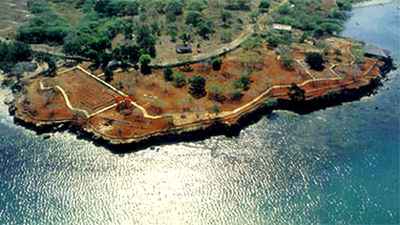
Aerial view of La Isabela
The site is located on the east bank of the Bajabonico River where it empties into the Bay of Isabela, about 28 miles west of present Puerto Plata on the north coast of the Dominican Republic. Columbus brought seventeen ships carrying some 1,500 men, along with pigs, horses, cattle and other livestock, seeds and plants for crops, and the tools and equipment necessary to start a colony. Among the all-male settlers were craftsmen, builders, Franciscan friars, farmers, other occupations and social classes, all necessary to implement a Spanish way of life.
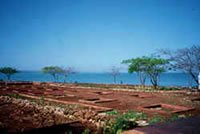
The location of the exterior walls and interior posts of the alhóndiga (warehouse).
The town was surrounded by a wall, with a fortified storehouse at one end and Columbus’s citadel at the other. It had a plaza on the water, with several stone buildings and 200 palm thatch huts provided housing for most of the town’s inhabitants.
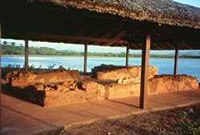
The Columbus house, made of rammed earth (tápia) and cut limestone, is the oldest remnant of a European structure in the Americas.
Archaeological evidence shows that there was a second settlement near the walled town, that served as a center for ceramic production, industry, agriculture and ranching. Isabela was only inhabited for five years, and disease, overwork, Indian hostilities, food shortages and mutinies occurred almost immediately, and it was abandoned when Santo Domingo was established in 1496-1497.
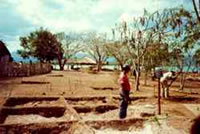
Excavations underway at the site
Historical archaeologists from the Florida Museum of Natural History collaborated with the Dirección Nacional de Parques de la República Dominicana, and the Universidad Nacional e Experimental Francisco de Miranda in Venezuela to excavate and study La Isabela between 1989 and 1999. The results of that work can be seen on site at the Museum of la Isabela, as well as in the articles, publications and reports listed below.
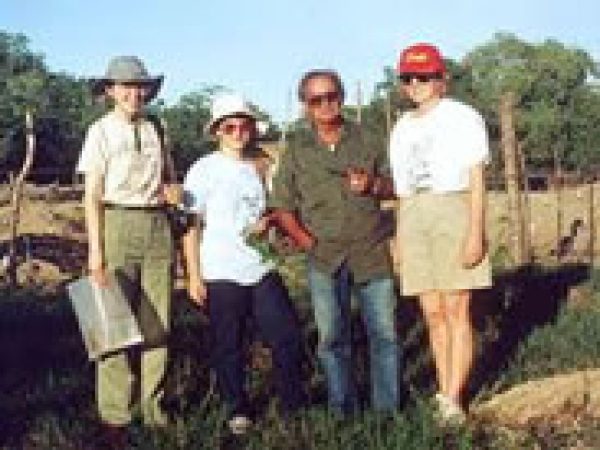
Left to Right: Elizabeth Reitz, Zooarchaeologist; Margaret Scarry, Archaeobotanist; José Cruxent, Principal Investigator; Kathleen Deagan, Principal Investigator.
Alan Stahl, Numismatist
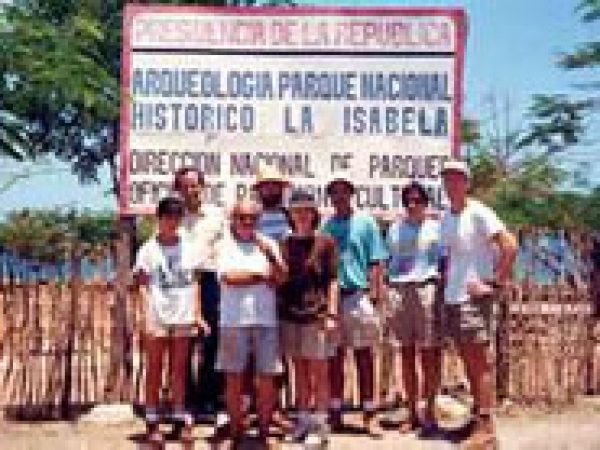
1990 Field Team: Marietta Estrada, George Avery, José Cruxent, Jim Cusick, Kathleen Deagen, Ricardo Fernández-Sardina, Kate Hoffman, Gardner Gordon
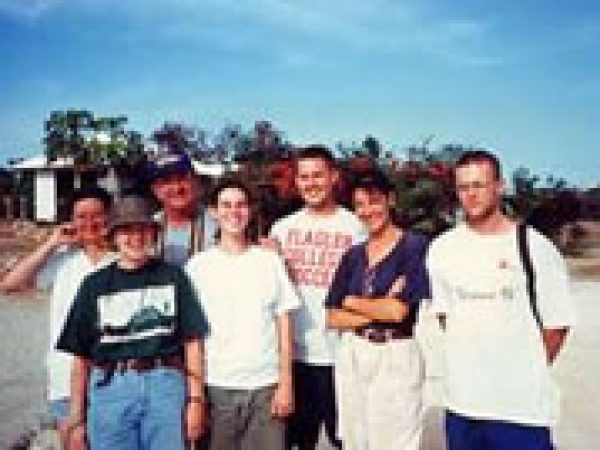
1995 Field Team: Mary Herron, Kathleen Deagan, Antonio Tejera Gaspar (Universidad de la Laguna, Tenerife), Kimberly Martin, Gifford Waters, Elena Sosa (Unversidad de la Laguna, Tenerife) and Jeremy Cohen
Chiarelli, B. (ed)
1987 La Isabela. Special issue of International Journal of Anthropology. edited by B. Chiarelli. Vol. 2 # 3pp. 195-253. Florence.
Cruxent, José F. M
1990 The origin of La Isabela. in Columbian Consequences.Volume 2. edited by D. H. Thomas. Washington: Smithsonian Institution Press. pp.251-260.
1987 La Isabela. Special issue of International Journal of Anthropology. edited by B. Chiarelli. Vol. 2 # 3pp. 195-253. Florence.
Deagan, Kathleen
1987 Columbus’s lost colony. National Geographic November, 1987, pp. 672-76
1992a La Isabela, foothold in the New World. National Geographic. 181(1):40-53.
2002a La Isabela: Columbus’s Outpost Among the Tainos 1493-1498. New Haven: Yale University Press.
2002b Archaeology at America’s First European Town: La Isabela, 1493-1498. New Haven: Yale University Press.
Deagan, Kathleen and José M. Cruxent
1995 The first European artifacts in the Americas: La Isabela 1493-1498. In The Scientific Study of Artifacts from Post-Medieval Europe and Beyond, edited by D. Hook and D. Gaimster. Occasional Papers of the British Museum, 109. London. pp. 2-12.
1997 Medieval foothold in the Americas. Archaeology May/June:54-59.
Dobal, Carlos
1988 Cómo pudo ser la Isabela? Santiago: Universitario Catolica Madre y Maestre.
Guerrero, José G. and Marcio Veloz-Maggiolo
1988 Los inicios de la colonización en America. Universidad Central del Este Serie V Centenario # 1. San Pedro Macoris.
Ober, Frederick
1893 In the wake of Columbus. Boston: D. Lothrop.
Ortega, Elpidio, y Guerrero José
1988 La Isabela y la arqueología en la ruta de Colón. San Pedro de Macorís: Universidad Central del Este.
Palm, Erwin
1945 Excavations at La Isabela, white man’s first town in the Americas. Acta Americana 3:298-303.
Puig Ortíz, José A.
1973 Por la valorización histórica de las ruinas de La Isabela, primera ciudad del Nuevo Mundo. Santo Domingo, R. D.: Editora del Caribe.
Stahl, Alan
1992 The coinage of La Isabela, 1493-1498. The Numismatist. October, 1992.
1995 Coins from the excavations at La Isabela, D.R. , the first European colony in the New World. American Journal of Numismatics (second series) 5-6:189-207.
Varela, Consuelo
1987a La Isabela, vida y ocaso de una ciudad efémira. Revista de Indias. Vol. XVLII (181):733-44).
 Left to Right: Elizabeth Reitz, Zooarchaeologist; Margaret Scarry, Archaeobotanist; José Cruxent, Principal Investigator; Kathleen Deagan, Principal Investigator.