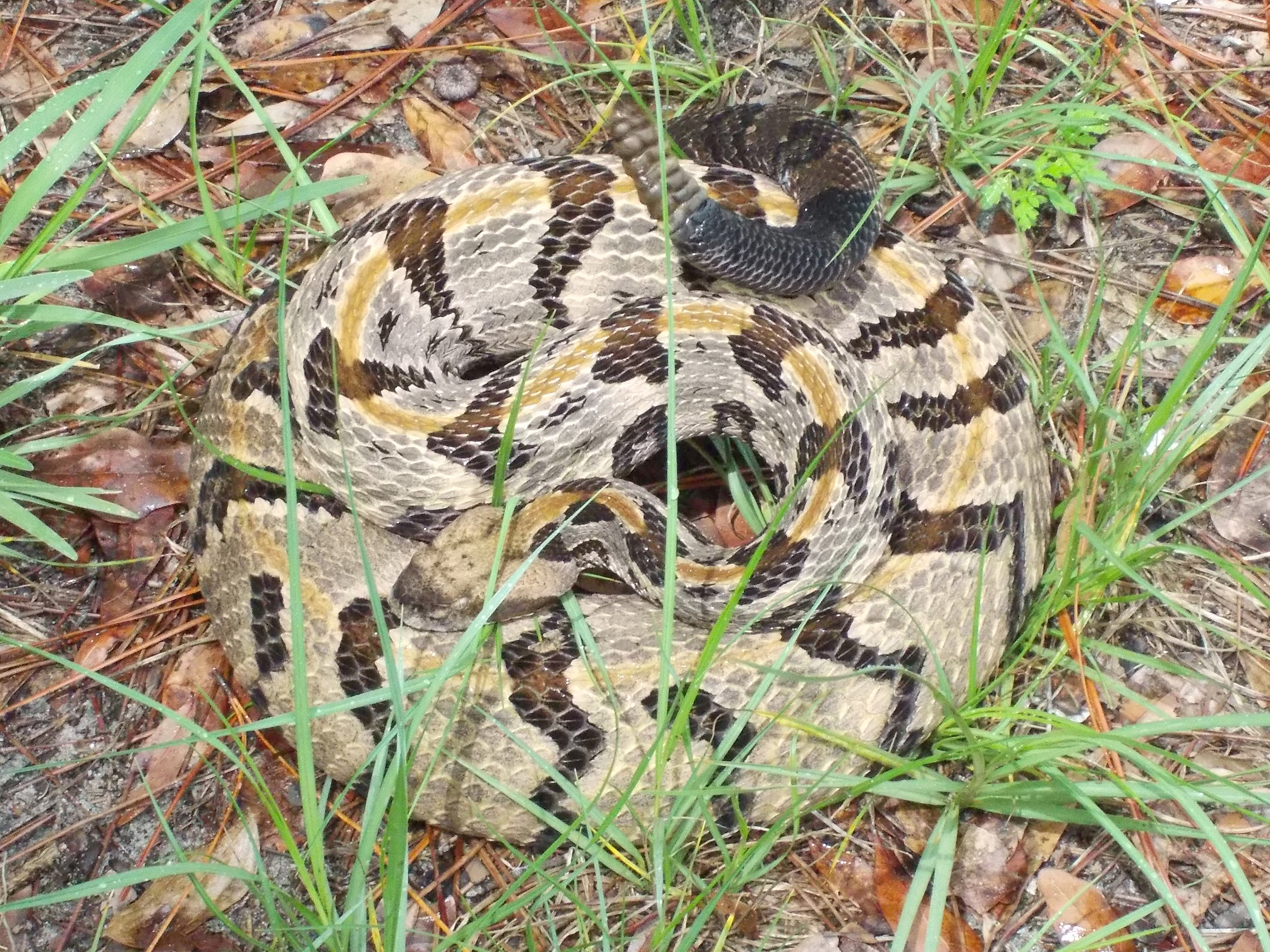
Most adult Timber Rattlesnakes are about 36-60 inches (76-152 cm) in total length. This is a large, heavy-bodied snake with a series of large, black, chevron-like crossbands down the pinkish gray or tan body. There is a reddish-brown stripe running down the center of the back. The tail is usually uniformly black. The tail ends in a rattle, which is often held above the ground. The large and thick head is distinct from the neck and sometimes has a dark diagonal line through the eye or just behind the eye. The coloration of juveniles is the same as described for adults, and the tip of the tail of newborns ends in a “button”, which is the first segment of the future rattle.
Timber Rattlesnake. Photo courtesy of Jason C. Seitz.
Range
Timber Rattlesnakes have a limited range in Florida and are found in only 12 counties in northern Florida. The range may extend to other nearby areas, but there are no confirmed records from other Florida counties.
Assessment of risk to people and pets
VENOMOUS The Timber Rattlesnake is a large and impressive snake, and bites can be very dangerous to people and pets. The victim should seek immediate medical care from a physician or hospital experienced in treating snakebites. Timber rattlesnakes are not aggressive and avoid direct contact with people and pets. Most bites occur when the snakes are intentionally molested or accidentally stepped on. This is a snake that should be simply left alone and not bothered.
Comparison with other species
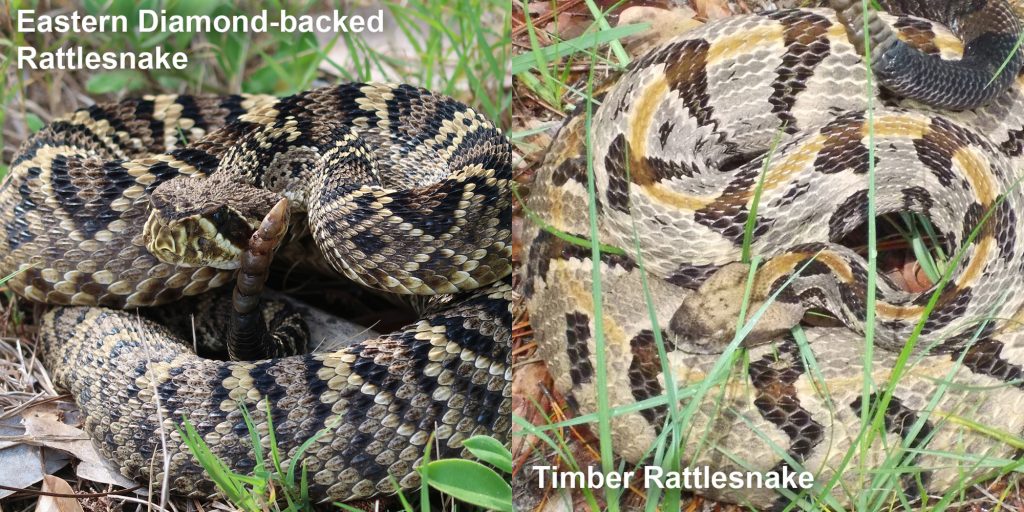
Eastern Diamond-backed Rattlesnake (Crotalus adamanteus)Venomous The Eastern Diamond-backed Rattlesnake has a row of large dark diamonds with brown centers and cream borders down its back. The large and thick head is distinct from the neck and has a light bordered dark stripe running diagonally through each eye. This is the only other rattlesnake with which a timber rattlesnake might be confused in Florida.
Adult Eastern diamond-back Rattlesnake. Photo courtesy of Luke Smith. Timber Rattlesnake. Photo courtesy of Jason C. Seitz.
Most adult Timber Rattlesnakes are about 36-60 inches (76-152 cm) in total length, with a record length recorded of 74.5 inches (189 cm). This is a large, heavy-bodied snake with a series of large, black, chevron-like crossbands down the pinkish gray or tan body. There is a reddish-brown stripe running down the center of the back. The tail is usually uniformly black. The tail ends in a rattle, which is often held above the ground. The dorsal scales of the body are keeled (each scale has a prominent raised ridge). The large and thick head is distinct from the neck and sometimes has a dark diagonal line through the eye or just behind the eye. The pupil is vertically elliptical (cat-like), and there is a deep facial pit organ located between the nostril and the eye. There are no large scales on the top of the head except for the scales over the eyes. The coloration of juveniles is the same as described for adults, but it may be brighter with more contrast. The tip of the tail of newborns ends in a “button”, which is the first segment of the future rattle.
Timber Rattlesnakes in Florida prefer damp bottomlands, river beds, hardwood hammocks, pine flatwoods, swamps, fields, and cane thickets. This species is occasionally found in suburban neighborhoods where development encroaches into favorable habitats
This is generally a mild tempered rattlesnake that will usually attempt to escape if disturbed. Some Timber Rattlesnakes lie quietly coiled when first discovered. However, if provoked they may remain coiled and shake their tails, producing a loud buzzing sound. Nonetheless, these snakes are not aggressive, and striking is only used in defense as a last resort.
Timber Rattlesnakes feed primarily on mammals and occasionally birds. However, lizards, snakes, amphibians, insects, and carrion are also occasionally consumed. These snakes may actively pursue prey by following their scent trails, but more typically these snakes sit and wait to ambush prey at the base of trees or next to fallen logs. Juveniles may use their tails as lures to attract small prey, but this has not yet been confirmed.
In Florida, females typically give birth to around 6-10 live young between August and October. Females remain with the young for about one week until their first shed, after which time they all disperse. Competing males engage in combat dances when trailing females during the breeding season.
Unlike other rattlesnakes in Florida, timber rattlesnakes are often observed climbing and resting in trees, sometimes at surprising heights. Although it is assumed that these snakes are pursuing arboreal prey such as squirrels or birds, this interesting behavior is not well studied or understood.
Contrary to folklore, the timber rattlesnake does not need to rattle before striking. It can lay silently and motionless, and then strike without the usual nervous buzz from its rattle. In fact, timber rattlesnakes that rattle are more likely to be heard, seen, and killed than those individuals that remain silent.
The Timber Rattlesnake is extremely beneficial to people because it preys on many species that are considered pests. Nevertheless, many are unfortunately killed by people every year. This indiscriminate killing, combined with the widespread loss of rattlesnake habitat to agricultural development, urban sprawl, and the commercial hunting for rattlesnake skins has caused a severe decline in most timber rattlesnake populations.
If you have a new or interesting observation for this species, please email the herpetology staff at the Florida Museum.
Ernst, C.H. and E.M. Ernst. 2003. Snakes of the United States and Canada. Smithsonian Institution Press, Washington, DC. 668 pp.
Krysko, K.L., K.M. Enge, and P.E. Moler. Amphibians and Reptiles of Florida. 2019. University of Florida Press, Gainesville, Florida. 706 pp.
Powell, R., R. Conant, and J.T. Collins. 2016. Peterson Field Guide to Reptiles and Amphibians of Eastern and Central North America. Fourth edition. Houghton Mifflin Harcourt Publishing Company, Boston and New York. xiv + 494 pp.
Still have questions about snakes or identifications? Feel free to email the herpetology staff at the Florida Museum with your questions or feedback on this profile.
Banner photo courtesy of Jason C. Seitz. Please credit any photographers on the page and see our copyright policy.