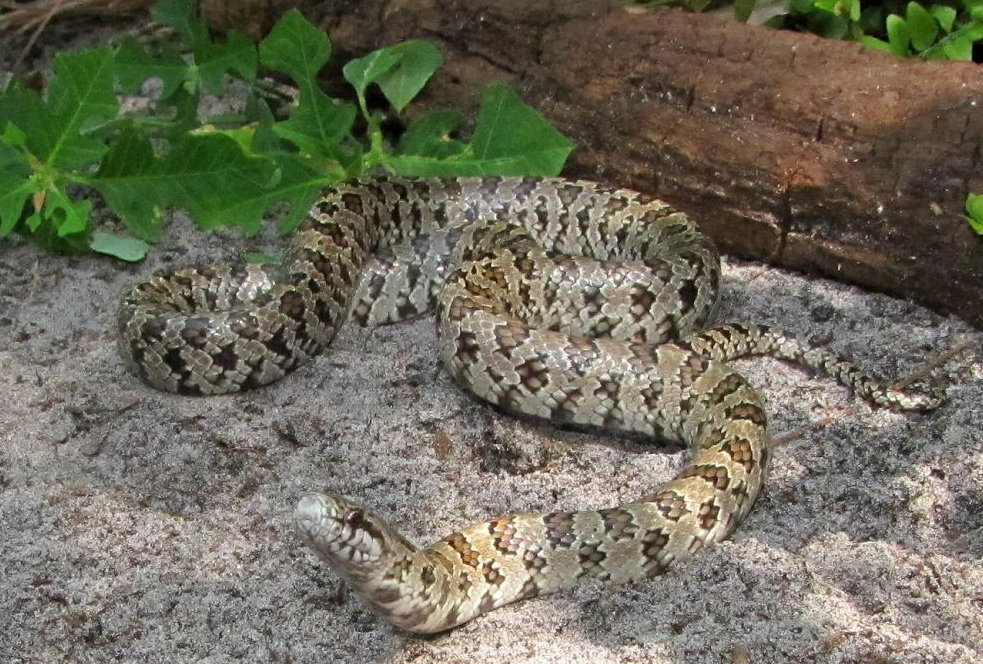
Most adult South Florida Mole Kingsnakes are about 30-42 inches (76-107 cm) in total length. Adults are gray, brown, or tan with at least 75 black-bordered reddish-brown blotches down the body and tail. Older individuals may be almost solid brown. The neck is indistinct, and there is sometimes a dark line through the eye. There is a network of dark lines on the back of the head. Juveniles are similar in appearance to adults but more vivid and with a silvery ground color.
South Florida Mole Kingsnake. Photo courtesy of Mark Kenderdine
Range
South Florida Mole Kingsnakes are known to occur only in the peninsula from Brevard County south to Lake Okeechobee and west to Charlotte and DeSoto counties. It is not found outside of Florida.
Assessment of risk to people and pets
Non-venomous. South Florida Mole Kingsnakes are not dangerous to people or pets, but they may bite to defend themselves. They avoid direct contact with people and pets. Virtually all bites occur when the snakes are intentionally molested.
Comparison with other species
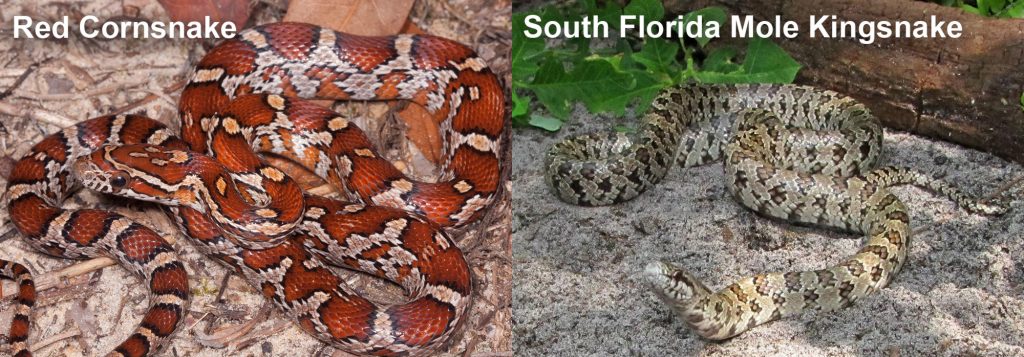
Red Cornsnake (Pantherophis guttatus)Non-venomous Eastern Cornsnakes have a distinct neck, a light spear-shaped pattern on the back of the head and neck, and a black and white checkerboard-patterned belly.
Juvenile red cornsnake. Photo courtesy of Todd Pierson. South Florida Mole Kingsnake. Photo courtesy of Mark Kenderdine
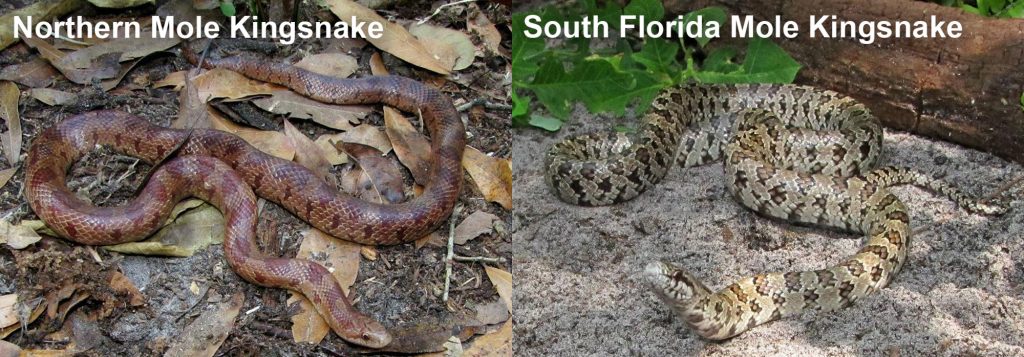
Northern Mole Kingsnake (Lampropeltis rhombomaculata)Non-venomousNorthern Mole Kingsnakes are only found in the Florida Panhandle. This species typically has 55 small dark blotches down the back and 21-23 midbody scale rows.
Northern Mole Kingsnake. Photo courtesy Mark Kenderdine/iNaturalist South Florida Mole Kingsnake. Photo courtesy of Mark Kenderdine
Most adult South Florida Mole Kingsnakes are about 30-42 inches (76-107 cm) in total length. Adults are gray, brown, or tan with at least 75 black-bordered reddish-brown blotches down the body and tail. There are smaller reddish-brown blotches on the sides between the larger mid-dorsal blotches. Older individuals may be almost solid brown. The belly is white or cream colored with brown blotches. The neck is indistinct, and there is sometimes a dark line through the eye. The pupil is round. There is a network of dark lines on the back of the head. The scales are smooth, and there are 21 or fewer scale rows at midbody. Juveniles are similar in appearance to adults but more vivid and with a silvery ground color.
South Florida Mole Kingsnakes have been found in pinelands, hardwood hammocks, prairies, cattle pastures, and agricultural fields. These highly secretive snakes are primarily burrowers and are rarely seen.
If grabbed or pinned, South Florida Mole Kingsnakes may bite the attacker while jerking and twitching the body and head. They may also rapidly vibrate the tail while releasing foul-smelling musk from glands within the base of the tail. Nonetheless, these snakes are not aggressive, and striking is only used in defense as a last resort.
South Florida Mole Kingsnakes commonly feed on lizards, snakes, and small mammals. Prey are typically killed by constriction.
Little is known of the reproductive biology of South Florida Mole Kingsnakes given that no natural nests have been recorded. But data from closely-related Northern Mole Kingsnakes (Lampropeltis rhombomaculata) suggest that females would lay around 3-16 eggs, which would hatch between July and August. The eggs are likely laid in underground burrows, loose soil, and piles of debris.
Up until 2016, both species of Mole Kingsnake in Florida (Lampropeltisrhombomaculata and L. occipitolineata) were considered subspecies of Lampropeltis calligaster. The decision to elevate the subspecies to distinct species appears to be mostly but not universally accepted.
South Florida Mole Kingsnakes are primarily nocturnal (active at night) and have been found under boards and logs, around plowed fields, and crossing roads at night.
County data coming soon.
If you have a new or interesting observation for this species, please email the herpetology staff at the Florida Museum.
Ernst, C.H. and E.M. Ernst. 2003. Snakes of the United States and Canada. Smithsonian Institution Press, Washington, DC. 668 pp.
Krysko, K.L., K.M. Enge, and P.E. Moler. 2019. Amphibians and Reptiles of Florida. University of Florida Press, Gainesville, Florida. 706 pp.
McKelvy, A.D. and F.T. Burbrink. 2016. Ecological divergence in the Yellow-bellied Kingsnake (Lampropeltis calligaster) at two North American biodiversity hotspots. Molecular Phylogenetics and Evolution 106: 61-72.
Powell, R., R. Conant, and J.T. Collins. 2016. Peterson Field Guide to Reptiles and Amphibians of Eastern and Central North America. Fourth edition. Houghton Mifflin Harcourt Publishing Company, Boston and New York. xiv + 494 pp.
Still have questions about snakes or identifications? Feel free to email the herpetology staff at the Florida Museum with your questions and feedback on this profile.