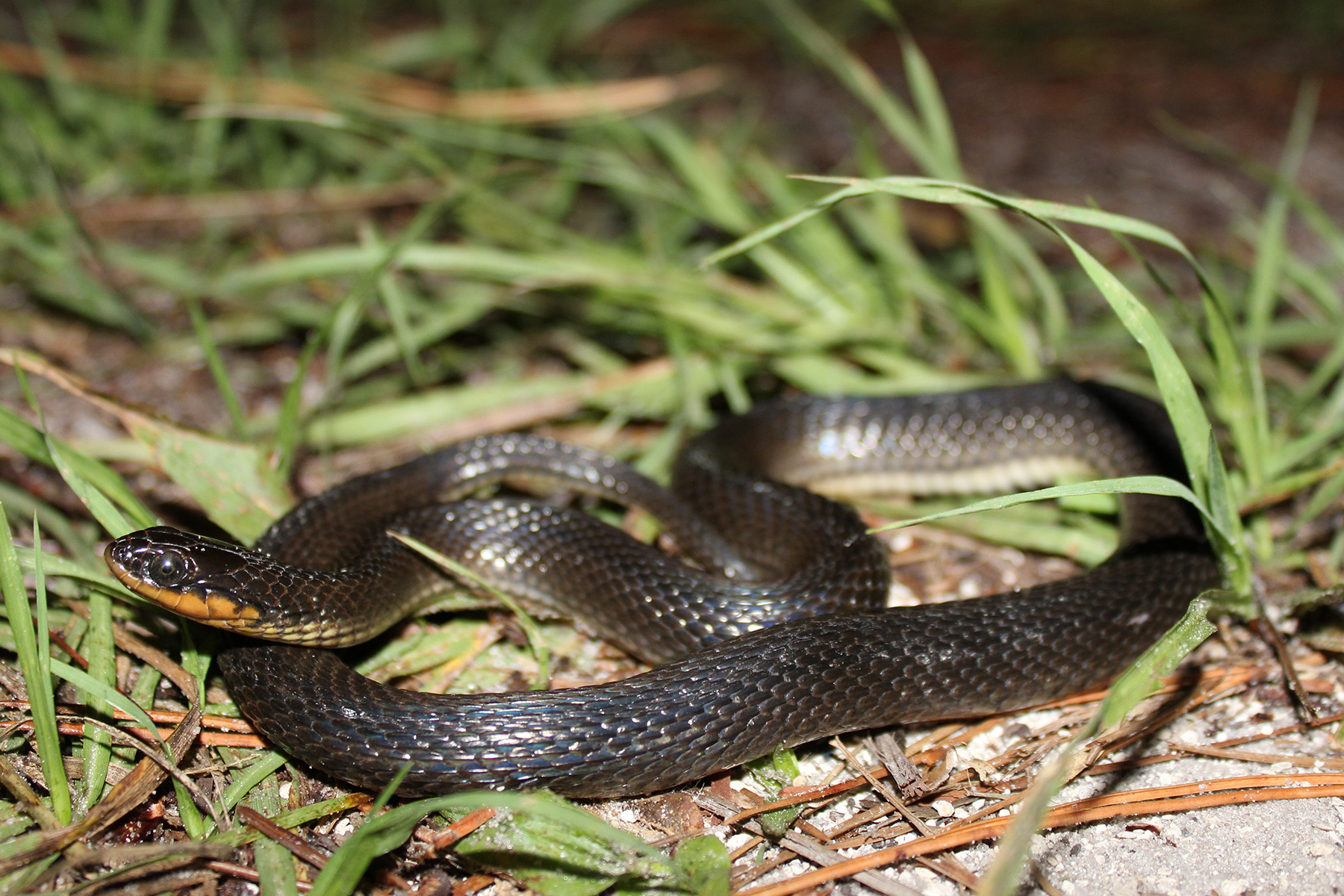
Most adult Glossy Swampsnakes are about 14-24 inches (36-61 cm) in total length. These small snakes are glossy brown to olive brown, and there may be a faint dark stripe down the back and down each side. The eyes are relatively large. The lip scales are yellow and contrast sharply with the brownish-olive color of the head. Juveniles are similar to that of adults.
Glossy Swampsnake. Photo courtesy of Luke Smith.
Juvenile Glossy Swampsnake. Photo courtesy of Luke Smith.
Range in Florida
Glossy Swampsnakes occur from Osceola County in the central peninsula northwest into the Panhandle.
Assessment of risk to people and pets
Non-venomous. Glossy Swampsnakes are not dangerous to people or pets.
Comparison with other species
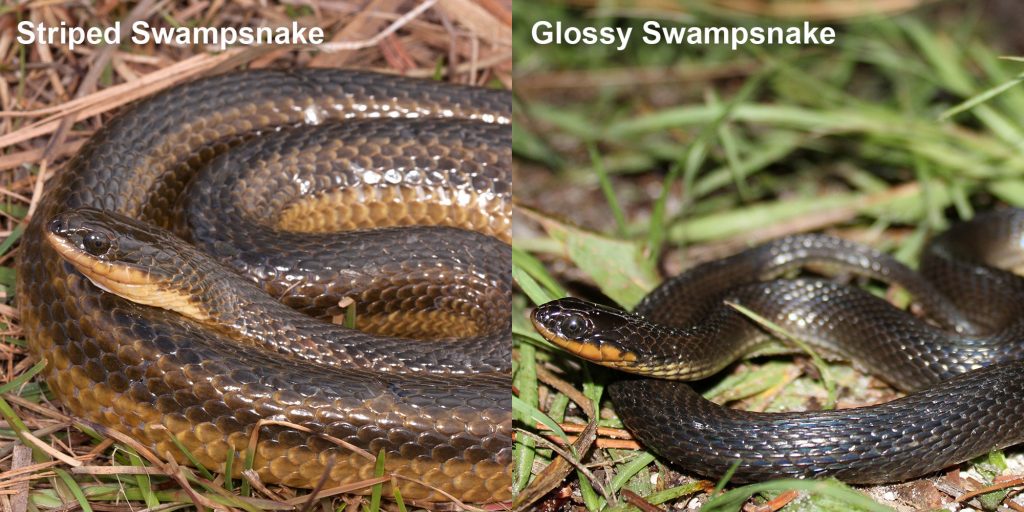
Striped Swampsnake (Liodytes alleni)Non-venomous Striped Swampsnakes have an unpatterned belly and smooth scales on the body.
Striped Swampsnake. Photo courtesy of Todd Pierson. Glossy Swampsnake. Photo courtesy of Luke Smith.
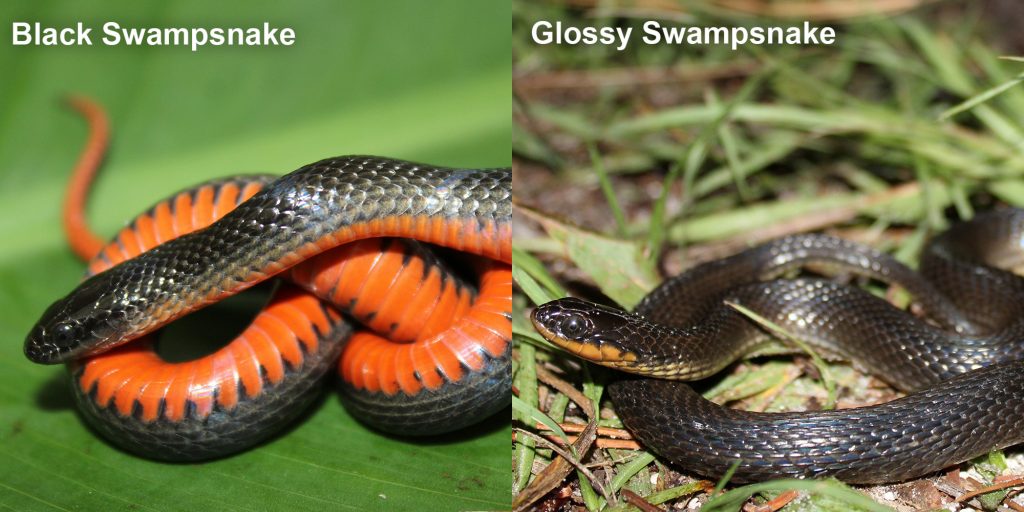
Black Swampsnake (Liodytes pygaea)Non-venomous Black Swampsnakes are glossy black with bright red bellies.
Black Swampsnake with belly color showing. Photo courtesy of Luke Smith. Glossy Swampsnake. Photo courtesy of Luke Smith.
Most adult Glossy Swampsnakes are about 14-24 inches (36-61 cm) in total length, with a record length recorded of 32.7 inches (83 cm). These small snakes are glossy brown to olive brown, and there may be a faint dark stripe down the back and down each side. The extreme lower sides are yellowish-tan colored. The lip scales are yellow and contrast sharply with the brownish-olive color of the head. The belly is yellow or cream colored with two rows of small black half-moon-shaped markings. The scales on the body are keeled (each scale has a prominent raised ridge), and there are 19 scale rows at midbody. The eyes are relatively large, and the pupils are round. Juveniles are similar to that of adults.
Glossy Swampsnakes are highly aquatic and inhabit a variety of slow-moving waterways such as cypress swamps, marshes, prairies, lakes, ponds, ditches, streams, and rivers. They may enter brackish areas of the St. Johns River. These secretive snakes are rarely encountered away from water, but they can sometimes be found under logs or debris near water, in crayfish burrows, or crossing roads during or after heavy rains.
These snakes typically do not bite in defense. If approached or cornered, Glossy Swampsnakes will usually attempt to escape by fleeing into the water and diving down to the bottom. A captured snake may flatten its head and release foul-smelling musk from two glands in the base of the tail.
Glossy Swampsnakes are nocturnal (active at night) and feed primarily on crayfish, but they will also feed on small fishes, salamanders, small frogs, and various arthropods such as dragonfly larvae and aquatic beetles.
In Florida, females typically give live birth to 6-14 young in late summer.
Eastern Glossy Swampsnake (Liodytes rigida rigida) Eastern Glossy Swampsnakes occur from Osceola County in the central peninsula northwest to the Apalachicola Basin in the Panhandle. The throat is yellow and streaked with brown pigment.
Gulf Swampsnake (Liodytes rigida sinicola) Gulf Swampsnakes occur in the western Florida Panhandle, west of the Apalachicola Basin. The throat is yellow and lacks a dark pattern.
County data coming soon.
If you have a new or interesting observation for this species, please email the herpetology staff at the Florida Museum.
Ernst, C.H. and E.M. Ernst. 2003. Snakes of the United States and Canada. Smithsonian Institution Press, Washington, DC. 668 pp.
Krysko, K.L., K.M. Enge, and P.E. Moler. 2019. Amphibians and Reptiles of Florida. University of Florida Press, Gainesville, Florida. 706 pp.
Powell, R., R. Conant, and J.T. Collins. 2016. Peterson Field Guide to Reptiles and Amphibians of Eastern and Central North America. Fourth edition. Houghton Mifflin Harcourt Publishing Company, Boston and New York. xiv + 494 pp.
Still have questions about snakes or identifications? Feel free to email the herpetology staff at the Florida Museum with your questions or feedback on this profile.
Banner photo courtesy of Luke Smith. Please credit any photographers on the page and see our copyright policy.