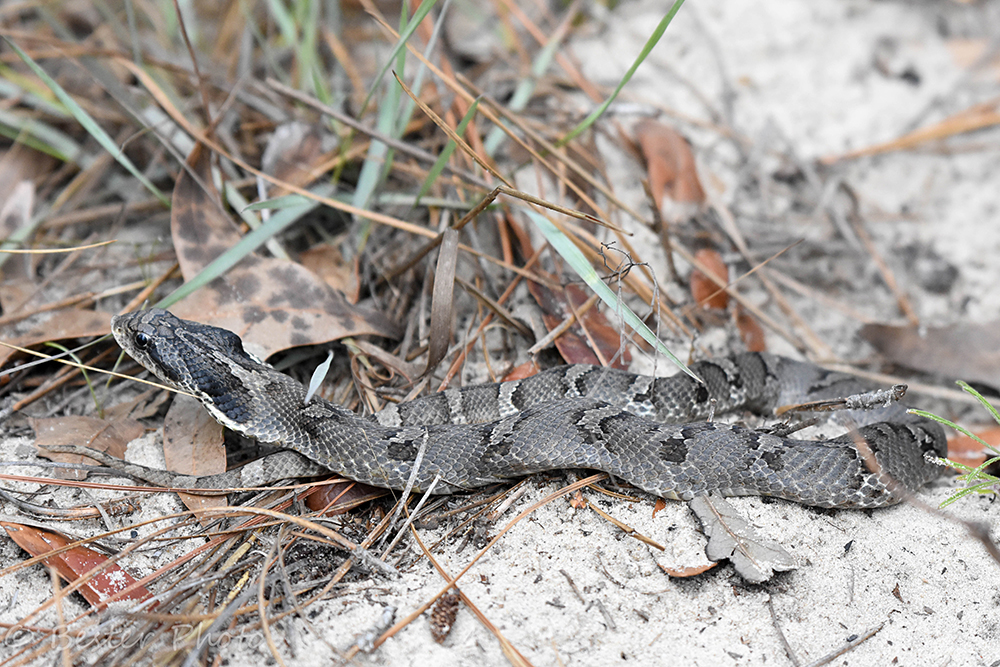
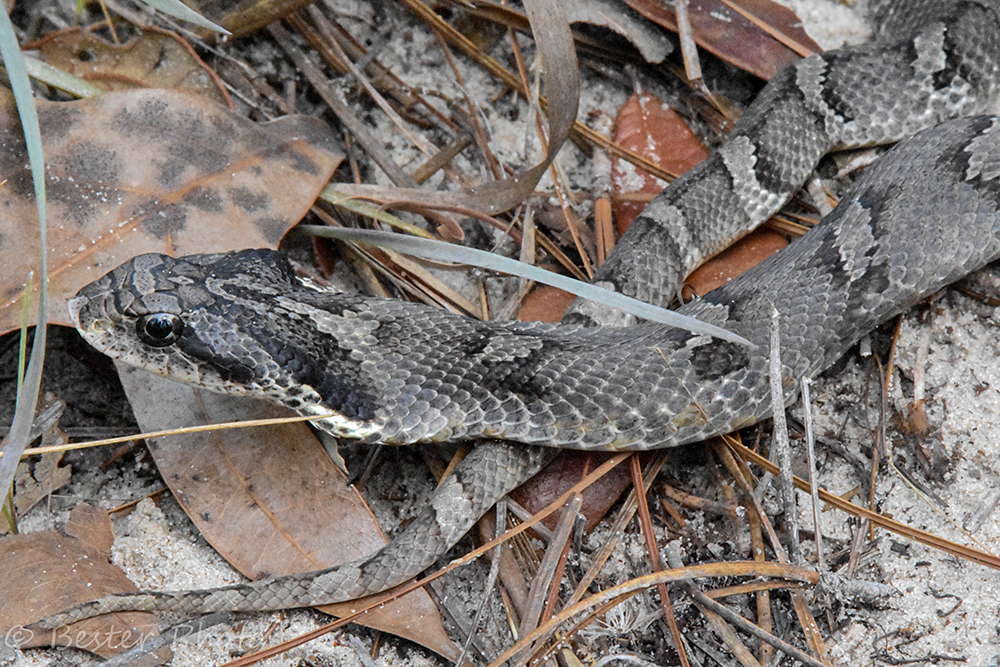
Most adult Eastern Hog-nosed Snakes are about 20-33 inches (51-84 cm) in total length. These are stout-bodied snakes with slightly upturned, pointed snouts. The color pattern is extremely variable and may be mostly yellow, tan, olive, brown, gray, orange, or reddish-brown with large, dark brown or black, irregular-shaped blotches on the back and smaller blotches on the sides. Some individuals may be entirely black or dark gray without any pattern. There is often a dark line extending from the upper jaw through the eye. Juvenile coloration is similar to that described for adults but more vivid.
Juvenile eastern hog-nosed snake hooding in defensive display. Photo courtesy of Bester Photo.
Juvenile eastern hog-nosed snake hooding in defensive display. Photo courtesy of Bester Photo.
Range in Florida
Eastern Hog-nosed Snakes are found throughout mainland Florida in every county. Aside from two isolated records from the 1930s, they are absent from the Florida Keys.
Assessment of risk to people and pets
Non-venomous. Eastern Hog-nosed Snakes are not dangerous to people or pets. They do, however, produce a mild venom that is used for subduing prey. This mild venom is delivered by two enlarged teeth at the back of the upper jaw. However, bites from eastern hog-nosed snakes are extremely rare. These snakes are not aggressive and usually do not bite even in self defense. People who have been bitten were usually handling the snake after handling frogs or toads (these snakes’ favorite food), and the bites were from snakes that were confused and hungry. Humans that are allergic to the small amount of venom produced have experienced local swelling and irritation, but no human death from this species has ever occurred. Virtually all bites have occurred when the snakes were intentionally handled.
Comparison with other species
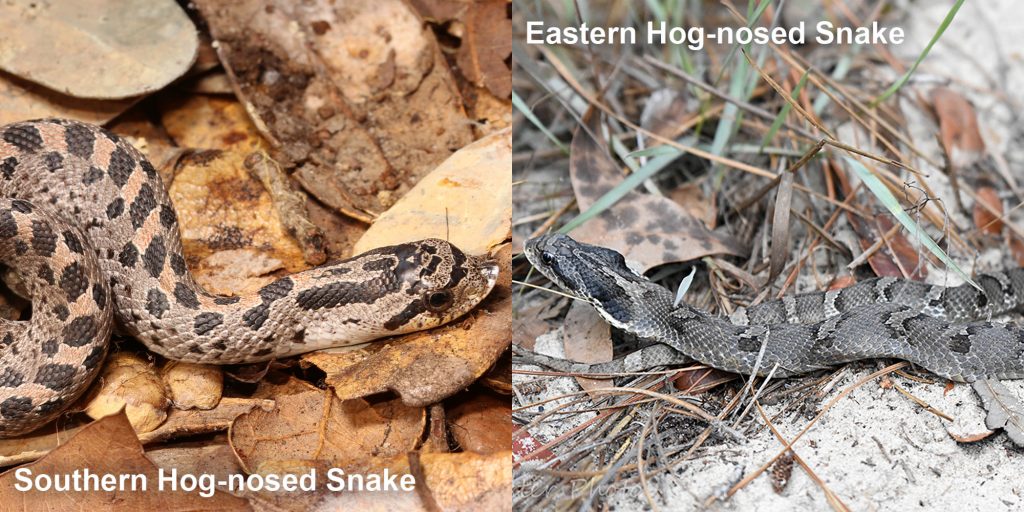
Southern Hog-nosed Snake (Heterodon simus)Non-venomous has a light-colored belly and underside of the tail, and a more upturned snout.
Southern Hognose Snake. Photo courtesy of Noah Mueller. Juvenile Eastern Hog-nosed Snake hooding in defensive display. Photo courtesy of Bester Photo.
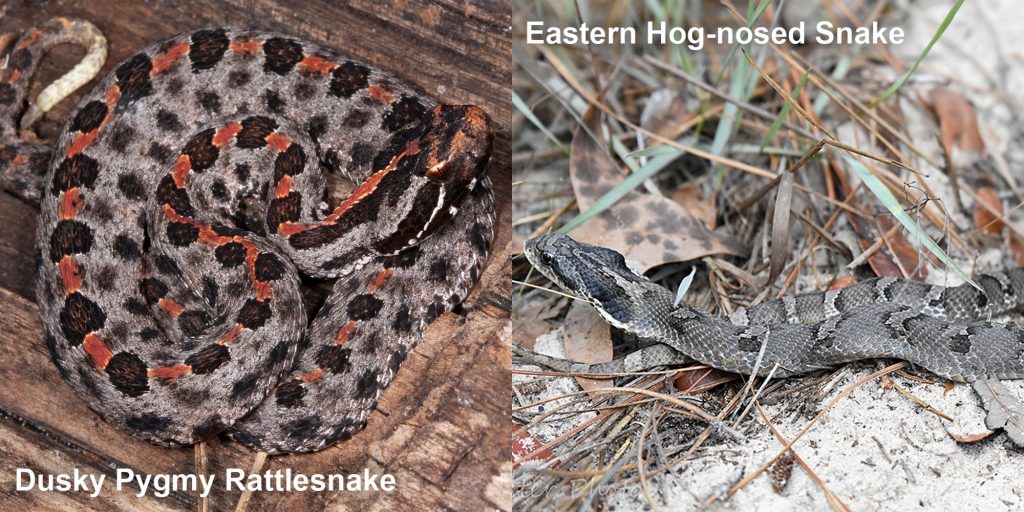
Pygmy Rattlesnake (Sistrurus miliarius)Venomous has a blunt nose and a small rattle on the tip of the tail.
Pygmy Rattlesnake. Photo courtesy of Todd Pierson. Eastern Hog-nose Snake. Photo courtesy of Bester Photo.
Most adult Eastern Hog-nosed Snakes are about 20-33 inches (51-84 cm) in total length, with a record length of 49.9 inches (126.8 cm). These are stout-bodied snakes with slightly upturned, pointed snouts. The color pattern is extremely variable and may be mostly yellow, tan, olive, brown, gray, orange, or reddish-brown with large, dark brown or black, irregular-shaped blotches on the back and smaller blotches on the sides. Some individuals may be entirely black or dark gray without any pattern. The belly may be yellow, light gray, or pinkish and may or may not be mottled gray or greenish. The underside of the tail is usually lighter than the rest of the belly. There is often a dark line extending from the upper jaw through the eye. The scales are keeled (each scale has a prominent raised ridge), and there are typically about 25 dorsal scale rows at midbody. The pupil is round. Juvenile coloration is similar to that described for adults but more vivid.
Eastern Hog-nosed Snakes can be locally abundant in certain habitats including sandhills, scrub, high pine and turkey oak woodlands, hardwood hammocks, meadows, and cultivated fields. Adults and juveniles of this species can be found in suburban neighborhoods where development encroaches into favorable habitats.
Eastern Hog-nosed Snakes are renowned for their elaborate “death feigning” defensive behavior. When threatened, a snake will flatten its head and neck and hiss loudly. It may strike, but only as a bluff with its mouth closed. If it is further harassed, it will flip onto its back and convulse for a short period and may defecate, expel foul-smelling musk from two glands in the base of the tail, and regurgitate its food. It will then remain motionless with its belly up, mouth open, and tongue hanging out. It may play dead for several minutes before cautiously turning over and crawling away.
Eastern Hog-nosed Snakes feed primarily on toads, which they often excavate from the ground using their upturned snout like a spade. However, they will occasionally eat frogs, salamanders, small mammals, and invertebrates. Juveniles eat small frogs and toads, insects, lizards, and small snakes. Eastern Hog-nosed Snakes are not constrictors but rather subdue their prey using a mild venom.
In Florida, females typically lay 4-61 eggs, which are often deposited in loose soil or under debris. The eggs hatch between August and September after incubating for about 39-65 days. Hatchlings are about 5-12 inches (13-30 cm) in total length.
The genus name Heterodon means “different tooth,” which refers to the presence of enlarged teeth on the rear of the upper jaw. These enlarged teeth inject a mild venom into prey, and they also serve to pop inflated toads like a balloon to enable swallowing.
Flattening the head and hissing when frightened has given rise to two of the local names used for Eastern Hog-nosed Snakes. Native Floridians call the banded form of these snakes “Puff adders” and correctly believe them to be harmless. However, the black form of these snakes is often called a “Spreading Adder” and is wrongly believed to be deadly. Both color forms of eastern hog-nosed snakes are harmless to humans.
Another old myth states that Eastern Hog-nosed Snakes can kill a person from twenty-five feet away by mixing venom with their breath. This myth is completely false, and their breath is harmless.
County data coming soon.
If you have a new or interesting observation for this species, please email the herpetology staff at the Florida Museum.
Ernst, C.H. and E.M. Ernst. 2003. Snakes of the United States and Canada. Smithsonian Institution Press, Washington, DC. 668 pp.
Krysko, K.L., K.M. Enge, and P.E. Moler. 2019. Amphibians and Reptiles of Florida. University of Florida Press, Gainesville, Florida. 706 pp.
Powell, R., R. Conant, and J.T. Collins. 2016. Peterson Field Guide to Reptiles and Amphibians of Eastern and Central North America. Fourth edition. Houghton Mifflin Harcourt Publishing Company, Boston and New York. xiv + 494 pp.
Still have questions about snakes or identifications? Feel free to email the herpetology staff at the Florida Museum with your questions or feedback on this profile.
Banner photo courtesy of Bester Photo. Please credit any photographers on the page and see our copyright policy.