This large horse was a very specialized leaf eater, or browser, at a time when most horses were beginning to exclusively eat grass. Megahippus was the last of the browsing horses in North America.

Where & When?
Fossils of Megahippus are uncommon. They are known from the Miocene of the Great Plains. Species in this genus lived from 15-11 million years ago.
How do we know Megahippus was a browser?
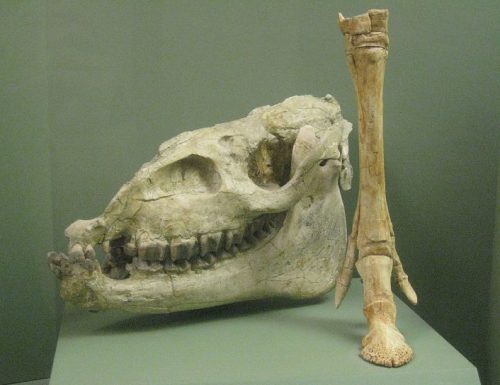
The most common way to determine whether a horse is a browser or grazer is whether they have low- or high-crowned teeth, but that’s not the only way.
Studies of living hoofed herbivores show that those with wide muzzles usually eat grass, whereas those with narrow snouts tend to eat soft vegetation, like leaves, sprouts, and fruits. Megahippus had a very narrow snout that was used to select rich food items (like fresh sprouting leaves) rather than twigs and old leaves that are not as nutritious.
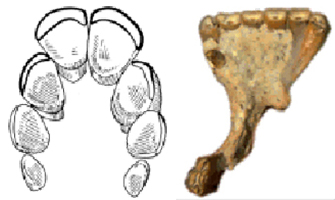 Note here how the front teeth in Megahippus (left) curve strongly in a narrow “U-shape,” an adaptation for browsing. Compare it with the broad linear muzzle of Calippus (right), a grazing horse.
Megahippus also had low-crowned teeth, so it would have been difficult for it to eat abrasive grass. Grass would have rapidly worn its teeth down.
Because Megahippus and other low-crowned “anchitheres” were three-toed browsers, they are sometimes considered to have been “stuck” in an evolutionary dead-end relative to their grazing contemporaries. They, however, evolved just as rapidly as the grazing horses. The grinding surfaces of their cheek teeth got larger, as did their overall body size. Megahippus, as its name suggests, was a fairly large horse (about 585 pounds) for its time.