The Florida Museum’s Vertebrate Paleontology collections provide the most complete basis available for study of Cenozoic vertebrate life and evolution in the eastern United States and the circum-Caribbean Basin area.
Combined, the five separate collections total about 1,000,000 fossil specimens, of which more than 720,000 are catalogued and on a searchable online database. Holotypes number about 275 specimens. Learn more about the collections…
Special Message for Visiting Researchers
As of December 1, 2020, visiting researchers are allowed to work in the vertebrate paleontology collections of the Florida Museum of Natural History. All visitors must follow CDC protocols to prevent the spread of Covid-19, including optional use of mask-wearing that covers the mouth and nose. Visiting researchers must arrange an appointment with either one of the curators or the senior collection manager.
All About Montbrook
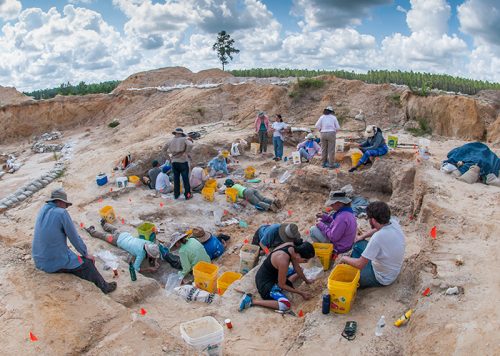
For the latest news about the Montbrook fossil site, about both the field and the museum collection, check out the Montbrook Fossil Dig blog.
Recent Research News From Our Collections
Maria Vallejo receives Emerging Scholar Award from the Association for Academic Women
María Vallejo-Pareja, a doctoral candidate at the University of Florida, has won an Emerging Scholar Award from the Association for…
Panama Canal expansion rewrites history of world’s most ecologically diverse bats
Most bats patrol the night sky in search of insects. New World leaf-nosed bats take a different approach. Among the…
Frogs were Florida’s first-known vertebrates from the Caribbean
Deep in the forests of Haiti lives the blue-eyed La Hotte glanded frog (Eleutherodactylus glandulifer), which once went 20 years…
TV Interview with Curator Dr. Jonathan Bloch
Recorded April 27 2022. https://www.news4jax.com/river-city-live/2022/04/27/digging-deep-into-floridas-fossil-history/
Alachua County bans fossil collecting in Gainesville creeks
On August 12, 2019 Alachua County issued a press release stating that digging for fossils is prohibited in creeks within the boundaries of the county, which includes the well known fossil-rich Gainesville Creeks. Residents of Alachua County are welcome to contact their county commissioner to voice support or opposition to this ruling. A 2021 news article on this issue can be found online.
Encyclopedia of Fossil Vertebrates of Florida
New additions to the species accounts are the rhino Teleoceras proterum, the vampire bat Desmodus stocki, and the muskrat Neofiber alleni. New additions to the descriptions of fossil sites are Gunn Farm Mine, Ichetucknee River, and the Montbrook Site. Let us know if there are any special species or fossil sites you want us to add.