Florida Museum of Natural History
ordway banner

Lab Director: Scott K. Robinson, Ordway Professor of Ecosystem Conservation, 352-273-1965, srobinson@flmnh.ufl.edu

Our lab studies the ecology, behavior, and conservation of birds in Florida, the American Midwest, and in the Neotropics. Our current research interests include the following projects:

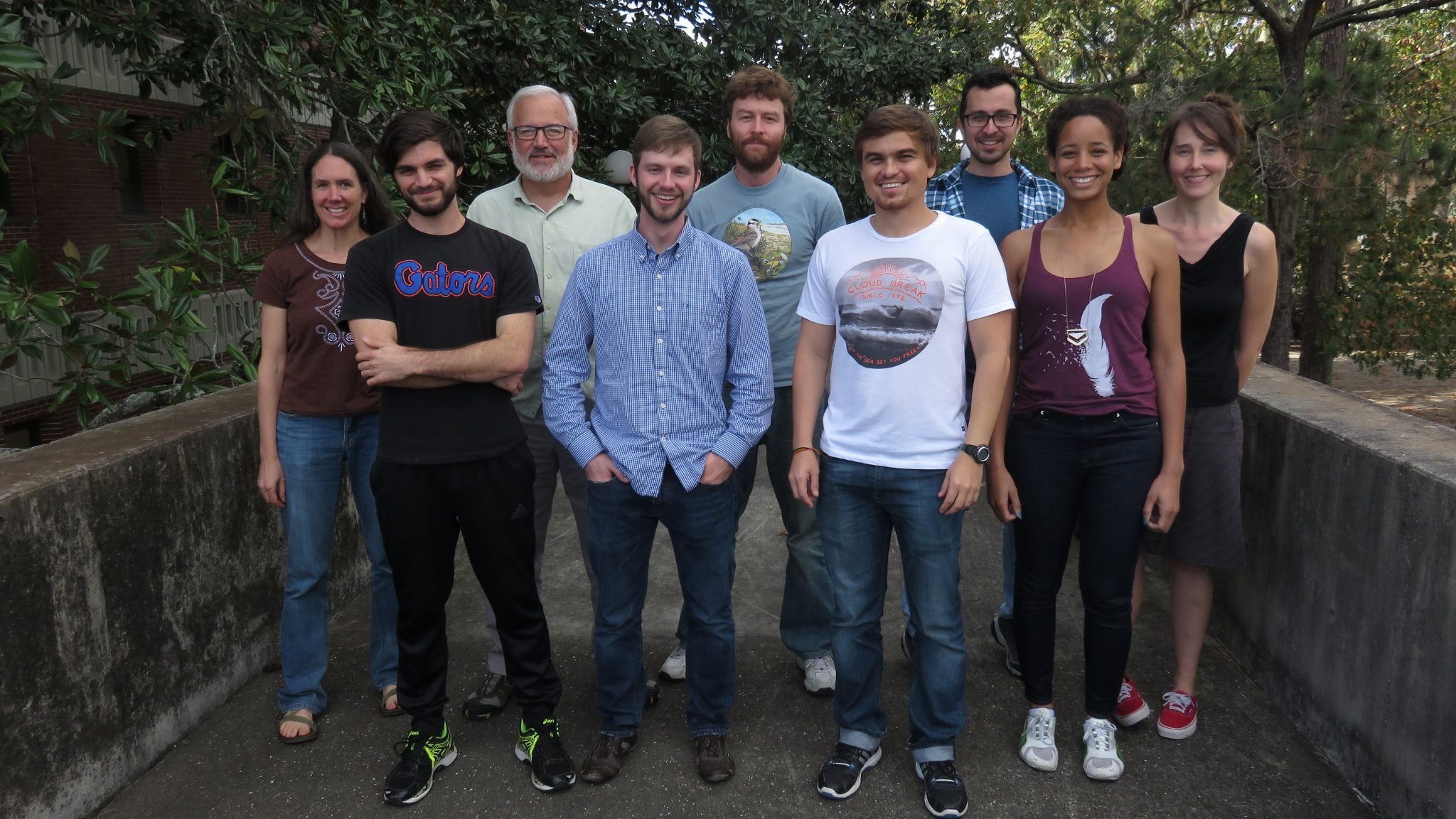
lab group photo ordway line
Jill Jankouski

Jill Jankowski
One of the most important challenges facing tropical ecologists and conservationists is to understand how species composition of communities changes across heterogeneous landscapes. Tropical altitudinal gradients exemplify such landscapes, and in the Neotropics, montane regions are important storehouses of biodiversity. My research focuses on describing the structure and organization of montane bird communities in Manu National Park, Peru, and in Monteverde, Costa Rica. Within these two regions, I am identifying levels and patterns of species turnover (also known as beta diversity) in avian communities along altitudinal gradients and using census data and experiments for various target species (e.g, from Henicorhina, Catharus, Scytalopus, Thripadectes) to test alternative ecological mechanisms that could limit altitudinal distributions. In particular, my studies of range limits focus on species that show "altitudinal replacements" or parapatric distributions with congeners along gradients, and test whether these species are limited in their altitudinal distribution by interspecific competition, or alternatively, specialization to particular habitats in montane landscapes. One goal for my research is to determine how the relative strength of ecological factors limiting species could be dependent upon underlying characteristics of gradients and patterns of species distributions. Another research goal is to use these census data of avian communities as a basis for long-term monitoring of populations and evaluating future climate change scenarios in tropical montane regions.


Gustavo Londono

Gustavo Londono
I am interested in the natural history, ecology and life history of birds, with a particular interest in the factors that influence bird incubation behavior. Specifically, I am interested in how bird incubation behavior is determined by intrinsic and extrinsic factors. My current research focuses on neo-tropical bird species, for which many nests have not yet even been described. Therefore, we have a poor understanding on factors that affect bird incubation behavior in neo-tropical areas. Additionally, I am interested in the ways in which the three main bird incubation components (nests, eggs and incubating birds) interact and contribute to intra and interspecific variation in incubation behavior. I will address this problem from three different perspectives by integrating behavioral, ecological and physiological approaches. Learn More >


Ari

Ari Martinez
I am generally interested in building bridges between ecology and conservation by addressing the maintenance of species diversity in managed forests (i.e., timber extraction) in the neotropics. More specifically, I am focusing on neotropical mixed-species flocks as species modules to assess the relative importance of species interactions such as mutualism and competition in shaping community structure. By using both experimental and observational approaches, I will assess the roles of different core flock species in influencing the cohesiveness of flocks and the dynamics of species interactions among flock members. In the context of managed forest landscapes, modification of habitat structure (through primary and secondary impacts of timber extraction) is expected to change the nature of species interactions among flock members and hence the cohesion and organization of flocks. By exploring the dynamics of species interactions and its consequences for flock cohesion, I intend to use a stable and predictable group of interacting species as an indicator of the degree of intervention in managed forests. Sufficient insights on a mechanistic level should enable the construction of ecological models that predict changes in species interactions as a function of a) the level of impacts generated by the primary and secondary impacts of timber extraction b) the habitat conditions under which it is advantageous to flock.


Christine Stracey-Richard

Christine Stracey Richard
My main objective is to try to understand how wildlife/nature work in urban areas. To do this I compare populations of bird species that live in town with those that live in the country. I'm focusing mostly on the Northern Mockingbird - a species that is more abundant in town than in rural areas - to test the hypotheses that 1) nest predation rates are reduced in town and 2) there are more food resources in town. Learn More >


Judit Ungvari-Martin

Judit Ungvari-Martin
After working in several different research labs and exploring aspects of empirical population genetics in Rhabditid nematodes and learning the tools of molecular biology using sucking lice, I finally get to focus on my own graduate research project, which is still just a couple of brewing ideas... I am broadly interested in avian biology. I have been studying nestling growth and feeding behavior of adult birds but I have started to get more interested in the physiological aspects of reproduction, the development of the immune system in the offspring, and the effects of urbanization on birds. I would also like to investigate the physiological ecology of tropical birds.